Alosco Michael L, Spitznagel Mary Beth, Raz Naftali, Cohen Ronald, Sweet Lawrence H, Colbert Lisa H, Josephson Richard, van Dulmen Manfred, Hughes Joel, Rosneck Jim, Gunstad John
Department of Psychology, Kent State University, Kent, Ohio, USA.
Cerebrovasc Dis Extra. 2012 Jan;2(1):88-98. doi: 10.1159/000343222. Epub 2012 Oct 25.
Cerebral hypoperfusion accompanies heart failure (HF) and is associated with reduced cognitive performance. Obesity is prevalent in persons with HF and is also a likely contributor to cognitive function, as it has been independently linked to cognitive impairment in healthy individuals. The current study examined the association between obesity and cognitive performance among older adults with HF and whether obesity interacts with cerebral hypoperfusion to exacerbate cognitive impairment.
Patients with HF (n = 99, 67.46 ± 11.36 years of age) completed neuropsychological testing and impedance cardiography. Cerebral blood flow velocity (CBF-V) measured by transcranial Doppler sonography quantified cerebral perfusion and body mass index (BMI) operationalized obesity.
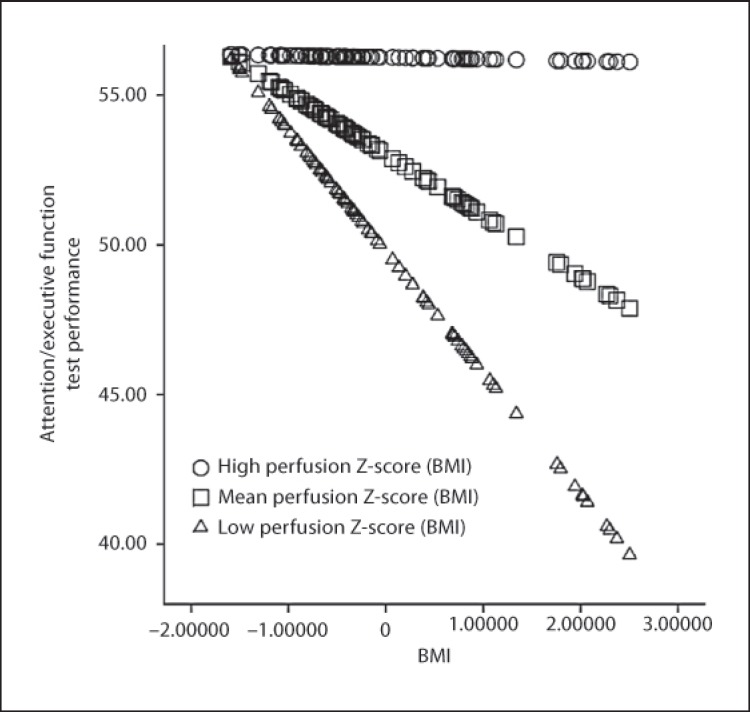
A hierarchical regression analysis showed that lower CBF-V was associated with reduced performance on tests of attention/executive function and memory. Elevated BMI was independently associated with reduced attention/executive function and language test performance. Notably, a significant interaction between CBF-V and BMI indicated that a combination of hypoperfusion and high BMI has an especially adverse influence on attention/executive function in HF patients.
The current findings suggest that cerebral hypoperfusion and obesity interact to impair cognitive performance in persons with HF. These results may have important clinical implications, as HF patients who are at high risk for cerebral hypoperfusion may benefit from weight reduction.
脑灌注不足伴随心力衰竭(HF)出现,并与认知功能下降相关。肥胖在HF患者中普遍存在,并且也可能是认知功能的一个影响因素,因为它已被独立地与健康个体的认知障碍联系起来。本研究调查了老年HF患者中肥胖与认知表现之间的关联,以及肥胖是否与脑灌注不足相互作用以加重认知障碍。
HF患者(n = 99,年龄67.46 ± 11.36岁)完成了神经心理学测试和阻抗心动图检查。通过经颅多普勒超声测量的脑血流速度(CBF-V)量化脑灌注,体重指数(BMI)用于定义肥胖。
分层回归分析表明,较低的CBF-V与注意力/执行功能和记忆测试中的表现下降相关。BMI升高与注意力/执行功能和语言测试表现下降独立相关。值得注意的是,CBF-V和BMI之间的显著交互作用表明,灌注不足和高BMI的组合对HF患者的注意力/执行功能有特别不利的影响。
目前的研究结果表明,脑灌注不足和肥胖相互作用会损害HF患者的认知表现。这些结果可能具有重要的临床意义,因为脑灌注不足风险高的HF患者可能会从减重中获益。