Chen Ruilin, Cai Guiyan, Xu Shurui, Sun Qianqian, Luo Jia, Wang Yajun, Li Ming, Lin Hui, Liu Jiao
National-Local Joint Engineering Research Center of Rehabilitation Medicine Technology, Fujian University of Traditional Chinese Medicine, Fuzhou, China.
College of Rehabilitation Medicine, Fujian University of Traditional Chinese Medicine, Fuzhou, China.
Front Aging Neurosci. 2022 Aug 17;14:905035. doi: 10.3389/fnagi.2022.905035. eCollection 2022.
This study aims to explore whether body mass index (BMI) level affects the executive function and hippocampal subregion volume of subjective cognitive decline (SCD).
A total of 111 participants were included in the analysis, including SCD (38 of normal BMI, 27 of overweight and obesity) and normal cognitive control (NC) (29 of normal BMI, 17 of overweight and obesity). All subjects underwent the Chinese version of the Stroop Color-Word Test (SCWT) to measure the executive function and a high-resolution 3D T1 structural image acquisition. Two-way ANOVA was used to examine the differences in executive function and gray matter volume in hippocampal subregions under different BMI levels between the SCD and NC.
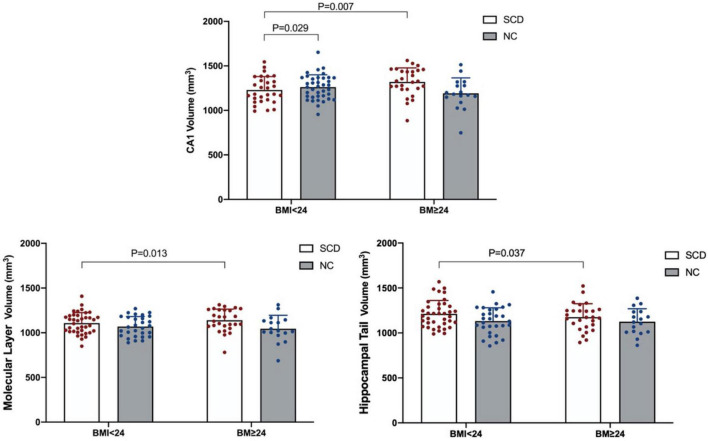
The subdimensions of executive function in which different BMI levels interact with SCD and NC include inhibition control function [SCWT C-B reaction time(s): = 5.732, = 0.018], and the hippocampal subregion volume of CA1 [ = 8.607, = 0.004], hippocampal tail [ = 4.077, = 0.046], and molecular layer [ = 6.309, = 0.014]. After correction by Bonferroni method, the population × BMI interaction only had a significant effect on the CA1 ( = 0.004). Further analysis found that the SCWT C-B reaction time of SCD was significantly longer than NC no matter whether it is at the normal BMI level [ = 4.325, = 0.040] or the high BMI level [ = 21.530, < 0.001], and the inhibitory control function of SCD was worse than that of NC. In the normal BMI group, gray matter volume in the hippocampal subregion (CA1) of SCD was significantly smaller than that of NC [ = 4.938, = 0.029]. For patients with SCD, the high BMI group had worse inhibitory control function [ = 13.499, < 0.001] and greater CA1 volume compared with the normal BMI group [ = 7.619, = 0.007].
The BMI level is related to the inhibition control function and the gray matter volume of CA1 subregion in SCD. Overweight seems to increase the gray matter volume of CA1 in the elderly with SCD, but it is not enough to compensate for the damage to executive function caused by the disease. These data provide new insights into the relationship between BMI level and executive function of SCD from the perspective of imaging.
本研究旨在探讨体重指数(BMI)水平是否会影响主观认知下降(SCD)的执行功能和海马亚区体积。
共有111名参与者纳入分析,包括SCD组(正常BMI者38例,超重和肥胖者27例)和正常认知对照组(NC)(正常BMI者29例,超重和肥胖者17例)。所有受试者均接受中文版斯特鲁普色词测验(SCWT)以测量执行功能,并进行高分辨率3D T1结构图像采集。采用双向方差分析来检验SCD组和NC组在不同BMI水平下执行功能和海马亚区灰质体积的差异。
不同BMI水平与SCD和NC相互作用的执行功能子维度包括抑制控制功能[SCWT C - B反应时间(秒):F = 5.732,P = 0.018],以及海马亚区CA1的体积[F = 8.607,P = 0.004]、海马尾部[F = 4.077,P = 0.046]和分子层[F = 6.309,P = 0.014]。经Bonferroni法校正后,群体×BMI交互作用仅对CA1有显著影响(P = 0.004)。进一步分析发现,无论处于正常BMI水平[F = 4.325,P = 0.040]还是高BMI水平[F = 21.530,P < 0.001],SCD组的SCWT C - B反应时间均显著长于NC组,且SCD组的抑制控制功能比NC组差。在正常BMI组中,SCD组海马亚区(CA1)的灰质体积显著小于NC组[F = 4.938,P = 0.029]。对于SCD患者,高BMI组与正常BMI组相比,抑制控制功能更差[F = 13.499,P < 0.001],且CA1体积更大[F = 7.619,P = 0.007]。
BMI水平与SCD的抑制控制功能及CA1亚区灰质体积有关。超重似乎会增加SCD老年人CA1的灰质体积,但不足以弥补疾病对执行功能造成的损害。这些数据从影像学角度为BMI水平与SCD执行功能之间的关系提供了新的见解。