Ogami Kentaro, Yamaguchi Rui, Imoto Seiya, Tamada Yoshinori, Araki Hiromitsu, Print Cristin, Miyano Satoru
Human Genome Center, The Institute of Medical Science, The University of Tokyo, 4-6-1 Shirokanedai, Minato-ku, Tokyo 108-8639 Japan.
BMC Syst Biol. 2012;6 Suppl 2(Suppl 2):S12. doi: 10.1186/1752-0509-6-S2-S12. Epub 2012 Dec 12.
TNF (Tumor Necrosis Factor-α) induces HUVEC (Human Umbilical Vein Endothelial Cells) to proliferate and form new blood vessels. This TNF-induced angiogenesis plays a key role in cancer and rheumatic disease. However, the molecular system that underlies TNF-induced angiogenesis is largely unknown.
We analyzed the gene expression changes stimulated by TNF in HUVEC over a time course using microarrays to reveal the molecular system underlying TNF-induced angiogenesis. Traditional k-means clustering analysis was performed to identify informative temporal gene expression patterns buried in the time course data. Functional enrichment analysis using DAVID was then performed for each cluster. The genes that belonged to informative clusters were then used as the input for gene network analysis using a Bayesian network and nonparametric regression method. Based on this TNF-induced gene network, we searched for sub-networks related to angiogenesis by integrating existing biological knowledge.
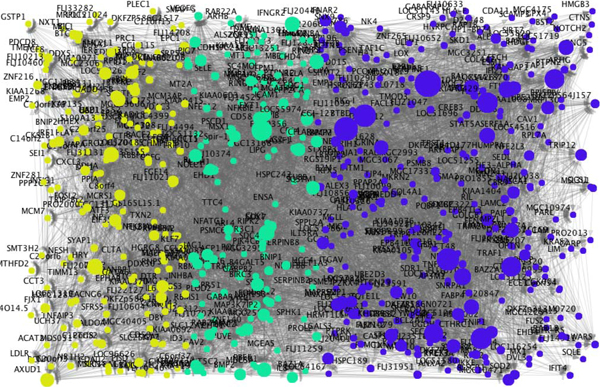
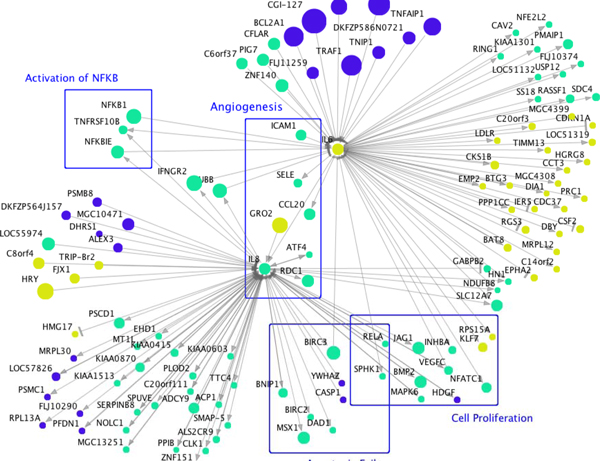
k-means clustering of the TNF stimulated time course microarray gene expression data, followed by functional enrichment analysis identified three biologically informative clusters related to apoptosis, cellular proliferation and angiogenesis. These three clusters included 648 genes in total, which were used to estimate dynamic Bayesian networks. Based on the estimated TNF-induced gene networks, we hypothesized that a sub-network including IL6 and IL8 inhibits apoptosis and promotes TNF-induced angiogenesis. More particularly, IL6 promotes TNF-induced angiogenesis by inducing NF-κB and IL8, which are strong cell growth factors.
Computational gene network analysis revealed a novel molecular system that may play an important role in the TNF-induced angiogenesis seen in cancer and rheumatic disease. This analysis suggests that Bayesian network analysis linked to functional annotation may be a powerful tool to provide insight into disease.
肿瘤坏死因子-α(TNF)可诱导人脐静脉内皮细胞(HUVEC)增殖并形成新血管。TNF诱导的血管生成在癌症和风湿性疾病中起关键作用。然而,TNF诱导血管生成的分子机制尚不清楚。
我们使用微阵列分析了TNF在一段时间内刺激HUVEC后基因表达的变化,以揭示TNF诱导血管生成的分子机制。通过传统的k均值聚类分析来识别隐藏在时间进程数据中的信息丰富的时间基因表达模式。然后使用DAVID对每个聚类进行功能富集分析。属于信息丰富聚类的基因随后被用作使用贝叶斯网络和非参数回归方法进行基因网络分析的输入。基于这个TNF诱导的基因网络,我们通过整合现有的生物学知识来搜索与血管生成相关的子网络。
对TNF刺激的时间进程微阵列基因表达数据进行k均值聚类,随后进行功能富集分析,确定了与细胞凋亡、细胞增殖和血管生成相关的三个具有生物学意义的聚类。这三个聚类总共包括648个基因,用于估计动态贝叶斯网络。基于估计的TNF诱导基因网络,我们假设一个包括IL6和IL8的子网络抑制细胞凋亡并促进TNF诱导的血管生成。更具体地说,IL6通过诱导NF-κB和IL8(它们是强大的细胞生长因子)来促进TNF诱导的血管生成。
计算基因网络分析揭示了一种新的分子机制,可能在癌症和风湿性疾病中所见的TNF诱导血管生成中起重要作用。该分析表明,与功能注释相关的贝叶斯网络分析可能是深入了解疾病的有力工具。