Sobell Department of Motor Neuroscience and Movement Disorders, Institute of Neurology, Queen Square, London, United Kingdom.
Mov Disord. 2013 Mar;28(3):356-61. doi: 10.1002/mds.25305. Epub 2013 Jan 2.
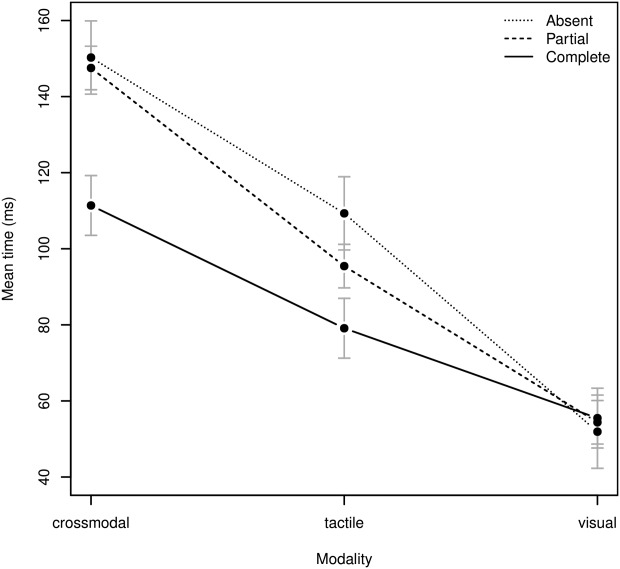
A characteristic feature of primary cervical dystonia is the presence of "sensory tricks" as well as the impairment of temporal and spatial sensory discrimination on formal testing. The aim of the present study was to test whether the amount of improvement of abnormal head deviation due to a sensory trick is associated with different performance of temporal sensory discrimination in patients with cervical dystonia. We recruited 32 patients with cervical dystonia. Dystonia severity was assessed using the Toronto Western Spasmodic Torticollis Rating Scale. Patients were rated according to clinical improvement to a sensory trick and assigned to 1 of the following groups: (1) no improvement (n = 6), (2) partial improvement (n = 17), (3) complete improvement (n = 9). Temporal discrimination thresholds were assessed for visual, tactile, and visuotactile modalities. Disease duration was shorter (P = .026) and dystonia severity lower (P = .033) in the group with complete improvement to sensory tricks compared with the group with partial improvement to sensory tricks. A significant effect for group and modality and a significant interaction between group × modality were found, with lower visuotactile discrimination thresholds in the group with complete improvement to sensory tricks compared with the other groups. In primary cervical dystonia, a complete resolution of dystonia during a sensory trick is associated with better visuotactile discrimination and shorter disease duration compared with patients with less effective sensory tricks, which may reflect progressive loss of adaptive mechanisms to basal ganglia dysfunction.
原发性颈部肌张力障碍的一个特征是存在“感觉窍门”,以及在正式测试中存在时间和空间感觉辨别障碍。本研究的目的是测试由于感觉窍门而导致的异常头部偏斜的改善量是否与颈部肌张力障碍患者的时间感觉辨别能力的不同表现相关。我们招募了 32 名患有颈部肌张力障碍的患者。使用多伦多西部痉挛性斜颈评分量表评估肌张力障碍的严重程度。根据对感觉窍门的临床改善程度对患者进行评分,并将其分为以下几组之一:(1)无改善(n = 6),(2)部分改善(n = 17),(3)完全改善(n = 9)。评估了视觉、触觉和视触觉模式的时间辨别阈值。与部分改善的感觉窍门组相比,完全改善的感觉窍门组的疾病持续时间更短(P =.026),肌张力障碍严重程度更低(P =.033)。发现组和模态存在显著影响,组×模态之间存在显著交互作用,与部分改善的感觉窍门组相比,完全改善的感觉窍门组的视触觉辨别阈值更低。在原发性颈部肌张力障碍中,与感觉窍门效果较差的患者相比,感觉窍门完全缓解肌张力障碍与更好的视触觉辨别能力和较短的疾病持续时间相关,这可能反映了对基底节功能障碍的适应性机制的逐渐丧失。