Division of Cardiovascular Medicine, Department of Medical and Health Sciences, Faculty of Health Sciences, Linköping University, Linköping, Sweden.
PLoS One. 2012;7(12):e52227. doi: 10.1371/journal.pone.0052227. Epub 2012 Dec 20.
Shear forces play a key role in the maintenance of vessel wall integrity. Current understanding regarding shear-dependent gene expression is mainly based on in vitro or in vivo observations with experimentally deranged shear, hence reflecting acute molecular events in relation to flow. Our objective was to combine computational fluid dynamic (CFD) simulations with global microarray analysis to study flow-dependent vessel wall biology in the aortic wall under physiological conditions.
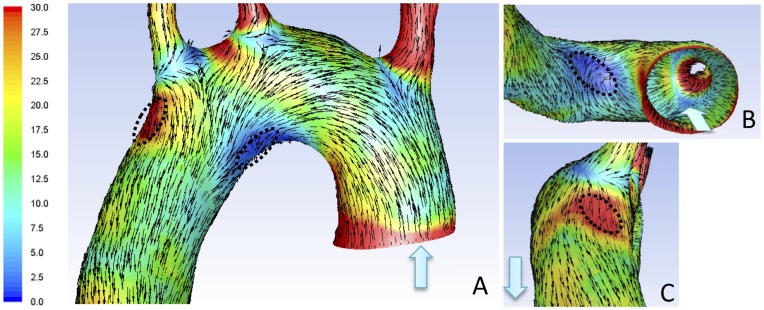
Male Wistar rats were used. Animal-specific wall shear stress (WSS) magnitude and vector direction were estimated using CFD based on aortic geometry and flow information acquired by magnetic resonance imaging. Two distinct flow pattern regions were identified in the normal rat aortic arch; the distal part of the lesser curvature being exposed to low WSS and a non-uniform vector direction, and a region along the greater curvature being subjected to markedly higher levels of WSS and a uniform vector direction. Microarray analysis identified numerous novel mechanosensitive genes, including Trpc4 and Fgf12, and confirmed well-known ones, e.g. Klf2 and Nrf2. Gene ontology analysis revealed an over-representation of genes involved in transcriptional regulation. The most differentially expressed gene, Hand2, is a transcription factor previously shown to be involved in extracellular matrix remodeling. HAND2 protein was endothelial specific and showed higher expression in the regions exposed to low WSS with disturbed flow.
Microarray analysis validated the CFD-defined WSS regions in the rat aortic arch, and identified numerous novel shear-sensitive genes. Defining the functional importance of these genes in relation to atherosusceptibility may provide important insight into the understanding of vascular pathology.
切应力在维持血管壁完整性方面起着关键作用。目前关于切应力依赖性基因表达的认识主要基于实验性改变切应力的体外或体内观察,因此反映了与流动相关的急性分子事件。我们的目的是将计算流体动力学(CFD)模拟与全基因组微阵列分析相结合,研究生理条件下主动脉壁中依赖于流动的血管壁生物学。
使用雄性 Wistar 大鼠。使用基于主动脉几何形状和通过磁共振成像获得的流动信息的 CFD 来估计动物特定的壁面切应力(WSS)大小和矢量方向。在正常大鼠主动脉弓中确定了两个不同的流动模式区域;小曲率的远端区域暴露于低 WSS 和非均匀的矢量方向,而沿着大曲率的区域则受到明显更高水平的 WSS 和均匀的矢量方向。微阵列分析鉴定了许多新的机械敏感性基因,包括 Trpc4 和 Fgf12,并证实了众所周知的基因,如 Klf2 和 Nrf2。基因本体论分析显示,参与转录调控的基因表达过度。差异表达最显著的基因 HAND2 是一种先前被证明参与细胞外基质重塑的转录因子。HAND2 蛋白具有内皮特异性,在低 WSS 暴露且血流紊乱的区域表达较高。
微阵列分析验证了大鼠主动脉弓中 CFD 定义的 WSS 区域,并鉴定了许多新的剪切敏感基因。确定这些基因与动脉粥样易感性的功能重要性可能为理解血管病理学提供重要的见解。