Research Center of Gastroenterology and Hepatology, University of Medicine and Pharmacy of Craiova, Craiova, Romania.
PLoS One. 2012;7(12):e52815. doi: 10.1371/journal.pone.0052815. Epub 2012 Dec 28.
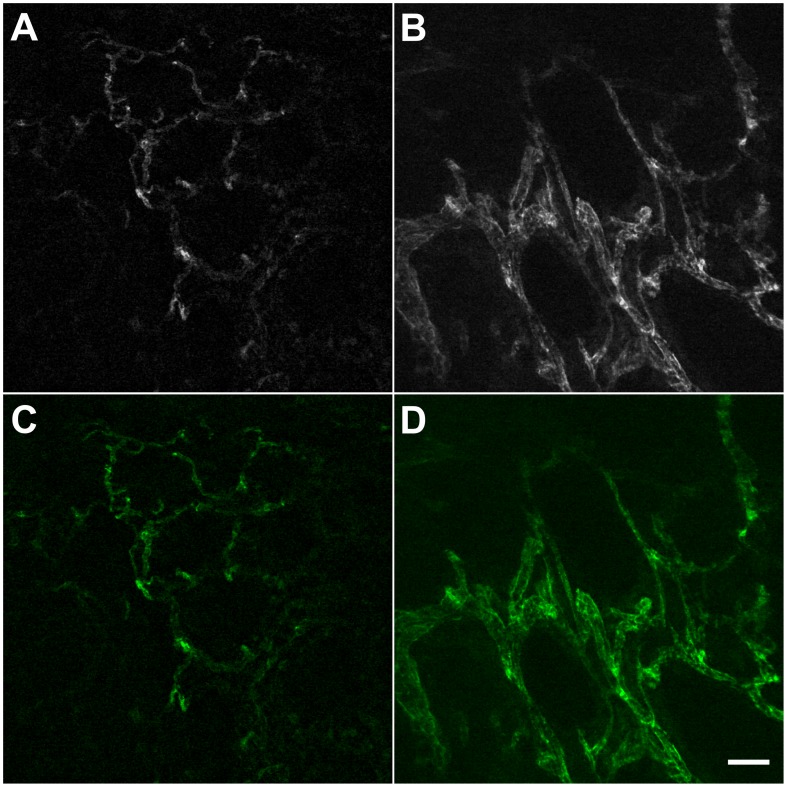
Numerous anti-angiogenic agents are currently developed to limit tumor growth and metastasis. While these drugs offer hope for cancer patients, their transient effect on tumor vasculature is difficult to assess in clinical settings. Confocal laser endomicroscopy (CLE) is a novel endoscopic imaging technology that enables histological examination of the gastrointestinal mucosa. The aim of the present study was to evaluate the feasibility of using CLE to image the vascular network in fresh biopsies of human colorectal tissue. For this purpose we have imaged normal and malignant biopsy tissue samples and compared the vascular network parameters obtained with CLE with established histopathology techniques.
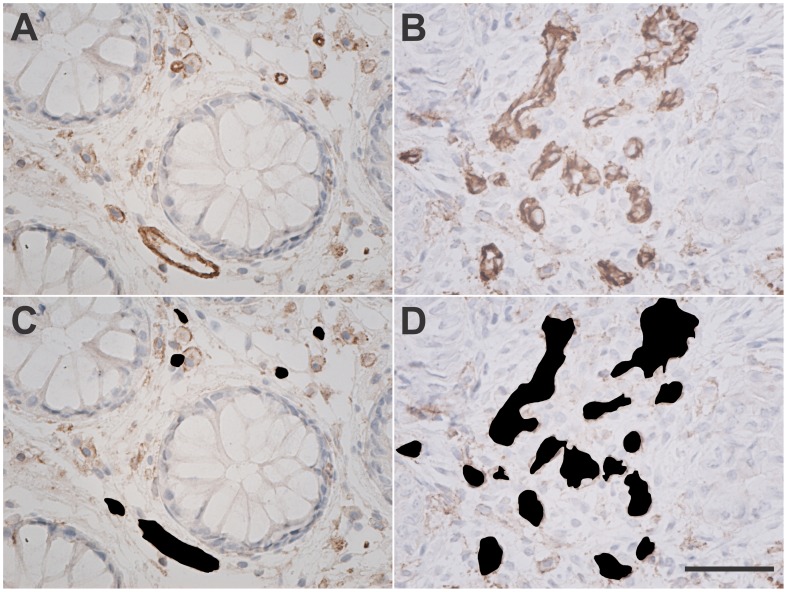
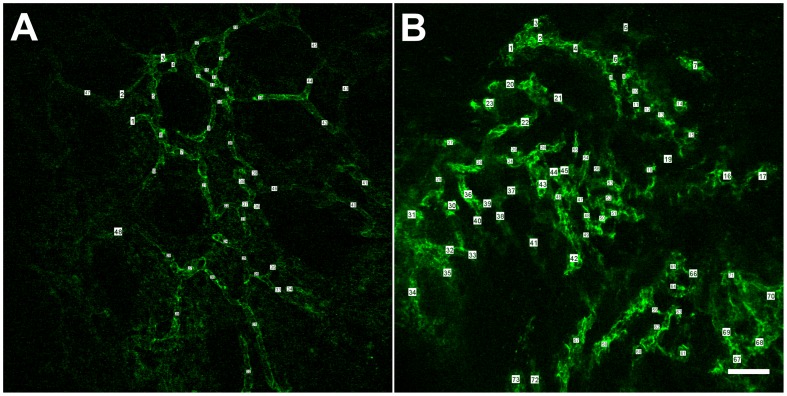
Fresh non-fixed biopsy samples of both normal and malignant colorectal mucosa were stained with fluorescently labeled anti-CD31 antibodies and imaged by CLE using a dedicated endomicroscopy system. Corresponding biopsy samples underwent immunohistochemical staining for CD31, assessing the microvessel density (MVD) and vascular areas for comparison with CLE data, which were measured offline using specific software.
The vessels were imaged by CLE in both normal and tumor samples. The average diameter of normal vessels was 8.5±0.9 µm whereas in tumor samples it was 13.5±0.7 µm (p = 0.0049). Vascular density was 188.7±24.9 vessels/mm(2) in the normal tissue vs. 242.4±16.1 vessels/mm(2) in the colorectal cancer samples (p = 0.1201). In the immunohistochemistry samples, the MVD was 211.2±42.9/mm(2) and 351.3±39.6/mm(2) for normal and malignant mucosa, respectively. The vascular area was 2.9±0.5% of total tissue area for the normal mucosa and 8.5±2.1% for primary colorectal cancer tissue.
Selective imaging of blood vessels with CLE is feasible in normal and tumor colorectal tissue by using fluorescently labeled antibodies targeted against an endothelial marker. The method could be translated into the clinical setting for monitoring of anti-angiogenic therapy.
目前有许多抗血管生成药物被开发出来,以限制肿瘤的生长和转移。虽然这些药物为癌症患者带来了希望,但它们对肿瘤血管系统的短暂作用在临床环境中很难评估。共聚焦激光内镜检查(CLE)是一种新型的内镜成像技术,可对胃肠道黏膜进行组织学检查。本研究旨在评估使用 CLE 对人结直肠组织新鲜活检标本中的血管网络进行成像的可行性。为此,我们对正常和恶性活检组织样本进行了成像,并将通过 CLE 获得的血管网络参数与已建立的组织病理学技术进行了比较。
用荧光标记的抗 CD31 抗体对新鲜非固定的结直肠黏膜活检样本进行染色,并使用专用的内镜检查系统进行 CLE 成像。对相应的活检样本进行 CD31 的免疫组织化学染色,评估微血管密度(MVD)和血管面积,与 CLE 数据进行比较,后者使用特定软件在线下进行测量。
CLE 可以在正常和肿瘤样本中对血管进行成像。正常血管的平均直径为 8.5±0.9 µm,而在肿瘤样本中为 13.5±0.7 µm(p=0.0049)。正常组织的血管密度为 188.7±24.9 条/mm(2),结直肠癌样本为 242.4±16.1 条/mm(2)(p=0.1201)。在免疫组化样本中,正常和恶性黏膜的 MVD 分别为 211.2±42.9/mm(2)和 351.3±39.6/mm(2)。正常黏膜的血管面积占总组织面积的 2.9±0.5%,原发性结直肠癌组织的血管面积占 8.5±2.1%。
通过使用针对内皮标志物的荧光标记抗体,CLE 可以在正常和肿瘤结直肠组织中选择性地对血管进行成像。该方法可转化为临床环境,用于监测抗血管生成治疗。