The Mind Research Network, Albuquerque, New Mexico, United States of America.
PLoS One. 2012;7(12):e52865. doi: 10.1371/journal.pone.0052865. Epub 2012 Dec 28.
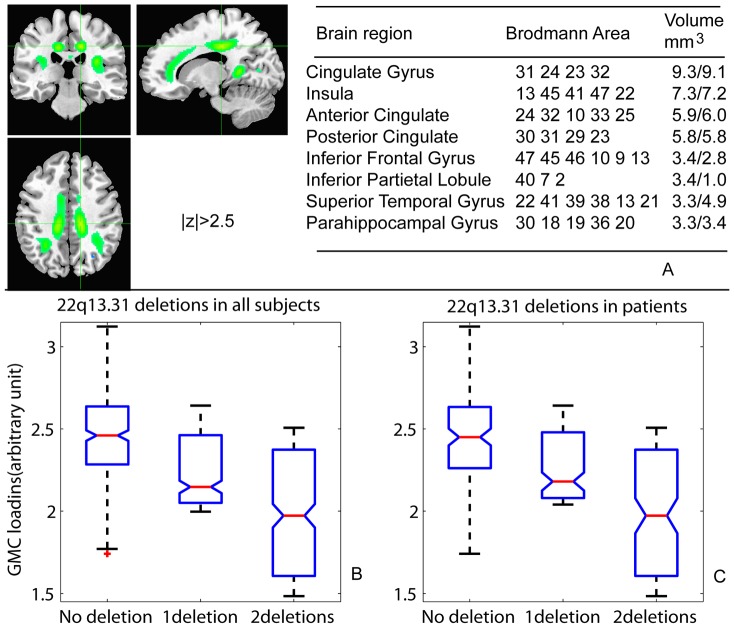
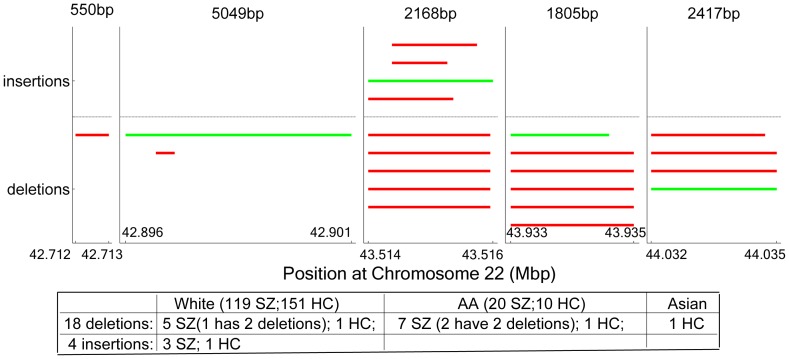
The association of copy number variation (CNV) with schizophrenia has been reported with evidence of increased frequency of both rare and large CNVs. Yet, little is known about the impact of CNVs in brain structure. In this pilot study, we explored collective effects of all CNVs in each cytogenetic band on the risk of schizophrenia and gray matter variation measured in structural magnetic resonance imaging. With 324 participants' CNV profiles (151 schizophrenia patients and 173 healthy controls), we first extracted specific CNV features that differ between patients and controls using a two sample t-test, and then tested their associations with gray matter concentration using a linear regression model in a subset of 301 participants. Our data first provided evidence of population structure in CNV features where elevated rare CNV burden in schizophrenia patients was confounded by the levels associated with African American subjects. We considered this ethnic group difference in the following cytoband analyses. Deletions in one cytoband 22q13.31 were observed significantly (p<0.05) more in patients than controls from all samples after controlling ethnicity, and the deletion load was also significantly (p = 1.44×10⁻⁴) associated with reduced gray matter concentration of a brain network mainly comprised of the cingulate gyrus and insula. Since 80% deletion carriers were patients, patients with deletions also showed reduced gray matter concentration compared with patients without deletions (p = 3.36×10⁻⁴). Our findings indicate that regional CNVs at 22q13.31, no matter the size, may influence the risk of schizophrenia with a remarkably increased mutation rate and with reduced gray matter concentration in the peri-limbic cortex. This proof-of-concept study suggests that the CNVs occurring at some 'hotspots' may in fact cause biological downstream effects and larger studies are important for confirming our initial results.
拷贝数变异(CNV)与精神分裂症的关联已被报道,其证据包括罕见和大片段 CNV 频率的增加。然而,关于 CNV 对大脑结构的影响知之甚少。在这项初步研究中,我们探索了每个细胞遗传带中所有 CNV 的集合效应,以研究其对精神分裂症风险和结构磁共振成像测量的灰质变化的影响。我们对 324 名参与者的 CNV 谱(151 名精神分裂症患者和 173 名健康对照)进行了研究,首先使用两样本 t 检验提取了患者和对照组之间存在差异的特定 CNV 特征,然后在 301 名参与者的亚组中使用线性回归模型测试了它们与灰质浓度的关联。我们的数据首次提供了 CNV 特征中人群结构的证据,其中精神分裂症患者中罕见 CNV 负担的增加与与非裔美国人相关的水平相混淆。我们在以下细胞带分析中考虑了这种种族差异。在控制种族因素后,我们从所有样本中观察到一个细胞带 22q13.31 的缺失在患者中明显(p<0.05)多于对照组,并且缺失负荷也与一个主要由扣带回和脑岛组成的脑网络的灰质浓度降低显著相关(p=1.44×10⁻⁴)。由于 80%的缺失携带者是患者,因此与没有缺失的患者相比,缺失的患者也表现出灰质浓度降低(p=3.36×10⁻⁴)。我们的研究结果表明,22q13.31 上的区域性 CNV,无论大小如何,都可能通过显著增加的突变率和边缘皮质的灰质浓度降低来影响精神分裂症的风险。这项概念验证研究表明,一些“热点”上发生的 CNV 实际上可能会产生生物学下游效应,更大规模的研究对于证实我们的初步结果非常重要。