Yeo Ronald A, Gangestad Steven W, Walton Esther, Ehrlich Stefan, Pommy Jessica, Turner Jessica A, Liu Jingyu, Mayer Andrew R, Schulz S Charles, Ho Beng-Choon, Bustillo Juan R, Wassink Thomas H, Sponheim Scott R, Morrow Eric M, Calhoun Vince D
Department of Psychology, University of New Mexico, Albuquerque, NM, USA; The Mind Research Network, Albuquerque, NM, USA.
Department of Psychology, University of New Mexico, Albuquerque, NM, USA.
Schizophr Res. 2014 Jun;156(1):71-5. doi: 10.1016/j.schres.2014.03.022. Epub 2014 Apr 24.
Cognitive deficits are prominent in schizophrenia and represent promising endophenotypes for genetic research.
The current study investigated the importance of two conceptually distinct genetic aggregates, one based on copy number variations (uncommon deletion burden), and one based on single nucleotide polymorphisms identified in recent risk studies (genetic risk score). The impact of these genetic factors, and their interaction, was examined on cognitive endophenotypes defined by principal component analysis (PCA) in a multi-center sample of 50 patients with schizophrenia and 86 controls. PCA was used to identify three different types of executive function (EF: planning, fluency, and inhibition), and in separate analyses, a measure general cognitive ability (GCA).
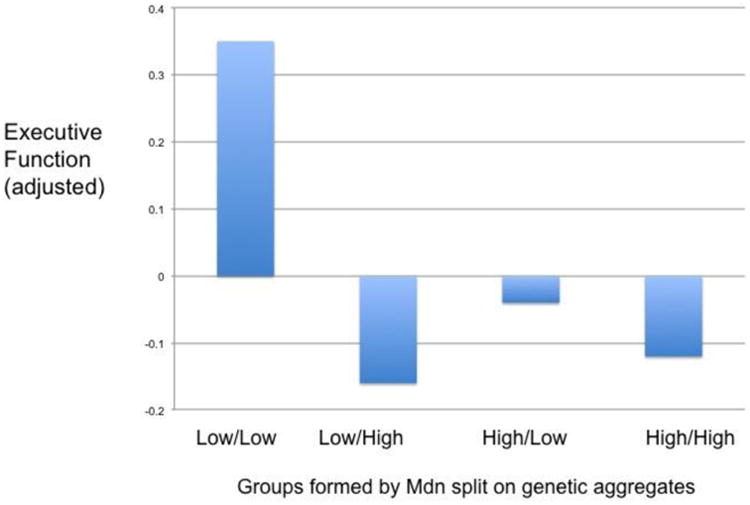
Cognitive deficits were prominent among individuals with schizophrenia, but no group differences were evident for either genetic factor. Among patients the deletion burden measures predicted cognitive deficits across the three EF components and GCA. Further, an interaction was noted between the two genetic factors for both EF and GCA and the observed patterns of interaction suggested antagonistic epistasis. In general, the set of genetic interactions examined predicted a substantial portion of variance in these cognitive endophenotypes.
Though adequately powered, our sample size is small for a genetic study.
These results draw attention to genetic interactions and the possibility that genetic influences on cognition differ in patients and controls.
认知缺陷在精神分裂症中很突出,是遗传研究中很有前景的内表型。
本研究调查了两种概念上不同的基因集合的重要性,一种基于拷贝数变异(罕见缺失负荷),另一种基于近期风险研究中确定的单核苷酸多态性(遗传风险评分)。在一个由50名精神分裂症患者和86名对照组成的多中心样本中,研究了这些遗传因素及其相互作用对通过主成分分析(PCA)定义的认知内表型的影响。PCA用于识别三种不同类型的执行功能(EF:计划、流畅性和抑制),并在单独的分析中,测量一般认知能力(GCA)。
精神分裂症患者中认知缺陷很突出,但两种遗传因素在两组中均无明显差异。在患者中,缺失负荷测量预测了三种EF成分和GCA的认知缺陷。此外,两种遗传因素在EF和GCA上均存在相互作用,观察到的相互作用模式表明存在拮抗上位性。总体而言,所研究的基因相互作用组预测了这些认知内表型中很大一部分的变异。
尽管样本量足够,但对于一项遗传研究来说,我们的样本量较小。
这些结果提请注意基因相互作用以及基因对认知的影响在患者和对照中可能不同的可能性。