Department of Neurology, University of Ulm, Ulm, Germany.
PLoS One. 2012;7(12):e53389. doi: 10.1371/journal.pone.0053389. Epub 2012 Dec 28.
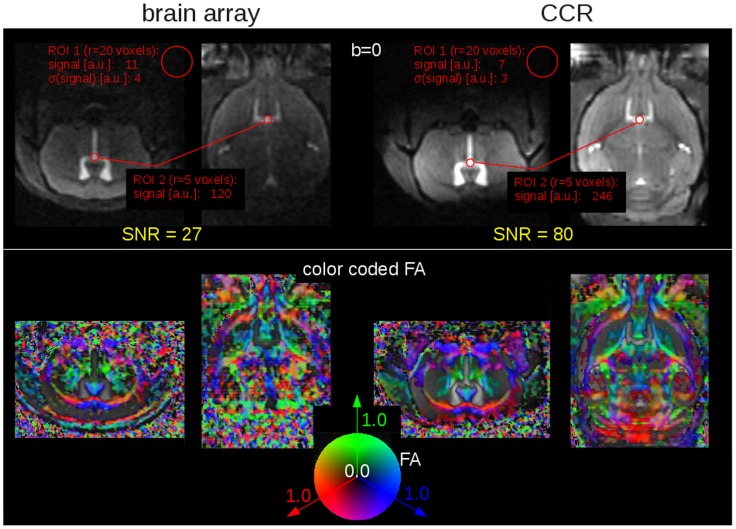
In-vivo high resolution diffusion tensor imaging (DTI) of the mouse brain is often limited by the low signal to noise ratio (SNR) resulting from the required small voxel sizes. Recently, cryogenically cooled resonators (CCR) have demonstrated significant increase of the effective SNR. It is the objective of this study to enable fast DTI of the mouse brain. In this context, CCRs appear attractive for SNR improvement.
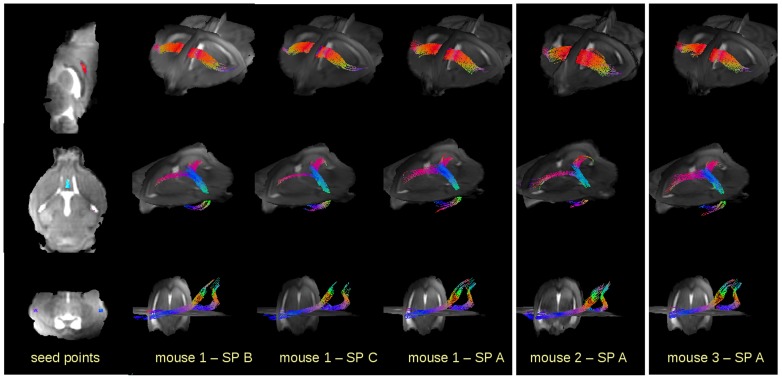
Three mice underwent a DTI examination at 156²×250 µm³ spatial resolution with a CCR at ultrahigh field (11.7T). Diffusion images were acquired along 30 gradient directions plus 5 references without diffusion encoding, resulting in a total acquisition time of 35 minutes. For comparison, mice additionally underwent a standardized 110 minutes acquisition protocol published earlier. Fractional anisotropy (FA) and fiber tracking (FT) results including quantitative tractwise fractional anisotropy statistics (TFAS) were qualitatively and quantitatively compared.
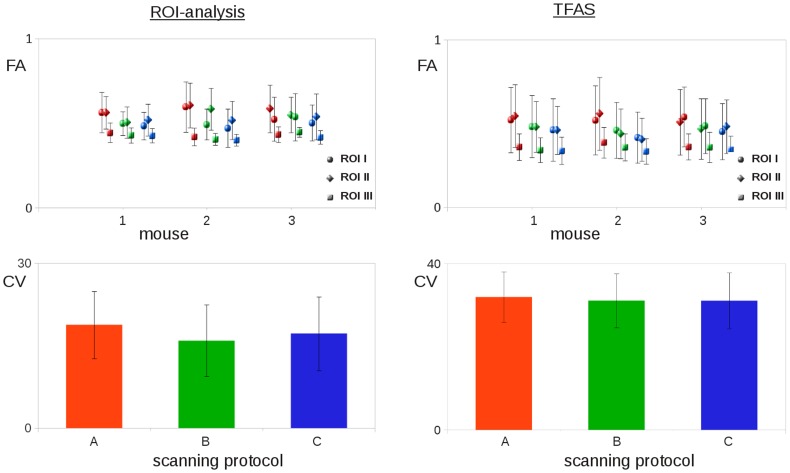
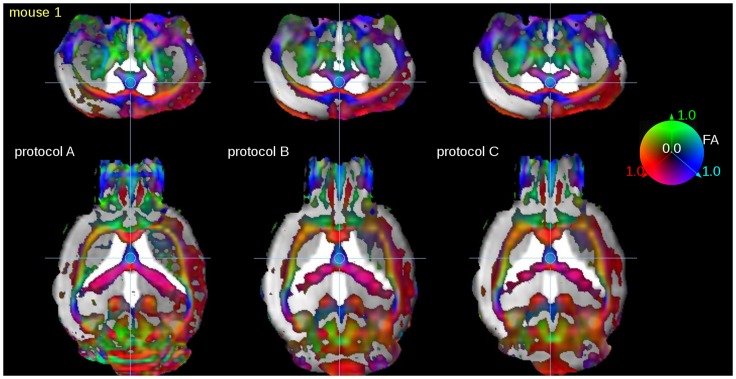
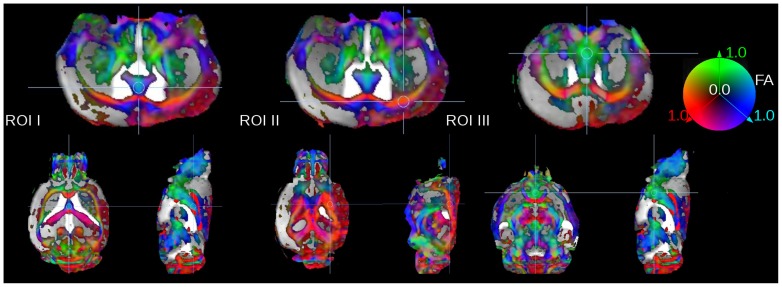
Qualitative and quantitative assessment of the calculated fractional anisotropy maps and fibre tracking results showed coinciding outcome comparing 35 minute scans to the standardized 110 minute scan. Coefficients of variation for ROI-based FA-comparison as well as for TFAS revealed comparable results for the different scanning protocols.
Mouse DTI at 11.7 T was performed with an acquisition time of approximately 30 minutes, which is considered feasible for cohort studies. The rapid acquisition protocol reveals reliable and reproducible FA-values and FT reconstructions, thus allowing an experimental setup for in-vivo large scale whole brain murine DTI cohort studies.
活体小鼠大脑的高分辨率扩散张量成像(DTI)通常受到所需小体素尺寸导致的低信噪比(SNR)的限制。最近,低温冷却谐振器(CCR)已证明可显著提高有效 SNR。本研究旨在实现快速的小鼠大脑 DTI。在此背景下,CCR 似乎很有吸引力,可以提高 SNR。
三只小鼠在超高磁场(11.7T)下使用 CCR 进行了 156²×250 µm³ 空间分辨率的 DTI 检查。扩散图像沿 30 个梯度方向加 5 个参考方向采集,无需扩散编码,总采集时间为 35 分钟。为了进行比较,小鼠还按照先前发表的标准化 110 分钟采集方案进行了检查。定性和定量比较了包括定量束向分数各向异性统计(TFAS)在内的各向异性分数(FA)和纤维追踪(FT)结果。
定性和定量评估计算的各向异性分数图和纤维追踪结果表明,35 分钟扫描与标准化 110 分钟扫描的结果一致。基于 ROI 的 FA 比较和 TFAS 的变异系数表明,不同扫描方案的结果具有可比性。
在 11.7T 下进行了约 30 分钟的小鼠 DTI 采集,这被认为是可行的队列研究。快速采集方案可提供可靠且可重复的 FA 值和 FT 重建,从而为活体大尺寸全脑小鼠 DTI 队列研究建立了实验设置。