Department of Neurobiology, Center for Neural Basis of Cognition, and Systems Neuroscience Institute, University of Pittsburgh School of Medicine, Pittsburgh, PA 15261, United States.
Curr Opin Neurobiol. 2013 Apr;23(2):245-9. doi: 10.1016/j.conb.2012.12.002. Epub 2013 Jan 1.
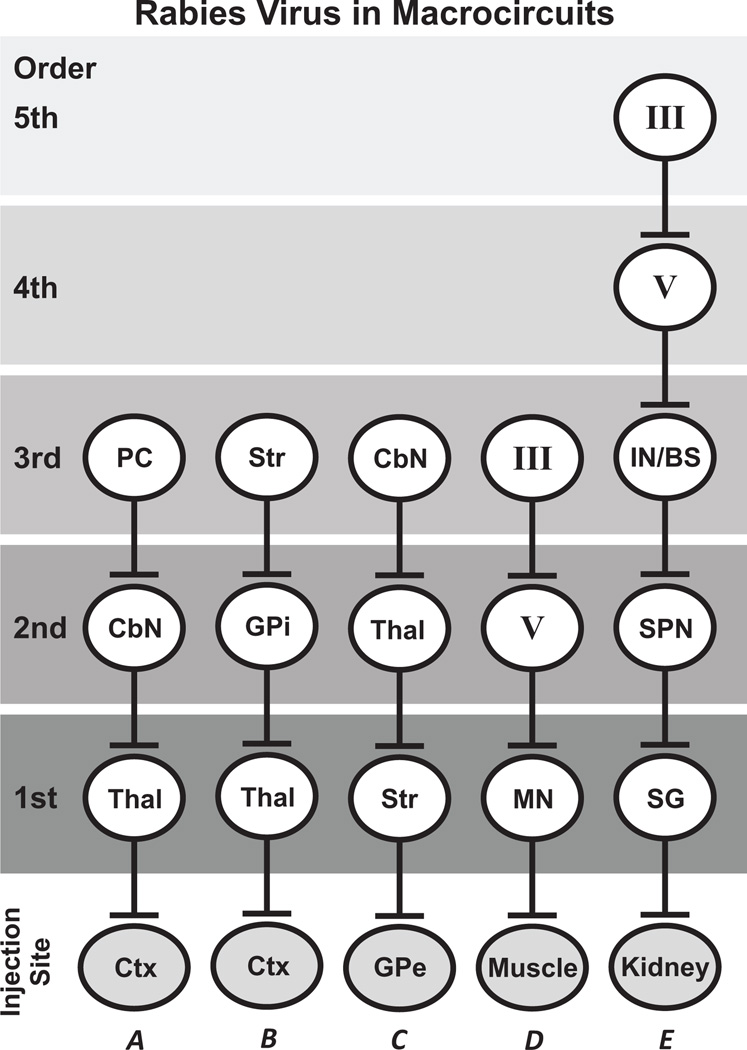
A major challenge in systems neuroscience is to unravel the complex matrix of connections that characterize functional circuits within the central nervous system. Retrograde transneuronal transport of rabies virus has proven to be especially useful for this purpose. Here we provide specific examples in which transneuronal transport of rabies virus has been used to unravel multi-synaptic pathways within motor, cognitive and autonomic circuits. Tracing with rabies virus defined: first, the closed-loop organization of cerebellar and basal ganglia circuits with the cerebral cortex; second, the presence of bidirectional communication between the cerebellum and basal ganglia; third, the specific cortical areas that have monosynaptic and/or disynaptic connections to spinal motoneurons in non-human primates; and fourth, the areas in the cerebral cortex with the most direct influence on the sympathetic innervation of the kidney. These examples demonstrate the power of transneuronal tracing with rabies virus to identify the macroarchitecture of complex neural circuits.
系统神经科学的一个主要挑战是阐明中枢神经系统内功能回路的复杂连接矩阵。狂犬病病毒逆行跨神经元转运已被证明在这方面特别有用。在这里,我们提供了具体的例子,说明狂犬病病毒的跨神经元转运已被用于阐明运动、认知和自主回路中的多突触通路。用狂犬病病毒进行追踪:首先,确定了小脑和基底神经节回路与大脑皮层的闭环组织;其次,小脑和基底神经节之间存在双向通讯;第三,特定的皮层区域与非人类灵长类动物的脊髓运动神经元具有单突触和/或双突触连接;第四,大脑皮层中对肾脏交感神经支配影响最大的区域。这些例子证明了用狂犬病病毒进行跨神经元追踪来确定复杂神经网络的宏观结构的强大功能。