Institute of Cognitive Neuroscience, University College London, London, United Kingdom.
Cortex. 2013 Sep;49(8):2201-9. doi: 10.1016/j.cortex.2012.10.006. Epub 2012 Dec 4.
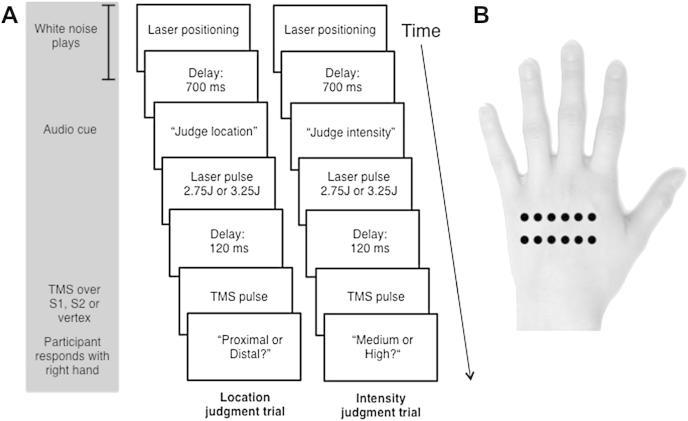
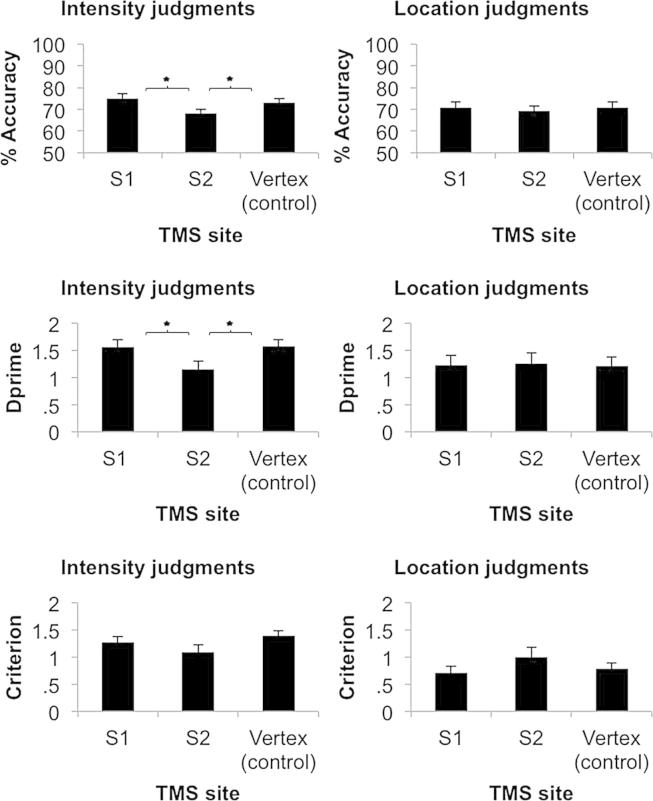
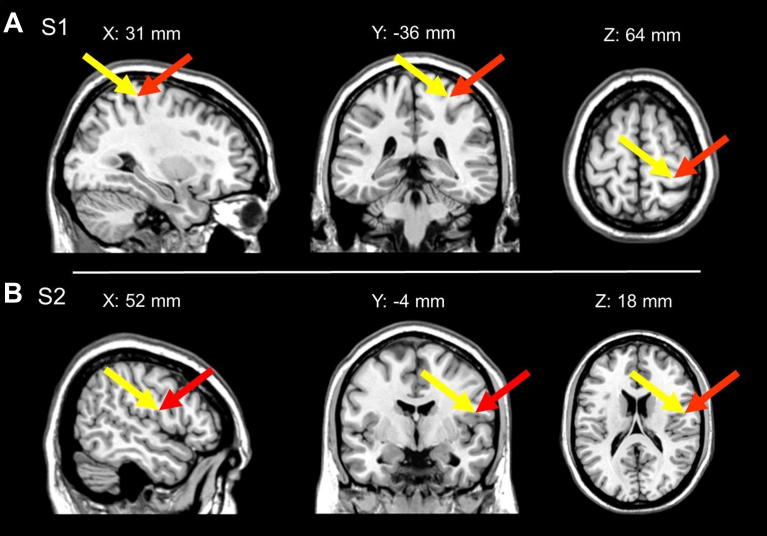
Pain is a complex sensory experience resulting from the activity of a network of brain regions. However, the functional contribution of individual regions in this network remains poorly understood. We delivered single-pulse transcranial magnetic stimulation (TMS) to the contralateral primary somatosensory cortex (S1), secondary somatosensory cortex (S2) and vertex (control site) 120 msec after selective stimulation of nociceptive afferents using neodymium:yttrium-aluminium-perovskite (Nd:YAP) laser pulses causing painful sensations. Participants were required to judge either the intensity (medium/high) or the spatial location (proximal/distal) of the stimulus in a two-alternative forced choice paradigm. When TMS pulses were delivered over S2, participants' ability to judge pain intensity was disrupted, as compared to S1 and vertex (control) stimulation. Signal-detection analysis demonstrated a loss of sensitivity to stimulation intensity, rather than a shift in perceived pain level or response bias. We did not find any effect of TMS on the ability to localise nociceptive stimuli on the skin. The novel finding that TMS over S2 can disrupt perception of pain intensity suggests a causal role for S2 in encoding of pain intensity.
疼痛是一种复杂的感官体验,源自大脑区域网络的活动。然而,该网络中各个区域的功能贡献仍知之甚少。我们在使用钕:钇铝石榴石(Nd:YAP)激光脉冲选择性刺激伤害感受传入纤维 120 毫秒后,向对侧初级体感皮层(S1)、次级体感皮层(S2)和顶点(对照部位)给予单次经颅磁刺激(TMS)脉冲,从而产生疼痛感觉。参与者需要在二选一的强制选择范式中判断刺激的强度(中/高)或空间位置(近端/远端)。与 S1 和顶点(对照)刺激相比,当 TMS 脉冲施加于 S2 时,参与者判断疼痛强度的能力受到干扰。信号检测分析表明,对刺激强度的敏感性降低,而不是感知疼痛水平或反应偏差的变化。我们没有发现 TMS 对定位皮肤上伤害性刺激的能力有任何影响。TMS 作用于 S2 可干扰疼痛强度感知的这一新颖发现表明,S2 在编码疼痛强度方面起着因果作用。