Department of Medicine, University of Texas Health Science Center, 7703 Floyd Curl Drive, San Antonio, TX 78229, United States.
Neurosci Lett. 2013 Feb 22;535:24-9. doi: 10.1016/j.neulet.2012.12.034. Epub 2013 Jan 4.
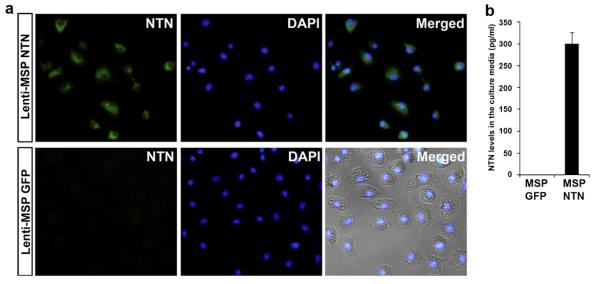
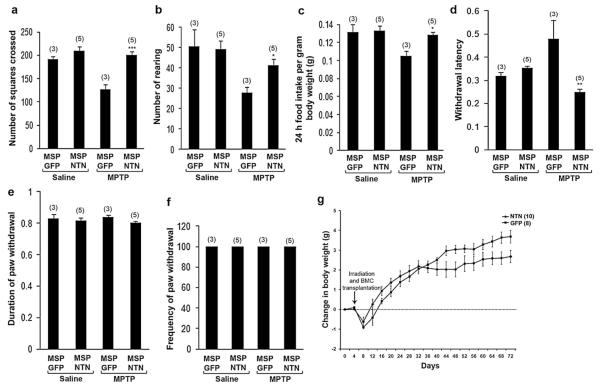
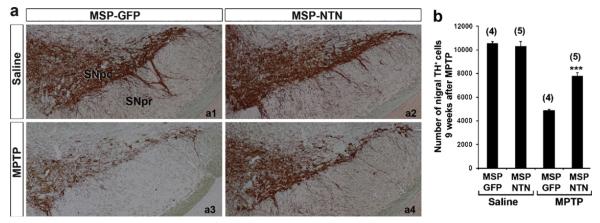
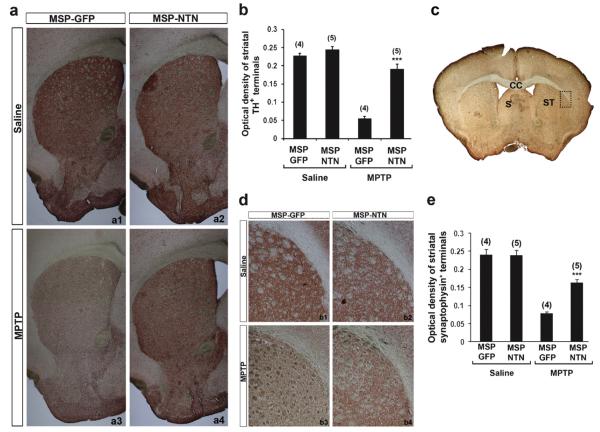
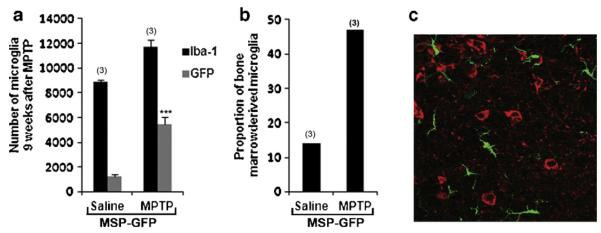
Although neurotrophic factors have long been recognized as potent agents for protecting against neuronal degeneration, clinical success in treating Parkinson's disease and other neurodegenerative disorders has been hindered by difficulties in delivery of trophic factors across the blood brain barrier (BBB). Bone marrow hematopoietic stem cell-based gene therapy is emerging as a promising tool for overcoming drug delivery problems, as myeloid cells can cross the BBB and are recruited in large numbers to sites of neurodegeneration, where they become activated microglia that can secrete trophic factors. We tested the efficacy of bone marrow-derived microglial delivery of neurturin (NTN) in protecting dopaminergic neurons against neurotoxin-induced death in mice. Bone marrow cells were transduced ex vivo with lentivirus expressing the NTN gene driven by a synthetic macrophage-specific promoter. Infected bone marrow cells were then collected and transplanted into recipient animals. Eight weeks after transplantation, the mice were injected with the neurotoxin 1-methyl-4-phenyl-1,2,3,6-tetrahydropuridine (MPTP) for seven days to induce dopaminergic neurodegeneration. Microglia-mediated NTN delivery dramatically ameliorated MPTP-induced degeneration of tyrosine hydroxylase (TH)-positive neurons of the substantia nigra and their terminals in the striatum. Microglia-mediated NTN delivery also induced significant recovery of synaptic marker staining in the striatum of MPTP-treated animals. Functionally, NTN treatment restored MPTP-induced decline in general activity, rearing behavior, and food intake. Thus, bone marrow-derived microglia can serve as cellular vehicles for sustained delivery of neurotrophic factors capable of mitigating dopaminergic injury.
虽然神经营养因子长期以来一直被认为是对抗神经元变性的有效药物,但由于难以将营养因子递送到血脑屏障(BBB)内,临床治疗帕金森病和其他神经退行性疾病的效果受到了阻碍。基于骨髓造血干细胞的基因治疗正成为克服药物递送问题的有前途的工具,因为髓样细胞可以穿过 BBB,并大量募集到神经退行性变部位,在那里它们被激活为可以分泌神经营养因子的小胶质细胞。我们测试了骨髓源性小胶质细胞递送电鳐神经生长因子(NTN)在保护多巴胺能神经元免受神经毒素诱导的死亡中的功效,在小鼠中。骨髓细胞通过表达受合成巨噬细胞特异性启动子驱动的 NTN 基因的慢病毒进行体外转导。然后收集感染的骨髓细胞并移植到受体动物中。移植后 8 周,用神经毒素 1-甲基-4-苯基-1,2,3,6-四氢吡啶(MPTP)对小鼠进行 7 天注射,以诱导多巴胺能神经元变性。小胶质细胞介导的 NTN 递送电鳐显著改善了 MPTP 诱导的黑质酪氨酸羟化酶(TH)阳性神经元及其纹状体终末的变性。小胶质细胞介导的 NTN 递送电鳐还诱导了 MPTP 处理动物纹状体中突触标记染色的显著恢复。功能上,NTN 治疗恢复了 MPTP 诱导的一般活动、竖起行为和摄食量下降。因此,骨髓源性小胶质细胞可以作为持续递送电鳐神经生长因子的细胞载体,减轻多巴胺能损伤。