Fraunhofer Institute for Biomedical Engineering, St. Ingbert, Germany.
PLoS One. 2012;7(12):e51715. doi: 10.1371/journal.pone.0051715. Epub 2012 Dec 27.
Infections with HIV still represent a major human health problem worldwide and a vaccine is the only long-term option to fight efficiently against this virus. Standardized assessments of HIV-specific immune responses in vaccine trials are essential for prioritizing vaccine candidates in preclinical and clinical stages of development. With respect to neutralizing antibodies, assays with HIV-1 Env-pseudotyped viruses are a high priority. To cover the increasing demands of HIV pseudoviruses, a complete cell culture and transfection automation system has been developed.
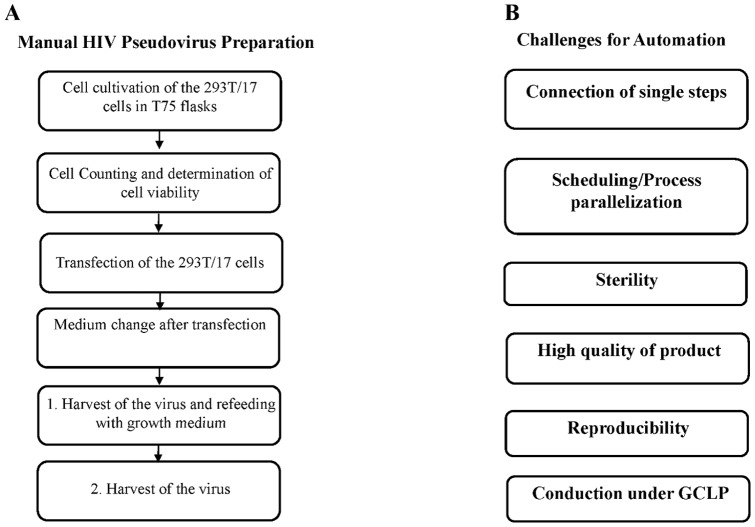
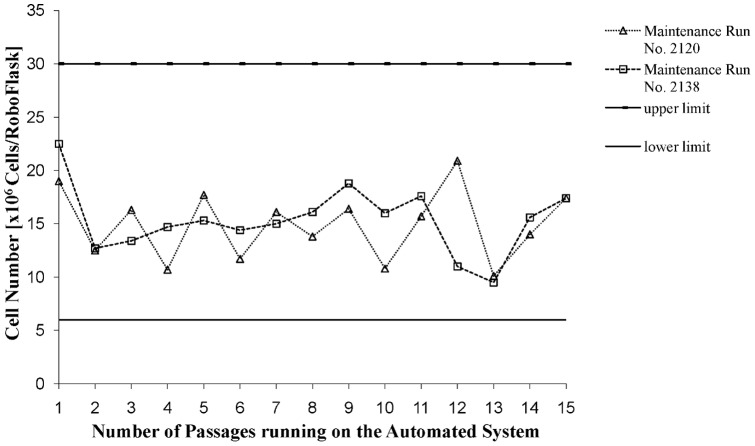
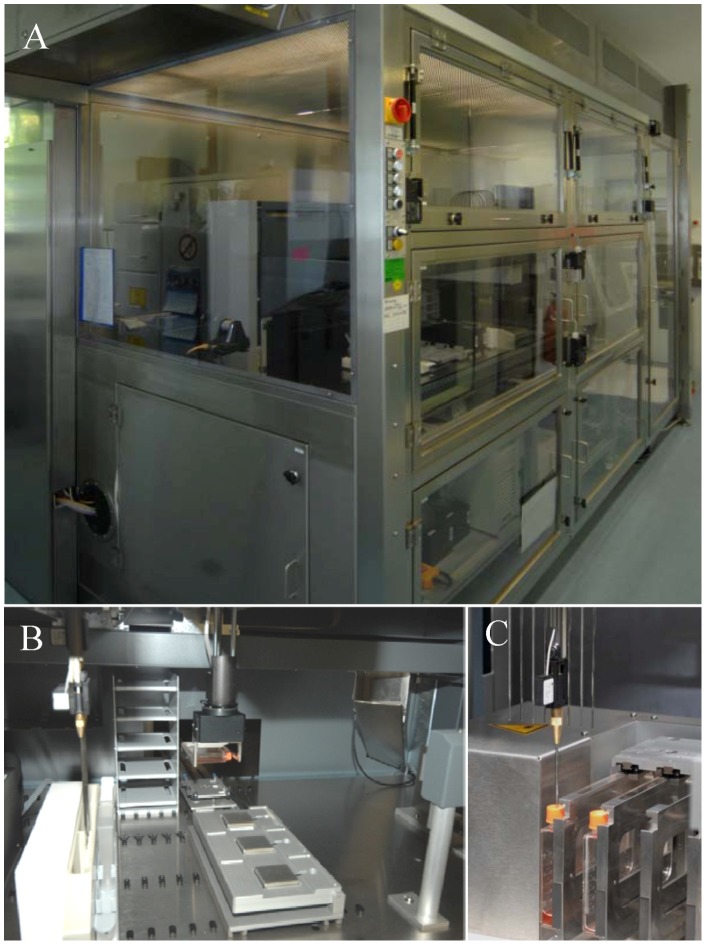
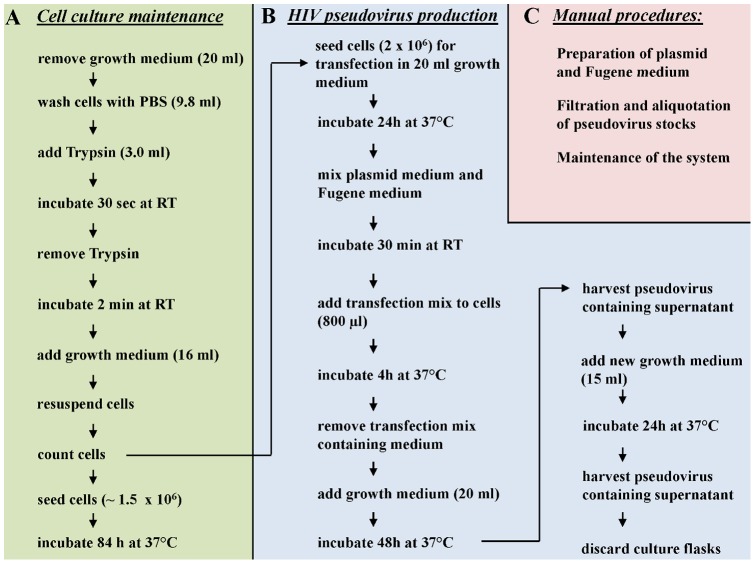
METHODOLOGY/PRINCIPAL FINDINGS: The automation system for HIV pseudovirus production comprises a modified Tecan-based Cellerity system. It covers an area of 5×3 meters and includes a robot platform, a cell counting machine, a CO(2) incubator for cell cultivation and a media refrigerator. The processes for cell handling, transfection and pseudovirus production have been implemented according to manual standard operating procedures and are controlled and scheduled autonomously by the system. The system is housed in a biosafety level II cabinet that guarantees protection of personnel, environment and the product. HIV pseudovirus stocks in a scale from 140 ml to 1000 ml have been produced on the automated system. Parallel manual production of HIV pseudoviruses and comparisons (bridging assays) confirmed that the automated produced pseudoviruses were of equivalent quality as those produced manually. In addition, the automated method was fully validated according to Good Clinical Laboratory Practice (GCLP) guidelines, including the validation parameters accuracy, precision, robustness and specificity.
An automated HIV pseudovirus production system has been successfully established. It allows the high quality production of HIV pseudoviruses under GCLP conditions. In its present form, the installed module enables the production of 1000 ml of virus-containing cell culture supernatant per week. Thus, this novel automation facilitates standardized large-scale productions of HIV pseudoviruses for ongoing and upcoming HIV vaccine trials.
艾滋病病毒感染仍然是全球范围内的一个重大公共卫生问题,疫苗是有效对抗该病毒的唯一长期选择。在疫苗试验中,对 HIV 特异性免疫反应进行标准化评估对于在临床前和临床开发阶段优先考虑疫苗候选物至关重要。就中和抗体而言,使用 HIV-1 包膜假型病毒的测定是重中之重。为了满足日益增长的 HIV 假病毒需求,已经开发出一种完整的细胞培养和转染自动化系统。
方法/主要发现:用于 HIV 假病毒生产的自动化系统包括一个经过修改的基于 Tecan 的 Cellerity 系统。它占地面积为 5×3 米,包括机器人平台、细胞计数器、用于细胞培养的 CO2 培养箱和培养基冰箱。根据手动标准操作程序实施细胞处理、转染和假病毒生产过程,并由系统自主控制和调度。该系统位于生物安全二级柜中,可确保人员、环境和产品的安全。已在自动化系统上生产了 140 毫升至 1000 毫升规模的 HIV 假病毒库存。自动化生产的 HIV 假病毒与手动生产的 HIV 假病毒进行平行比较(桥接试验),结果表明,自动化生产的假病毒与手动生产的假病毒质量相当。此外,根据良好临床实验室规范 (GCLP) 指南,包括准确性、精密度、稳健性和特异性等验证参数,对自动化方法进行了全面验证。
已成功建立了一种自动化 HIV 假病毒生产系统。它允许在 GCLP 条件下高质量生产 HIV 假病毒。在其目前的形式下,安装的模块每周可生产 1000 毫升含病毒的细胞培养上清液。因此,这种新型自动化系统为正在进行和即将进行的 HIV 疫苗试验提供了标准化的大规模 HIV 假病毒生产。