University Department of Medicine, Queen Mary Hospital, Hong Kong.
Gastroenterol Res Pract. 2012;2012:898931. doi: 10.1155/2012/898931. Epub 2012 Dec 4.
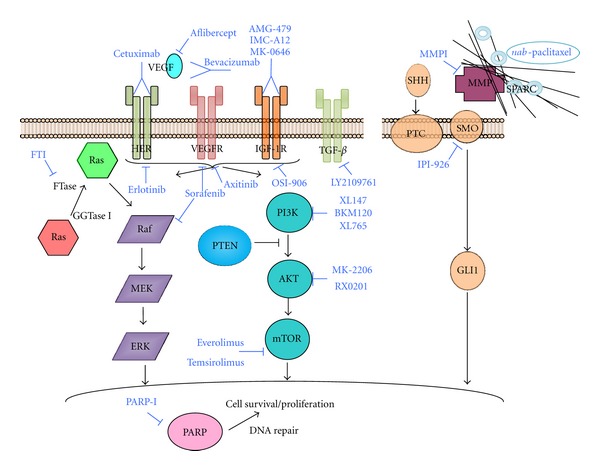
Development of systemic treatment for advanced pancreatic cancer (APC) has been challenging. After fluorouracil, gemcitabine (GEM) became the treatment of choice based on its benefit of symptom relief. Many cytotoxic agents have been combined with GEM in search of regimens with improved survival benefit. However, there were only marginal benefits in people with good performance status. Recently, the combination regimen consisting of oxaliplatin, irinotecan, fluorouracil, and leucovorin (FOLFIRINOX) was found to achieve unprecedented survival benefit and has become the preferred option for patients with good clinical conditions. On the other hand, many biological agents have been combined with GEM, but only erlotinib was found to derive statistically significant survival advantage. However, the effect was too small to be appreciated clinically. The effort in development of targeted therapy in APC continues. This paper summarized key findings in the development of chemotherapy and targeted therapy for APC patients and discussed future directions in management.
晚期胰腺癌(APC)的系统治疗一直具有挑战性。继氟尿嘧啶之后,吉西他滨(GEM)因其能缓解症状而成为治疗的首选药物。为了寻求能提高生存获益的方案,许多细胞毒性药物已与 GEM 联合使用。然而,在身体状况良好的人群中,获益仅为边际获益。最近,奥沙利铂、伊立替康、氟尿嘧啶和亚叶酸(FOLFIRINOX)联合方案的应用发现能取得前所未有的生存获益,已成为身体状况良好的患者的首选方案。另一方面,许多生物制剂已与 GEM 联合使用,但只有厄洛替尼被发现具有统计学意义的生存优势。然而,其获益太小,在临床上难以体现。在 APC 的靶向治疗开发方面仍在不断努力。本文总结了 APC 患者化疗和靶向治疗的关键研究结果,并探讨了未来的管理方向。