Congrains Ada, Kamide Kei, Ohishi Mitsuru, Rakugi Hiromi
Department of Geriatric Medicine and Nephrology, Osaka University Graduate School of Medicine, 2-2 B6, Yamadaoka, Suita, Osaka 565-0871, Japan.
Int J Mol Sci. 2013 Jan 10;14(1):1278-92. doi: 10.3390/ijms14011278.
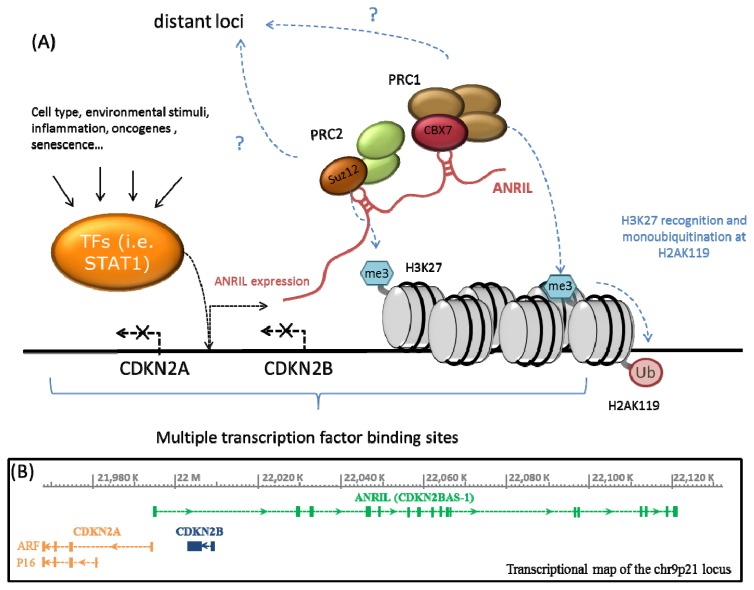
ANRIL is a recently discovered long non-coding RNA encoded in the chromosome 9p21 region. This locus is a hotspot for disease-associated polymorphisms, and it has been consistently associated with cardiovascular disease, and more recently with several cancers, diabetes, glaucoma, endometriosis among other conditions. ANRIL has been shown to regulate its neighbor tumor suppressors CDKN2A/B by epigenetic mechanisms and thereby regulate cell proliferation and senescence. However, the clear role of ANRIL in the pathogenesis of these conditions is yet to be understood. Here, we review the recent findings on ANRIL molecular characterization and function, with a particular focus on its implications in human disease.
ANRIL是一种最近发现的长链非编码RNA,由9号染色体p21区域编码。该基因座是疾病相关多态性的热点,一直与心血管疾病相关,最近还与几种癌症、糖尿病、青光眼、子宫内膜异位症等疾病相关。研究表明,ANRIL通过表观遗传机制调节其邻近的肿瘤抑制因子CDKN2A/B,从而调节细胞增殖和衰老。然而,ANRIL在这些疾病发病机制中的明确作用尚不清楚。在此,我们综述了关于ANRIL分子特征和功能的最新研究发现,特别关注其在人类疾病中的意义。