Rosenberg Noah M, Urman Richard D, Gallagher Sean, Stenglein John, Liu Xiaoxia, Shapiro Fred E
University of Massachusetts Memorial Medical Center, Worcester.
Eplasty. 2012;12:e59. Epub 2012 Dec 25.
To implement a customizable checklist in an interdisciplinary, team-based plastic surgery setting to reduce surgical complications.
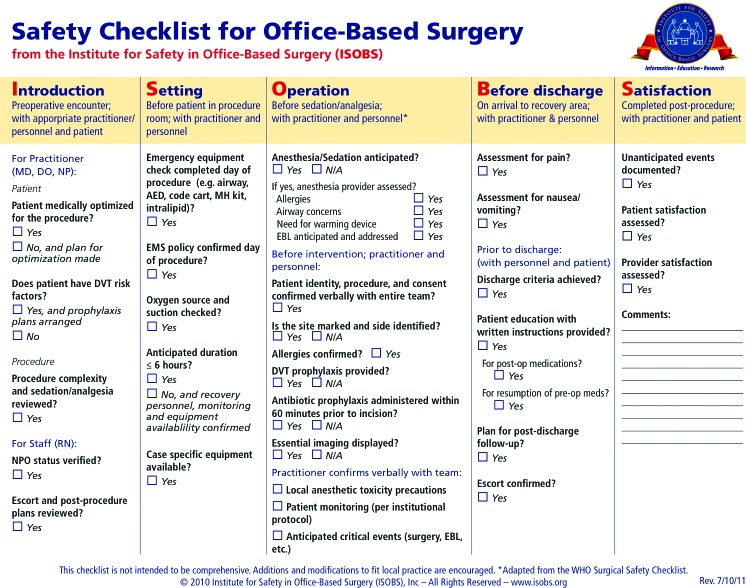
We examined the effects on patient outcomes and documentation of a customizable, office-based surgical safety checklist. On the basis of the World Health Organization Surgical Safety Checklist, we developed a 28-element, perioperative checklist for use in the office-based surgical setting. The checklist was implemented in an office-based plastic surgery practice with an already high standard of care. We recorded baseline, prechecklist rates for each checklist item and postoperative adverse outcomes via a retrospective chart review of 219 cases. After an education program and 30-day run-in period, a prospective, post-checklist implementation chart review was initiated (n = 184), with outcome data compared to the baseline.
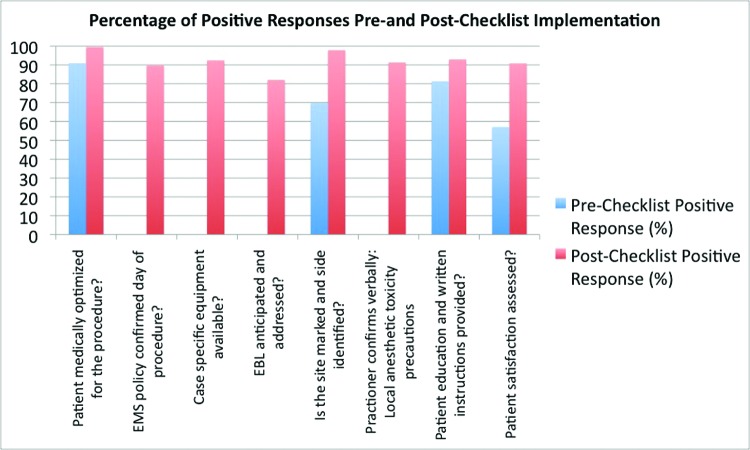
The total number of complications per 100 patients decreased from 15.1 to 2.72 after checklist implementation (P < .0001), for an absolute risk reduction of 12.4. The proportion of patients with one or more complications decreased from 11.9% to 2.72% (P = .0006). Site and side marking increased from 69.9% prechecklist to 97.8% (P < .0001). Medical optimization increased from 90.9% to 99.5% (P < .0001). Emergency medical services (EMS) policy confirmation, case-specific equipment availability, anticipation of estimated blood loss, and verbal confirmation of local anesthetic toxicity precautions increased from 0% to 90.0% (P < .0001), 92.4% (P < .0001), 82.1% (P < .0001), and 91.3% (P < .0001), respectively. Assessment of patient satisfaction increased from 57.1% to 90.8% (P < .0001).
Implementation of a customizable checklist was associated with a reduction in surgical complications in an office-based plastic surgery practice with an already high standard of care.
在跨学科、团队协作的整形手术环境中实施可定制的检查表,以减少手术并发症。
我们研究了可定制的门诊手术安全检查表对患者结局和文件记录的影响。基于世界卫生组织手术安全检查表,我们制定了一份包含28项内容的围手术期检查表,用于门诊手术环境。该检查表在一个护理水平已经很高的门诊整形手术机构中实施。我们通过对219例病例的回顾性病历审查,记录了每个检查表项目的基线、检查表实施前的发生率以及术后不良结局。在开展一项教育计划并经过30天的试运行期后,启动了一项前瞻性的检查表实施后病历审查(n = 184),并将结局数据与基线进行比较。
检查表实施后,每100例患者的并发症总数从15.1降至2.72(P <.0001),绝对风险降低了12.4。有一项或多项并发症的患者比例从11.9%降至2.72%(P =.0006)。手术部位和侧别标记从检查表实施前的69.9%增至97.8%(P <.0001)。医疗优化从90.9%增至99.5%(P <.0001)。紧急医疗服务(EMS)政策确认、特定病例设备可用性、预计失血量评估以及局部麻醉毒性预防措施的口头确认分别从0%增至90.0%(P <.0001)、92.4%(P <.0001)、82.1%(P <.0001)和91.3%(P <.0001)。患者满意度评估从57.1%增至90.8%(P <.0001)。
在一个护理水平已经很高的门诊整形手术机构中,实施可定制的检查表与手术并发症的减少相关。