Faculty of Medicine, National University of Science and Technology, Ascot, Bulawayo, Zimbabwe.
BMC Complement Altern Med. 2013 Jan 11;13:13. doi: 10.1186/1472-6882-13-13.
Tulbaghia violacea Harv. (Alliaceae) is used to treat various ailments, including hypertension (HTN) in South Africa. This study aims to evaluate the contributions of muscarinic receptors and changes in plasma aldosterone levels to its anti-hypertensive effect.
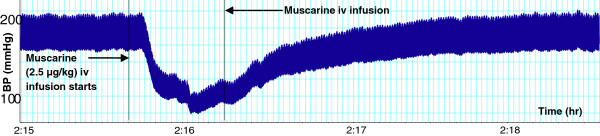
In the acute experiments, methanol leaf extracts (MLE) of T. violacea (30-120 mg/kg), muscarine (0.16 -10 μg/kg), and atropine (0.02 - 20.48 mg/kg), and/or the vehicle (dimethylsulfoxide (DMSO) and normal saline (NS)) were respectively and randomly administered intravenously in a group of spontaneously hypertensive (SHR) weighing 300 to 350 g and aged less than 5 months. Subsequently, T. violacea (60 mg/kg) or muscarine (2.5 μg/kg) was infused into eight SHRs, 20 min after atropine (5.12 mg/kg) pre-treatment. In the chronic (21 days) experiments, the SHRs were randomly divided into three groups, and given the vehicle (0.2 ml/day of DMSO and NS), T. violacea (60 mg/kg/day) and captopril (10 mg/kg/day) respectively into the peritoneum, to investigate their effects on blood pressure (BP), heart rate (HR), and plasma aldosterone levels. Systolic BP and HR were measured using tail-cuff plethysmography during the intervention. BP and HR were measured via a pressure transducer connecting the femoral artery and the Powerlab at the end of each intervention in the acute experiment; and on day 22 in the chronic experiment.
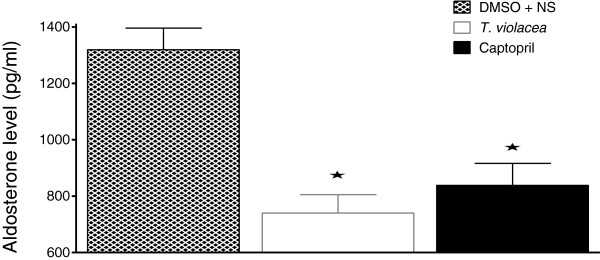
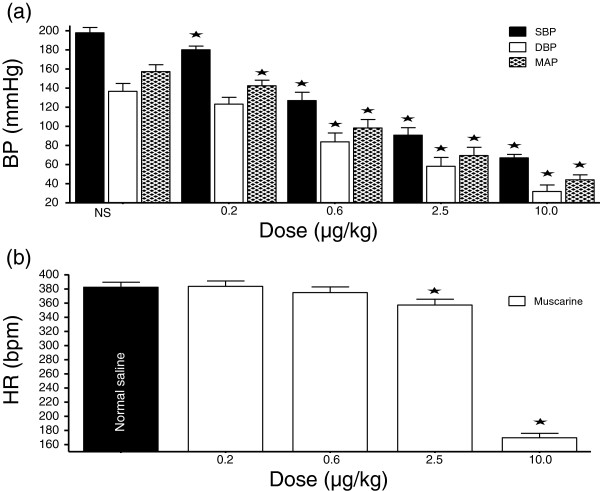
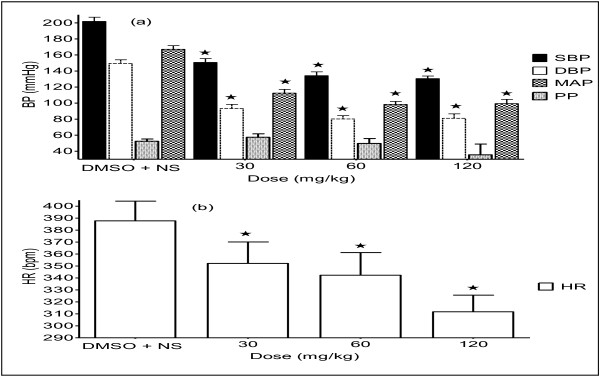
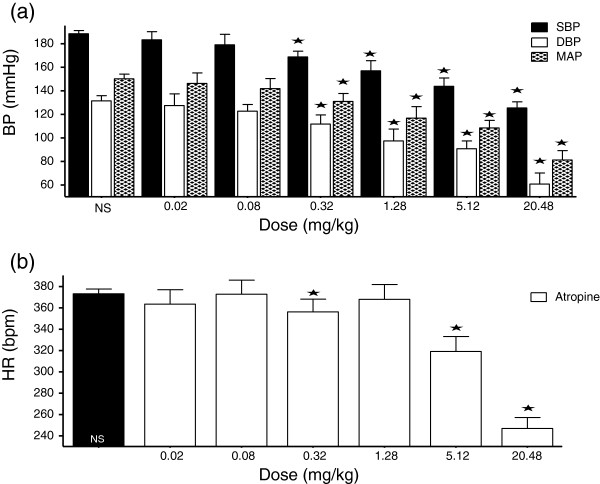
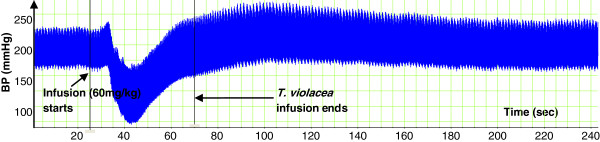
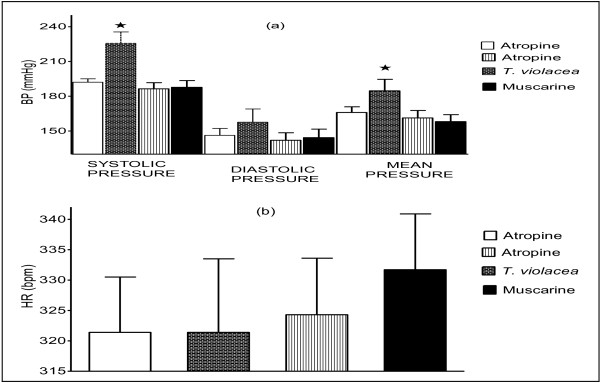
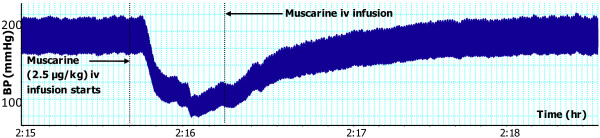
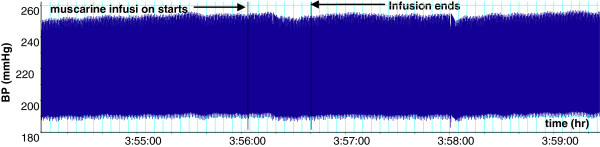
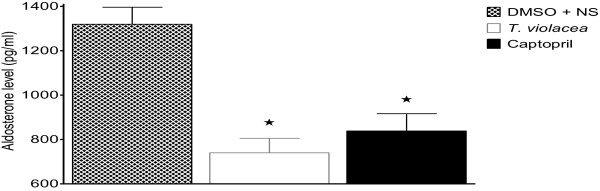
In the acute experiments, T. violacea, muscarine, and atropine significantly (p < 0.05) reduced BP dose-dependently. T. violacea and muscarine produced dose-dependent decreases in HR, while the effect of atropine on HR varied. After atropine pre-treatment, dose-dependent increases in BP and HR were observed with T. violacea; while the BP and HR effects of muscarine were nullified. In the chronic experiments, the T. violacea-treated and captropril-treated groups had signicantly lower levels of aldosterone in plasma when compared to vehicle-treated group. Compared to the vehicle-treated group, significant reduction in BP was only seen in the captopril-treated group; while no difference in HR was observed among the groups.
The results obtained in this study suggest that stimulation of the muscarinic receptors and a reduction in plasma aldosterone levels contribute to the anti-hypertesive effect of T. violacea.
南非人用紫葳属植物(葱科)来治疗各种疾病,包括高血压(HTN)。本研究旨在评估毒蕈碱受体的作用以及血浆醛固酮水平的变化对其降压作用的影响。
在急性实验中,紫葳属植物的甲醇叶提取物(MLE)(30-120mg/kg)、毒蕈碱(0.16-10μg/kg)和阿托品(0.02-20.48mg/kg)以及载体(二甲基亚砜(DMSO)和生理盐水(NS))分别随机静脉内注射到一组体重为 300 至 350 克且年龄小于 5 个月的自发性高血压(SHR)大鼠中。随后,在阿托品(5.12mg/kg)预处理 20 分钟后,将紫葳属植物(60mg/kg)或毒蕈碱(2.5μg/kg)输注到 8 只 SHR 中。在慢性(21 天)实验中,将 SHR 随机分为三组,分别给予载体(DMSO 和 NS,0.2ml/天)、紫葳属植物(60mg/kg/天)和卡托普利(10mg/kg/天)腹膜内给药,以研究它们对血压(BP)、心率(HR)和血浆醛固酮水平的影响。在干预期间使用尾部血压计测量收缩压和心率。在急性实验中,在每个干预结束时通过压力传感器连接股动脉和 Powerlab 测量 BP 和 HR;在慢性实验中于第 22 天进行测量。
在急性实验中,紫葳属植物、毒蕈碱和阿托品均能显著(p<0.05)降低血压,呈剂量依赖性。紫葳属植物和毒蕈碱使 HR 呈剂量依赖性降低,而阿托品对 HR 的影响则不同。在阿托品预处理后,随着紫葳属植物剂量的增加,BP 和 HR 呈剂量依赖性增加;而毒蕈碱对 BP 和 HR 的作用则被消除。在慢性实验中,与载体处理组相比,紫葳属植物治疗组和卡托普利治疗组的血浆醛固酮水平显著降低。与载体处理组相比,只有卡托普利治疗组的 BP 显著降低;而各组的 HR 无差异。
本研究结果表明,毒蕈碱受体的刺激和血浆醛固酮水平的降低有助于紫葳属植物的降压作用。