Levei Erika, Frentiu Tiberiu, Ponta Michaela, Tanaselia Claudiu, Borodi Gheorghe
INCDO-INOE 2000, Research Institute for Analytical Instrumentation, 67 Donath, 400293, Cluj-Napoca, Romania.
Chem Cent J. 2013 Jan 14;7(1):5. doi: 10.1186/1752-153X-7-5.
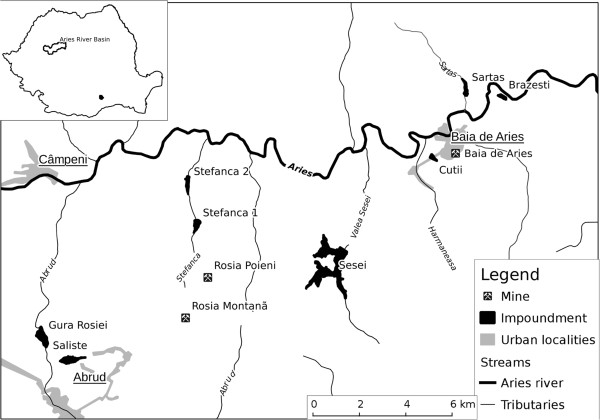
The objective of this study was to examine the potential environmental risk of tailings resulted after precious and base metal ores processing, stored in seven impoundments located in the Aries river basin, Romania. The tailings were characterized by mineralogical and elemental composition, contamination indices, acid rock drainage generation potential and water leachability of hazardous/priority hazardous metals and ions. Multivariate statistical methods were used for data interpretation.
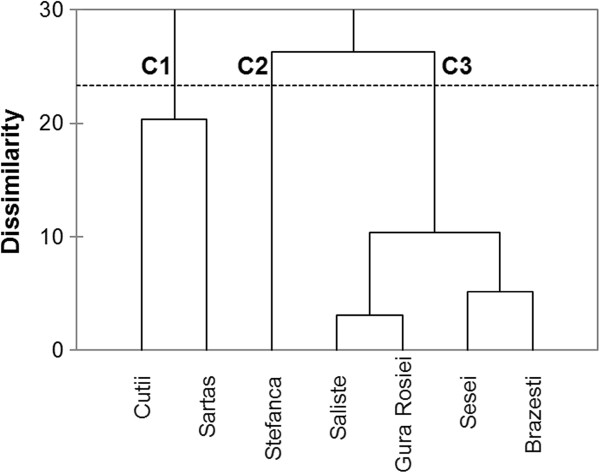
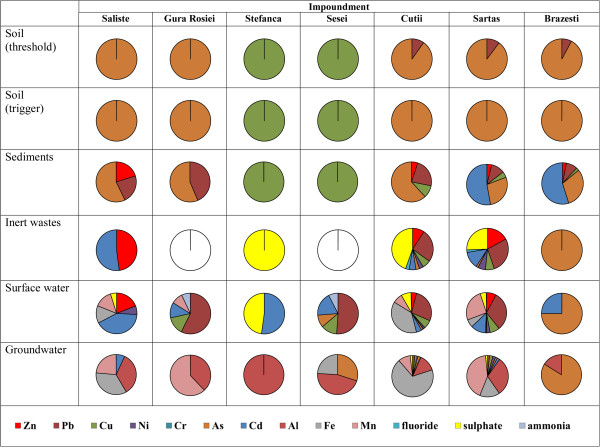
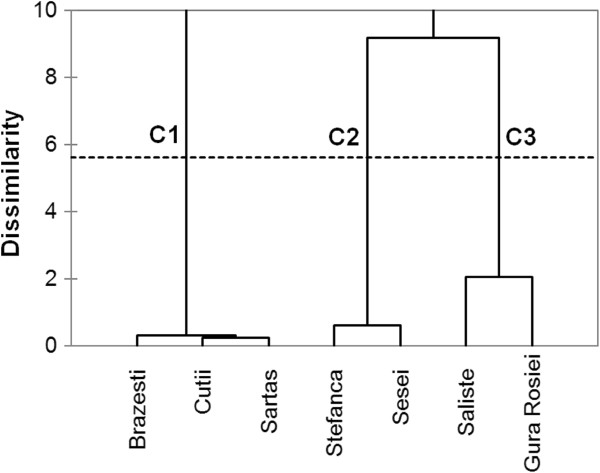
Tailings were found to be highly contaminated with several hazardous/priority hazardous metals (As, Cu, Cd, Pb), and pose potential contamination risk for soil, sediments, surface and groundwater. Two out of the seven studied impoundments does not satisfy the criteria required for inert wastes, shows acid rock drainage potential and thus can contaminate the surface and groundwater. Three impoundments were found to be highly contaminated with As, Pb and Cd, two with As and other two with Cu. The tailings impoundments were grouped based on the enrichment factor, geoaccumulation index, contamination factor and contamination degree of 7 hazardous/priority hazardous metals (As, Cd, Cr, Cu, Ni, Pb, Zn) considered typical for the studied tailings. Principal component analysis showed that 47% of the elemental variability was attributable to alkaline silicate rocks, 31% to acidic S-containing minerals, 12% to carbonate minerals and 5% to biogenic elements. Leachability of metals and ions was ascribed in proportion of 61% to silicates, 11% to acidic minerals and 6% to the organic matter. A variability of 18% was attributed to leachability of biogenic elements (Na, K, Cl-, NO3-) with no potential environmental risk. Pattern recognition by agglomerative hierarchical clustering emphasized the grouping of impoundments in agreement with their contamination degree and acid rock drainage generation potential.
Tailings stored in the studied impoundments were found to be contaminated with some hazardous/ priority hazardous metals, fluoride and sulphate and thus presents different contamination risk for the environment. A long term monitoring program of these tailings impoundments and the expansion of the ecologization measures in the area is required.
本研究的目的是调查罗马尼亚阿列什河流域七个尾矿库中储存的贵金属和贱金属矿石加工后产生的尾矿的潜在环境风险。通过矿物学和元素组成、污染指数、酸岩排水产生潜力以及危险/优先危险金属和离子的水浸出性对尾矿进行了表征。采用多元统计方法进行数据解释。
发现尾矿受到多种危险/优先危险金属(砷、铜、镉、铅)的高度污染,对土壤、沉积物、地表水和地下水构成潜在污染风险。七个研究尾矿库中有两个不符合惰性废物所需的标准,显示出酸岩排水潜力,因此可能污染地表水和地下水。发现三个尾矿库受到砷、铅和镉的高度污染,两个受到砷污染,另外两个受到铜污染。根据所研究尾矿典型的7种危险/优先危险金属(砷、镉、铬、铜、镍、铅、锌)的富集因子、地累积指数、污染因子和污染程度,对尾矿库进行了分组。主成分分析表明,47%的元素变异性归因于碱性硅酸盐岩石,31%归因于含酸性硫的矿物,12%归因于碳酸盐矿物,5%归因于生物成因元素。金属和离子的浸出性按比例归因于61%的硅酸盐、11%的酸性矿物和6%的有机物。18%的变异性归因于生物成因元素(钠、钾、氯、硝酸根)的浸出性,无潜在环境风险。凝聚层次聚类的模式识别强调了尾矿库根据其污染程度和酸岩排水产生潜力的分组。
研究尾矿库中储存的尾矿被发现受到一些危险/优先危险金属、氟化物和硫酸盐的污染,因此对环境呈现出不同的污染风险。需要对这些尾矿库进行长期监测计划,并扩大该地区的生态化措施。