London School of Hygiene and Tropical Medicine, London, UK.
BMJ Open. 2013 Jan 11;3(1):e001870. doi: 10.1136/bmjopen-2012-001870.
To assess how long the UK's National Institute for Health and Clinical Excellence's (NICE) Technology Appraisal Programme has taken to produce guidance and to determine independent predictors of time to guidance.
Retrospective time to event (survival) analysis.
Technology Appraisal guidance produced by NICE. DATASOURCE: All appraisals referred to NICE by February 2010 were included, except those referred prior to 2001 and a number that were suspended.
Duration from the start of an appraisal (when the scope document was released) until publication of guidance.
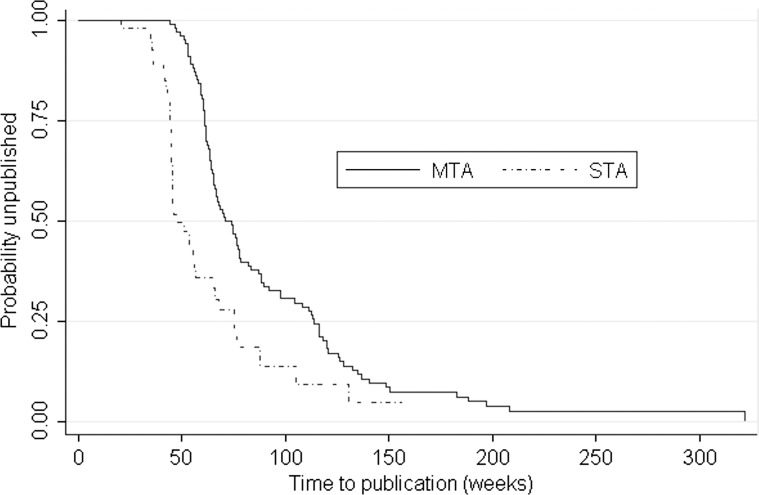
Single Technology Appraisals (STAs) were published significantly faster than Multiple Technology Appraisals (MTAs) with median durations of 48.0 (IQR; 44.3-75.4) and 74.0 (IQR; 60.9-114.0) weeks, respectively (p <0.0001). Median time to publication exceeded published process timelines, even after adjusting for appeals. Results from the modelling suggest that STAs published guidance significantly faster than MTAs after adjusting for other covariates (by 36.2 weeks (95% CI -46.05 to -26.42 weeks)) and that appeals against provisional guidance significantly increased the time to publication (by 42.83 weeks (95% CI 35.50 to 50.17 weeks)). There was no evidence that STAs of cancer-related technologies took longer to complete compared with STAs of other technologies after adjusting for potentially confounding variables and only weak evidence suggesting that the time to produce guidance is increasing each year (by 1.40 weeks (95% CI -0.35 to 2.94 weeks)).
The results from this study suggest that the STA process has resulted in significantly faster guidance compared with the MTA process irrespective of the topic, but that these gains are lost if appeals are made against provisional guidance. While NICE processes continue to evolve over time, a trade-off might be that decisions take longer but at present there is no evidence of a significant increase in duration.
评估英国国家卫生与临床优化研究所(NICE)技术评估计划产生指导的时间,并确定指导时间的独立预测因素。
回顾性时间事件(生存)分析。
NICE 发布的技术评估指南。
除了 2001 年前提交和一些中止的评估外,所有在 2010 年 2 月前提交给 NICE 的评估都被包括在内。
从评估开始(发布范围文件时)到发布指南的持续时间。
单一技术评估(STA)的发布速度明显快于多技术评估(MTA),中位持续时间分别为 48.0(IQR;44.3-75.4)和 74.0(IQR;60.9-114.0)周(p<0.0001)。即使在调整了上诉因素后,中位发布时间也超过了公布的处理时间线。模型结果表明,在调整了其他协变量后,STA 发布指南的速度明显快于 MTA(快 36.2 周(95%CI-46.05 至-26.42 周)),对临时指南的上诉显著增加了发布时间(增加 42.83 周(95%CI 35.50 至 50.17 周))。在调整了潜在混杂变量后,没有证据表明癌症相关技术的 STA 比其他技术的 STA 完成时间更长,只有微弱的证据表明,每年制作指导的时间都在增加(增加 1.40 周(95%CI-0.35 至 2.94 周))。
这项研究的结果表明,无论主题如何,STA 流程都导致了指导的显著加快,但如果对临时指导提出上诉,这些优势就会丧失。虽然 NICE 流程随着时间的推移继续发展,但权衡可能是决策需要更长的时间,但目前没有证据表明持续时间有显著增加。