Department of Anaesthesiology and Intensive Care Medicine, University Hospital Schleswig-Holstein, Kiel, Germany.
J Am Heart Assoc. 2012 Oct;1(5):e001313. doi: 10.1161/JAHA.112.001313. Epub 2012 Oct 25.
Recently, it has been demonstrated that rescuers could safely provide a low, static downward force in direct contact with patients during elective cardioversion. The purpose of our experimental study was to investigate whether shock delivery during uninterrupted chest compressions may have an impact on cardiopulmonary resuscitation (CPR) quality and can be safely performed in a realistic animal model of CPR.
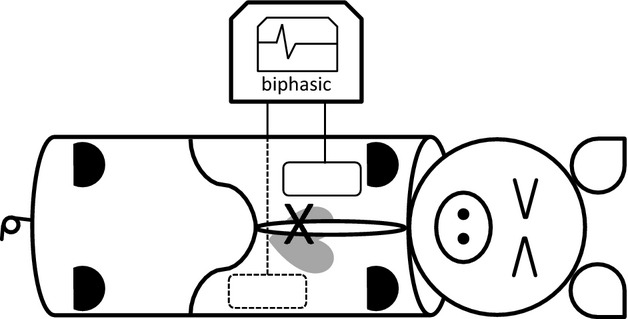
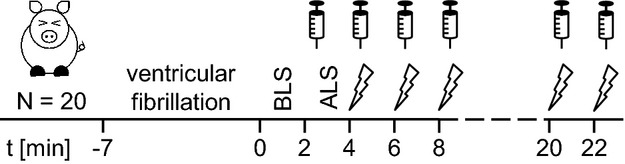
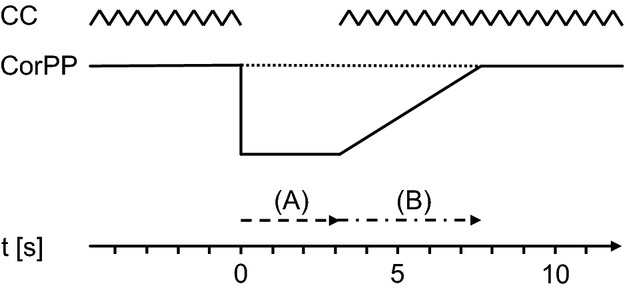
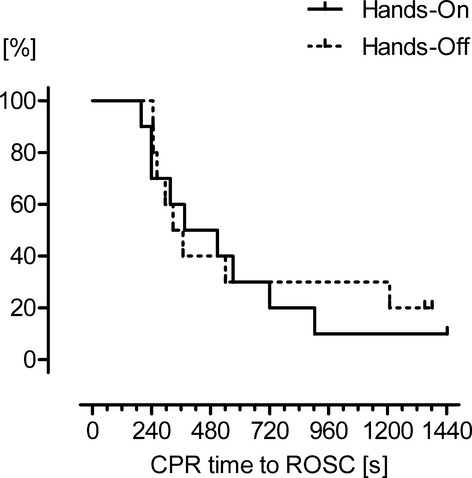
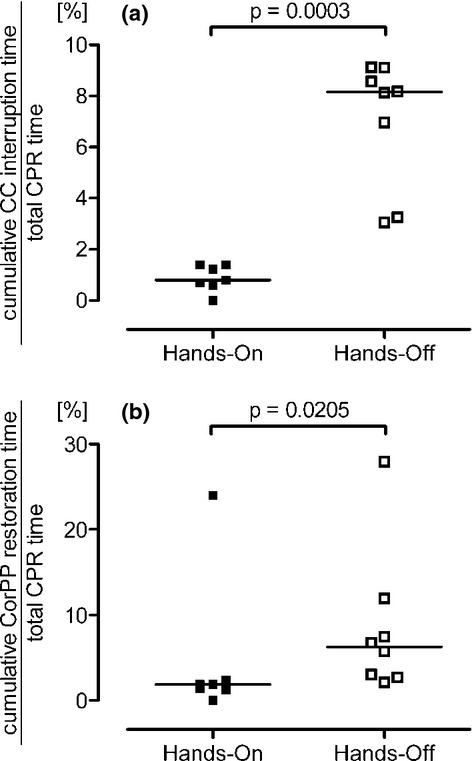
Twenty anesthetized swine were subjected to 7 minutes of ventricular fibrillation followed by CPR according to the 2010 American Heart Association Guidelines. Pregelled self-adhesive defibrillation electrodes were attached onto the torso in the ventrodorsal direction and connected to a biphasic defibrillator. Animals were randomized either to (1) hands-on defibrillation, where rescuers wore 2 pairs of polyethylene gloves and shocks were delivered during ongoing chest compressions, or (2) hands-off defibrillation, where hands were taken off during defibrillation. CPR was successful in 9 out of 10 animals in the hands-on group (versus 8 out of 10 animals in the hands-off group; not significant). In the hands-on group, chest compressions were interrupted for 0.8% [0.6%; 1.4%] of the total CPR time (versus 8.2% [4.2%; 9.0%]; P=0.0003), and coronary perfusion pressure was earlier restored to its pre-interruption level (P=0.0205). Also, rescuers neither sensed any kind of electric stimulus nor did Holter ECG reveal any serious cardiac arrhythmia.
Hands-on defibrillation may improve CPR quality and could be safely performed during uninterrupted chest compressions in our standardized porcine model.
最近有研究表明,在择期电复律期间,救援人员可以安全地与患者直接接触,提供低静态向下力。我们的实验研究目的是探讨在不间断胸外按压期间进行除颤是否会对心肺复苏(CPR)质量产生影响,并在现实的CPR 动物模型中安全进行。
20 只麻醉猪经历 7 分钟的心室颤动,然后按照 2010 年美国心脏协会指南进行 CPR。将预涂胶自粘除颤电极以腹背方向贴在胸上,并与双相除颤器相连。动物随机分为(1)手动除颤组,救援人员戴 2 副聚乙烯手套,在持续进行胸外按压时进行除颤,或(2)手离开除颤组,在除颤时手离开。手放在除颤器上的组中有 9/10(90%)的动物(而手离开除颤器的组中有 8/10(80%)的动物)的 CPR 成功(无统计学差异)。在手动除颤组中,胸外按压中断时间占总 CPR 时间的 0.8%[0.6%;1.4%](而手离开除颤器组为 8.2%[4.2%;9.0%];P=0.0003),并且冠状动脉灌注压更早恢复到中断前水平(P=0.0205)。此外,救援人员没有感觉到任何电刺激,动态心电图也没有发现任何严重的心律失常。
在我们的标准化猪模型中,手动除颤可以改善 CPR 质量,并可以在不间断的胸外按压期间安全进行。