Department of Radiology, Medical University Hospital SPSK-M, Katowice, Poland.
BMC Nephrol. 2013 Jan 14;14:10. doi: 10.1186/1471-2369-14-10.
Process of accelerated atherosclerosis specific for uremia increases cardiovascular risk in patients with chronic kidney disease (CKD) and may be influenced by the different structure of arteries. The study assesses the influence of traditional and novel risk factors on calcification of coronary arteries (CAC) and abdominal aorta (AAC) in hemodialysis patients (HD).
CAC and AAC were assessed by CT in 104 prevalent adult HD and 14 apparently healthy subjects with normal kidney function (control group). Mineral metabolism parameters, plasma levels of FGF-23, MGP, osteoprotegerin, osteopontin, fetuin-A, CRP, IL-6 and TNF-α were measured.
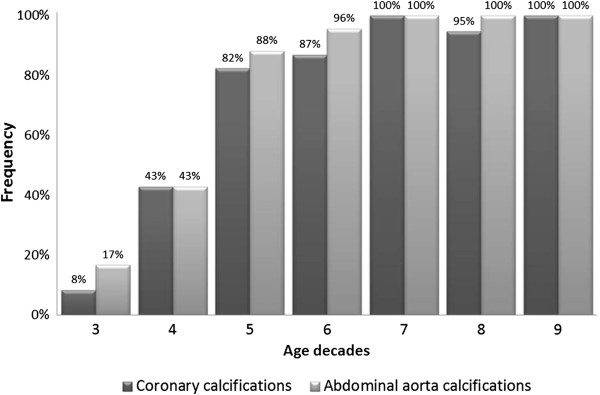
CAC and AAC (calcification score ≥ 1) were found in 76 (73.1%) and 83 (79.8%) HD respectively, more frequent than in the control group. In 7 HD with AAC no CAC were detected. The frequency and severity of calcifications increased with age. Both CAC and AAC were more frequently detected in diabetics (OR = 17.37 and 13.00, respectively). CAC score was significantly greater in males. CAC and AAC scores were correlated significantly with pack-years of smoking and plasma osteoprotegrin levels. However the independent contribution of plasma osteoprotegerin levels was not confirmed in multiple regression analysis. Age (OR = 1.13) and hemodialysis vintage (OR = 1.14) were the independent risk factor favoring the occurrence of CAC; while age (OR = 1.20) was the only predictor of AAC occurrence in HD.
尿毒症特有的动脉粥样硬化进程会增加慢性肾脏病(CKD)患者的心血管风险,并且可能受到动脉结构差异的影响。本研究评估了传统和新型危险因素对血液透析(HD)患者冠状动脉(CAC)和腹主动脉(AAC)钙化的影响。
通过 CT 评估 104 例成年 HD 患者和 14 例肾功能正常的健康对照者(对照组)的 CAC 和 AAC。测定矿物质代谢参数、成纤维细胞生长因子 23(FGF-23)、基质 Gla 蛋白(MGP)、骨保护素、骨桥蛋白、胎球蛋白 A、C 反应蛋白(CRP)、白细胞介素 6(IL-6)和肿瘤坏死因子-α(TNF-α)的血浆水平。
76 例(73.1%)和 83 例(79.8%)HD 患者分别发现 CAC 和 AAC(钙化评分≥1),高于对照组。7 例 AAC 无 CAC 的 HD 患者。钙化的频率和严重程度随年龄增加而增加。糖尿病患者 CAC 和 AAC 的发生率更高(OR=17.37 和 13.00)。男性 CAC 评分显著更高。CAC 和 AAC 评分与吸烟包年数和血浆骨保护素水平显著相关。然而,在多元回归分析中,血浆骨保护素水平的独立贡献并未得到证实。年龄(OR=1.13)和血液透析年限(OR=1.14)是 CAC 发生的独立危险因素;而年龄(OR=1.20)是 HD 患者 AAC 发生的唯一预测因素。