Division of Nephrology, Asia University Hospital, Taichung, Taiwan.
College of Medicine, China Medical University, Taichung, Taiwan.
BMC Nephrol. 2018 Nov 8;19(1):313. doi: 10.1186/s12882-018-1124-x.
Abdominal aortic calcification (AAC) has been known to be associated with cardiovascular mortality in hemodialysis. However, the association between AAC and future coronary artery disease (CAD) occurrence is not clear. We aimed to clarify the association of AAC severity and the occurrence of future CAD events in hemodialysis patients.
Hemodialysis (HD) patients were recruited in this prospective cohort study. AAC severity was quantified by AAC score, which was measured by lateral lumbar radiography. We used receiver operation curve (ROC) analysis to find the cutoff AAC value for CAD prediction. CAD-free survival was analyzed by Kaplan-Meier study.
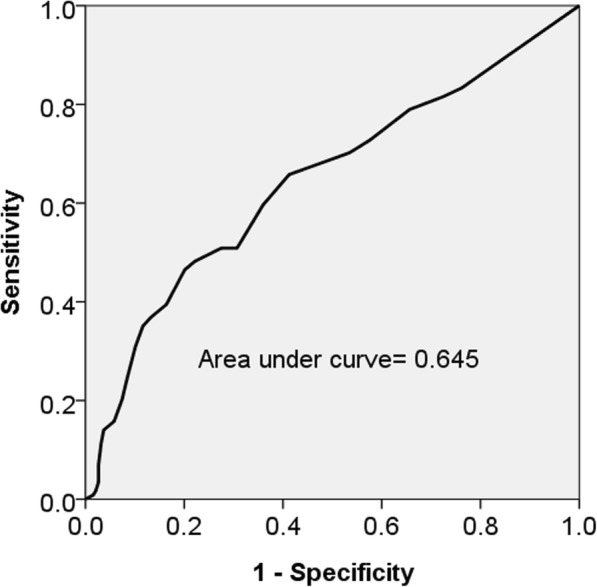
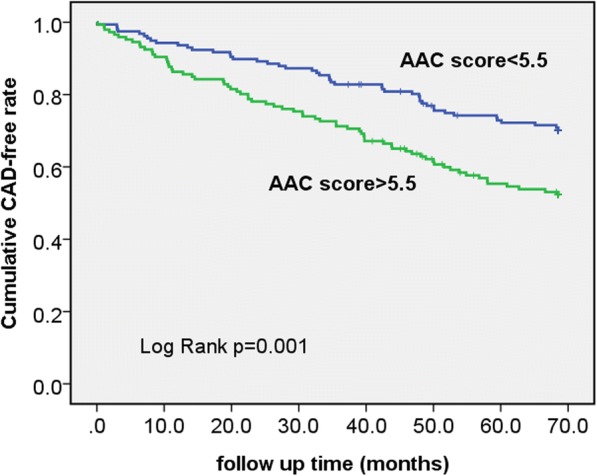
There were 303 patients recruited for study with a median (interquartile range) follow-up of 95 (65-146) months. The AAC score in patients with occurrence of new CAD [9 (3-15.25), n = 114] was higher than in patients without new CAD occurrence [5 (1-9) n = 189], p < 0.001. Multivariate hazard ratio of AAC score for CAD was 1.039 (p = 0.016). ROC study showed that an AAC score of 5.5 had a sensitivity of 0.658 and a specificity of 0.587 in the prediction of new CAD occurrence. Patients with AAC score above 5.5 had significantly higher cumulative incidence of CAD than patients with AAC score below 5.5. Age, diabetes, prior history of CAD, and longer dialysis vintage were major factors associated with higher AAC score.
AAC score can predict the occurrence of future CAD events in HD patients. The best cut-off value of AAC score is 5.5. AAC score greater than 5.5 is a reliable abdominal aortic calcification marker, and can predict future CAD in ESRD patients. Major contributive factors for higher AAC score were age, presence of diabetes, prior history of CAD, and longer dialysis vintage.
已知腹主动脉钙化(AAC)与血液透析患者的心血管死亡率相关。然而,AAC 与未来冠心病(CAD)发生之间的关系尚不清楚。我们旨在阐明血液透析患者 AAC 严重程度与未来 CAD 事件发生之间的关系。
本前瞻性队列研究纳入血液透析(HD)患者。AAC 严重程度通过侧位腰椎 X 线片测量的 AAC 评分来量化。我们使用接受者操作特征曲线(ROC)分析来确定用于 CAD 预测的 AAC 值的截断值。通过 Kaplan-Meier 研究分析 CAD 无事件生存率。
共有 303 例患者入组研究,中位(四分位间距)随访时间为 95(65-146)个月。发生新 CAD [9(3-15.25),n=114]的患者的 AAC 评分高于未发生新 CAD 事件[5(1-9),n=189],p<0.001。AAC 评分对 CAD 的多变量危险比为 1.039(p=0.016)。ROC 研究显示,AAC 评分 5.5 预测新 CAD 发生的灵敏度为 0.658,特异性为 0.587。AAC 评分高于 5.5 的患者 CAD 的累积发生率明显高于 AAC 评分低于 5.5 的患者。年龄、糖尿病、既往 CAD 病史和更长的透析龄是与更高 AAC 评分相关的主要因素。
AAC 评分可预测 HD 患者未来 CAD 事件的发生。AAC 评分的最佳截断值为 5.5。大于 5.5 的 AAC 评分是可靠的腹主动脉钙化标志物,可预测 ESRD 患者的未来 CAD。更高 AAC 评分的主要促成因素是年龄、糖尿病、既往 CAD 病史和更长的透析龄。