Department of Cell and Developmental Biology, Graduate School of Biostudies, Kyoto University, Kyoto, Japan.
Proc Jpn Acad Ser B Phys Biol Sci. 2013;89(1):59-65. doi: 10.2183/pjab.89.59.
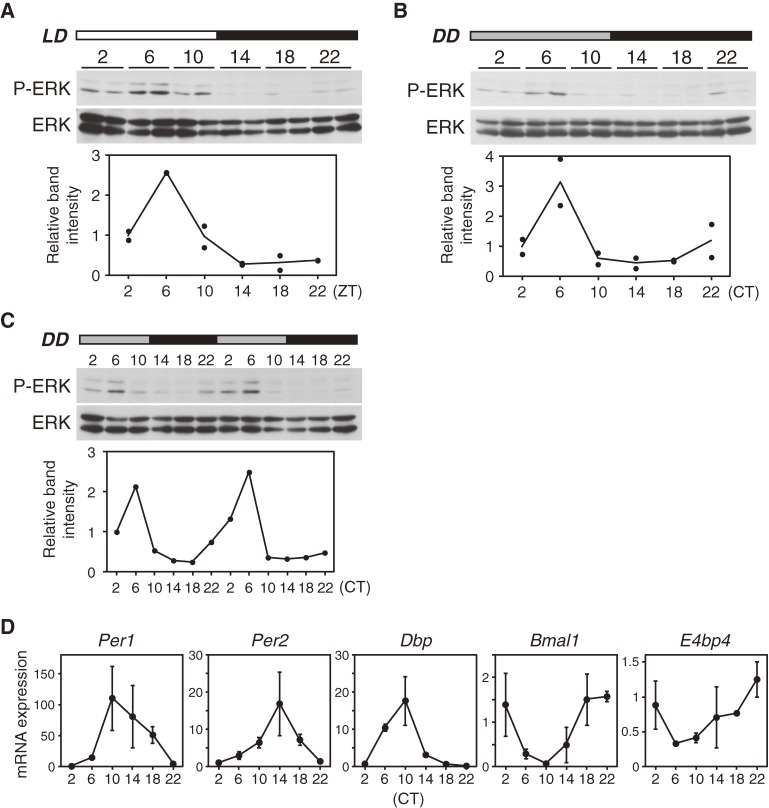
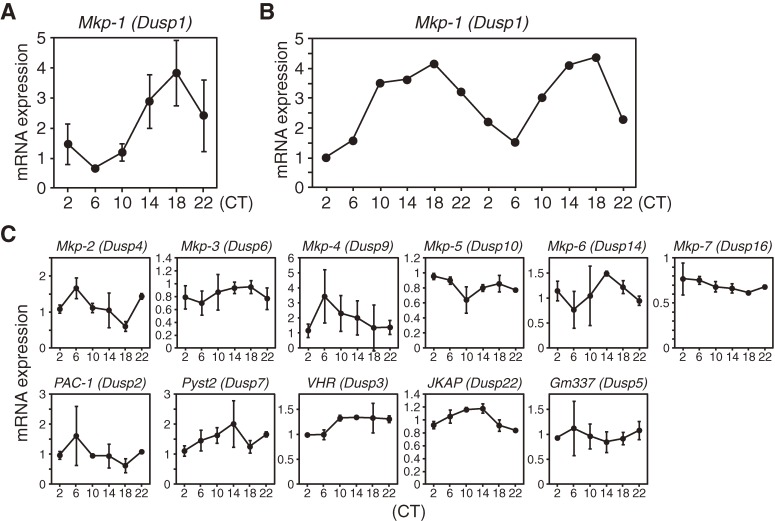
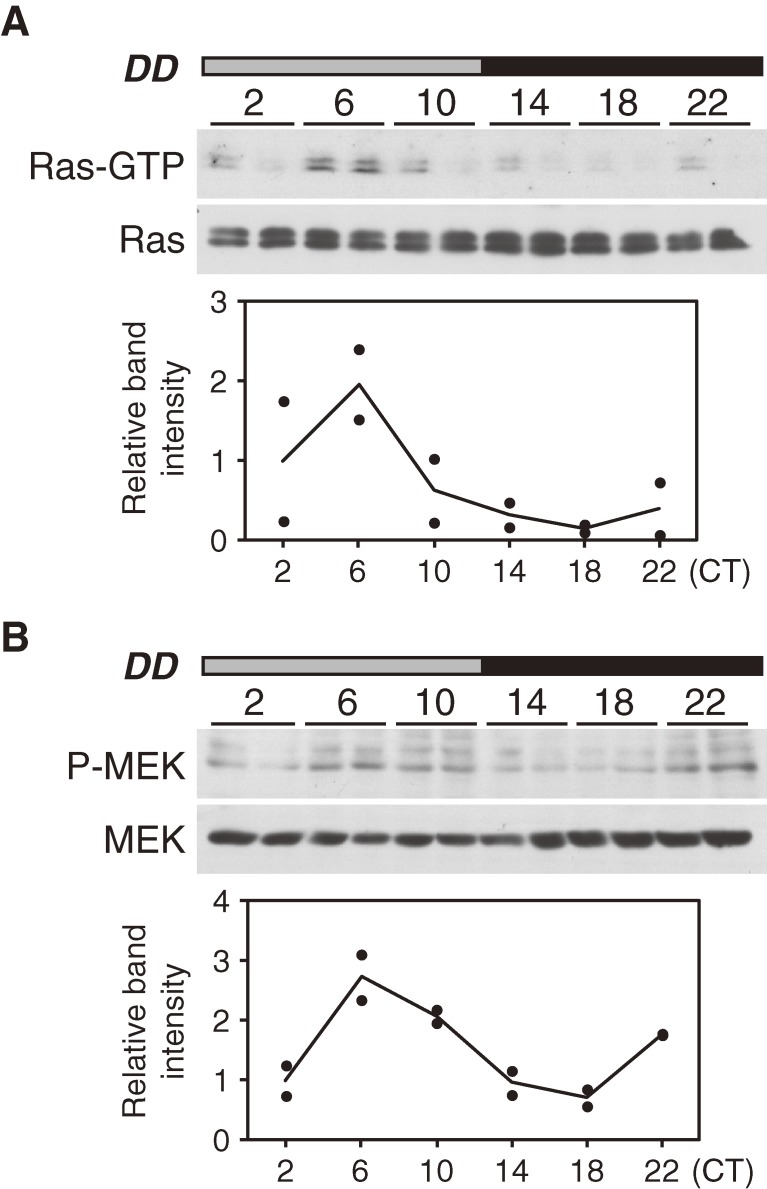
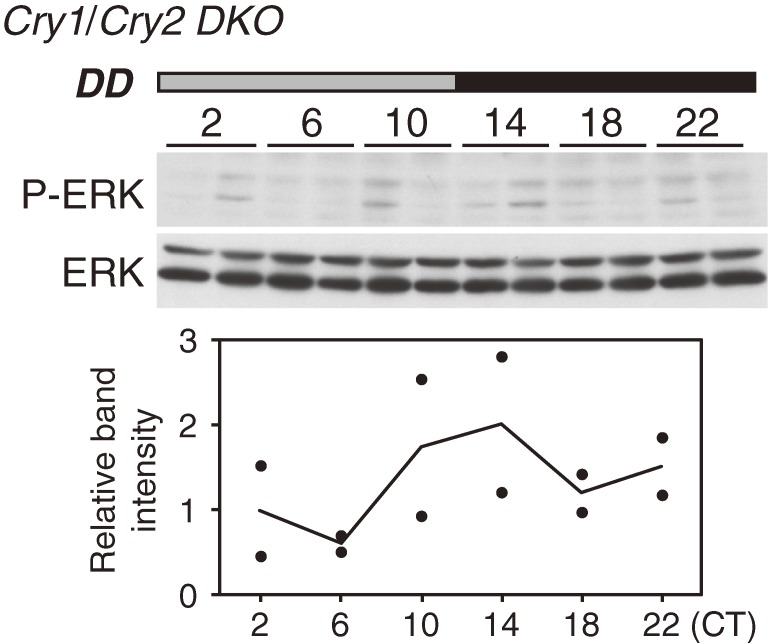
Accumulating evidence indicates that ERK MAP kinase signaling plays an important role in the regulation of the circadian clock, especially in the clock-resetting mechanism in the suprachiasmatic nucleus (SCN) in mammals. Previous studies have also shown that ERK phosphorylation exhibits diurnal variation in the SCN. However, little is known about circadian regulation of ERK signaling in peripheral tissues. Here we show that the activity of Ras/ERK signaling exhibits circadian rhythms in mouse liver. We demonstrate that Ras activation, MEK phosphorylation, and ERK phosphorylation oscillate in a circadian manner. As the oscillation of ERK phosphorylation is lost in Cry1/Cry2 double-knockout mice, Ras/ERK signaling should be under the control of the circadian clock. Furthermore, expression of MAP kinase phosphatase-1 (Mkp-1) shows diurnal changes in liver. These results indicate that Ras/ERK signaling is strictly regulated by the circadian clock in liver, and suggest that the circadian oscillation of the activities of Ras, MEK, and ERK may regulate diurnal variation of liver function and/or homeostasis.(Communicated by Shigekazu NAGATA, M.J.A.).
越来越多的证据表明 ERK MAP 激酶信号在生物钟的调节中起着重要作用,特别是在哺乳动物的视交叉上核 (SCN) 的时钟重置机制中。先前的研究还表明,ERK 磷酸化在 SCN 中表现出昼夜变化。然而,关于外周组织中 ERK 信号的昼夜调节知之甚少。在这里,我们显示 Ras/ERK 信号在小鼠肝脏中表现出昼夜节律。我们证明 Ras 激活、MEK 磷酸化和 ERK 磷酸化呈昼夜节律波动。由于 Cry1/Cry2 双敲除小鼠中 ERK 磷酸化的振荡消失,Ras/ERK 信号应该受到生物钟的控制。此外,MAP 激酶磷酸酶-1 (Mkp-1) 的表达在肝脏中呈现昼夜变化。这些结果表明 Ras/ERK 信号在肝脏中受到生物钟的严格调控,并表明 Ras、MEK 和 ERK 的活性昼夜波动可能调节肝脏功能和/或内稳态的昼夜变化。(由 Shigekazu NAGATA,M.J.A. 交流)。