Schizophrenia Research Institute, Sydney, Australia.
PLoS One. 2013;8(1):e52724. doi: 10.1371/journal.pone.0052724. Epub 2013 Jan 8.
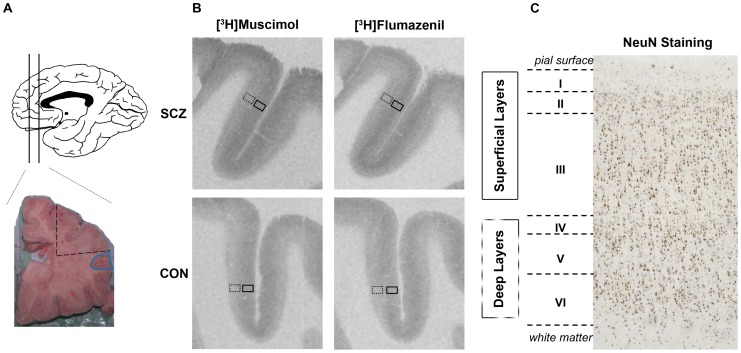
GABA(A) receptors (GABA(A)R) are composed of several subunits that determine sensitivity to drugs, synaptic localisation and function. Recent studies suggest that agonists targeting selective GABA(A)R subunits may have therapeutic value against the cognitive impairments observed in schizophrenia. In this study, we determined whether GABA(A)R binding deficits exist in the dorsolateral prefrontal cortex (DLPFC) of people with schizophrenia and tested if changes in GABA(A)R binding are related to the changes in subunit mRNAs. The GABA orthosteric and the benzodiazepine allosteric binding sites were assessed autoradiographically using [(3)H]Muscimol and [(3)H]Flumazenil, respectively, in a large cohort of individuals with schizophrenia (n = 37) and their matched controls (n = 37). We measured, using qPCR, mRNA of β (β1, β2, β3), γ (γ1, γ2, γ2S for short and γ2L for long isoform, γ3) and δ subunits and used our previous measurements of GABA(A)R α subunit mRNAs in order to relate mRNAs and binding through correlation and regression analysis.
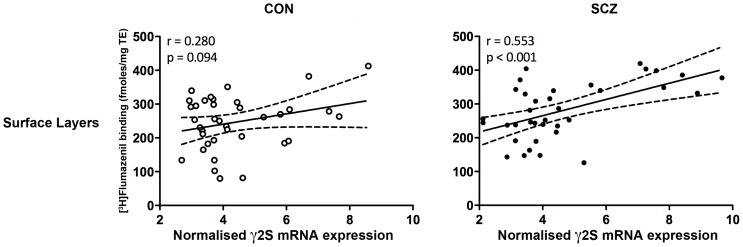
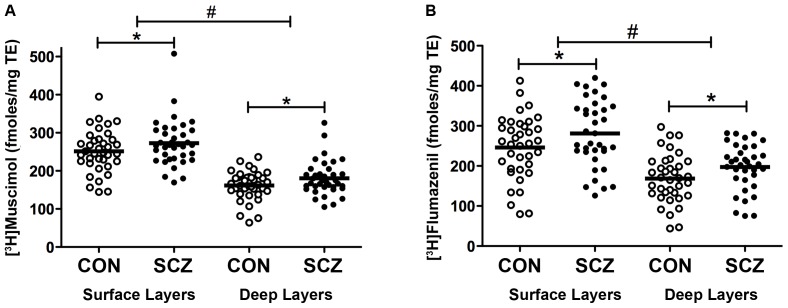
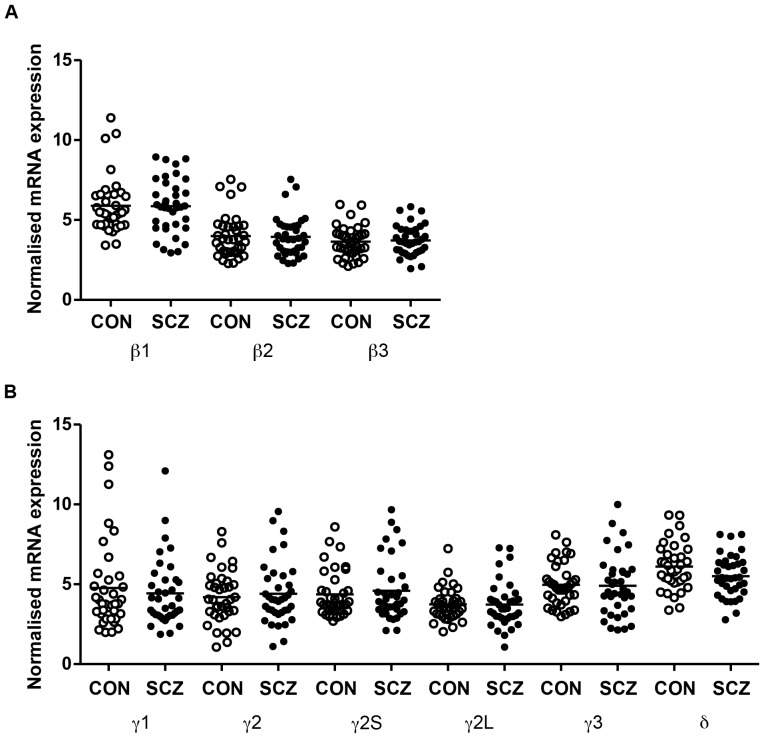
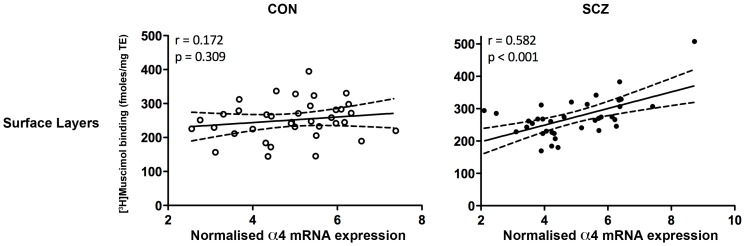
Significant increases in both [(3)H]Muscimol (p = 0.016) and [(3)H]Flumazenil (p = 0.012) binding were found in the DLPFC of schizophrenia patients. Expression levels of mRNA subunits measured did not show any significant difference in schizophrenia compared to controls. Regression analysis revealed that in schizophrenia, the [(3)H]Muscimol binding variance was most related to α4 mRNA levels and the [(3)H]Flumazenil binding variance was most related to γ2S subunit mRNA levels. [(3)H]Muscimol and [(3)H]Flumazenil binding were not affected by the lifetime anti-psychotics dose (chlorpromazine equivalent).
We report parallel increases in orthosteric and allosteric GABA(A)R binding sites in the DLPFC in schizophrenia that may be related to a "shift" in subunit composition towards α4 and γ2S respectively, which may compromise normal GABAergic modulation and function. Our results may have implications for the development of treatment strategies that target specific GABA(A)R receptor subunits.
γ-氨基丁酸 A 型受体(GABA(A)R)由几个亚基组成,这些亚基决定了对药物的敏感性、突触定位和功能。最近的研究表明,针对选择性 GABA(A)R 亚基的激动剂可能具有治疗精神分裂症认知障碍的价值。在这项研究中,我们确定了精神分裂症患者的背外侧前额叶皮层(DLPFC)是否存在 GABA(A)R 结合缺陷,并测试了 GABA(A)R 结合的变化是否与亚基 mRNA 的变化相关。使用 [(3)H]Muscimol 和 [(3)H]Flumazenil 分别通过放射自显影评估 GABA 本体和苯二氮䓬变构结合位点,在一个大的精神分裂症患者队列(n = 37)及其匹配的对照者(n = 37)中进行。我们使用 qPCR 测量了 β(β1、β2、β3)、γ(γ1、γ2、γ2S 短和 γ2L 长同工型、γ3)和 δ 亚基的 mRNA,并使用我们之前测量的 GABA(A)R α 亚基 mRNA 来通过相关和回归分析将 mRNA 和结合联系起来。
在精神分裂症患者的 DLPFC 中,[(3)H]Muscimol(p = 0.016)和 [(3)H]Flumazenil(p = 0.012)结合均显著增加。与对照组相比,在精神分裂症中,测量的 mRNA 亚基表达水平没有显示出任何显著差异。回归分析表明,在精神分裂症中,[(3)H]Muscimol 结合的方差与 α4 mRNA 水平最相关,而 [(3)H]Flumazenil 结合的方差与 γ2S 亚基 mRNA 水平最相关。[(3)H]Muscimol 和 [(3)H]Flumazenil 结合不受终生抗精神病药物剂量(氯丙嗪当量)的影响。
我们报告了精神分裂症患者 DLPFC 中本体和变构 GABA(A)R 结合位点的平行增加,这可能与亚基组成分别向 α4 和 γ2S“转移”有关,这可能会损害正常的 GABA 能调节和功能。我们的结果可能对开发针对特定 GABA(A)R 受体亚基的治疗策略具有重要意义。