Takenami Iukary, Finkmoore Brook, Machado Almério, Emodi Krisztina, Riley Lee W, Arruda Sérgio
Advanced Laboratory of Public Health, Oswaldo Cruz Foundation, Gonçalo Moniz Research Center, Salvador, Bahia 40296 710, Brazil.
Pulm Med. 2012;2012:757152. doi: 10.1155/2012/757152. Epub 2012 Dec 17.
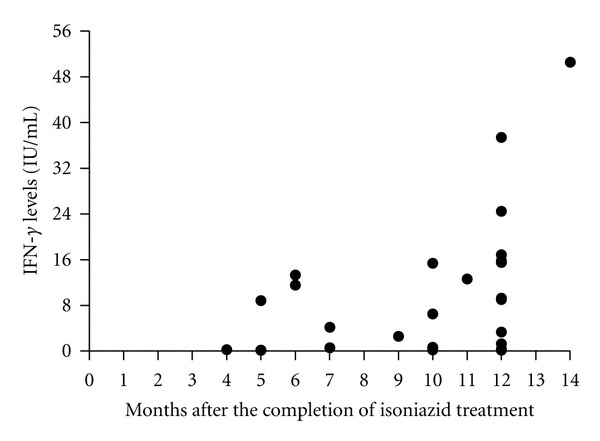
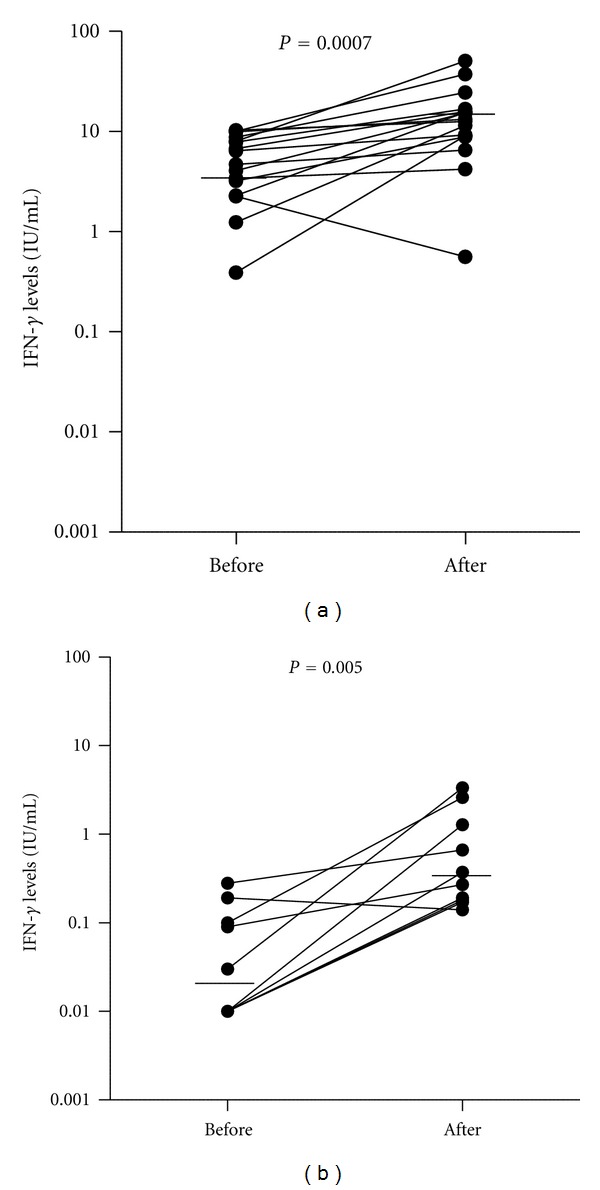
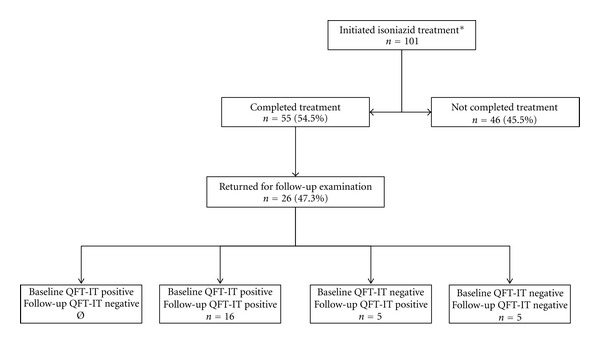
Objectives. We investigated IFN-γ levels before and after a six month course of isoniazid among individuals with latent tuberculosis infection (LTBI) in a high-transmission setting. Design. A total of 26 household contacts of pulmonary tuberculosis patients who were positive for LTBI by tuberculin skin test completed six months of treatment and submitted a blood sample for a follow-up examination. The IFN-γ response to Mycobacterium tuberculosis-specific antigens was measured, and the results before and after the completion of LTBI treatment were compared. Results. Of the 26 study participants, 25 (96%) showed an IFN-γ level higher than their baseline level before treatment (P ≤ 0.001). Only one individual had a decreased IFN-γ level after treatment but remained positive for LTBI. Conclusion. In a high-transmission setting, the IFN-γ level has increased after LTBI treatment. Further studies must be undertaken to understand if this elevation is transient.
目的。我们在高传播环境下,对潜伏性结核感染(LTBI)个体进行了为期六个月的异烟肼疗程前后的γ干扰素(IFN-γ)水平调查。设计。共有26名肺结核患者的家庭接触者,通过结核菌素皮肤试验确诊为LTBI阳性,他们完成了六个月的治疗,并提交血样进行随访检查。测量了对结核分枝杆菌特异性抗原的IFN-γ反应,并比较了LTBI治疗前后的结果。结果。26名研究参与者中,25名(96%)显示治疗前IFN-γ水平高于基线水平(P≤0.001)。只有一名个体治疗后IFN-γ水平下降,但仍为LTBI阳性。结论。在高传播环境下,LTBI治疗后IFN-γ水平有所升高。必须进一步开展研究,以了解这种升高是否是短暂的。