Faculty of Medical Technology, Niigata University of Health and Welfare, Niigata, Japan.
PLoS One. 2013;8(1):e53488. doi: 10.1371/journal.pone.0053488. Epub 2013 Jan 11.
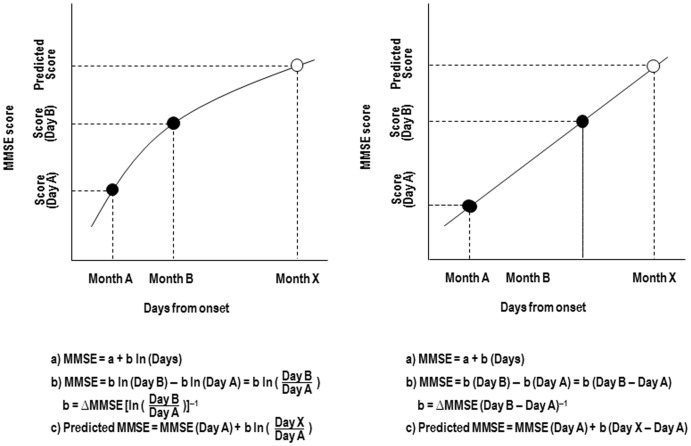
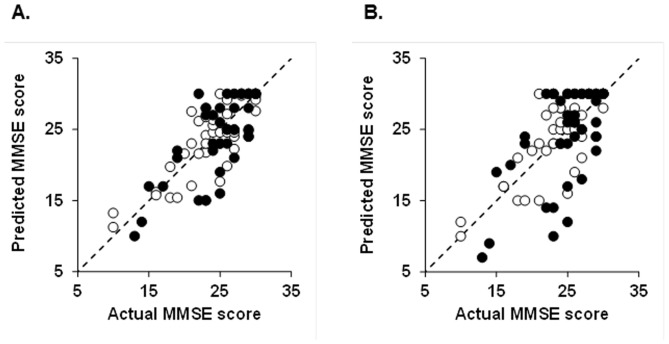
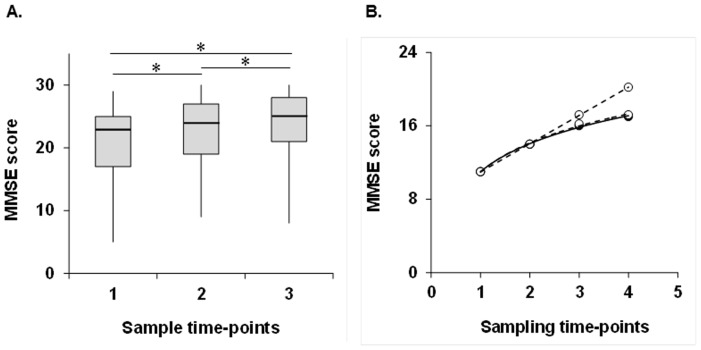
Cognitive disorders in the acute stage of stroke are common and are important independent predictors of adverse outcome in the long term. Despite the impact of cognitive disorders on both patients and their families, it is still difficult to predict the extent or duration of cognitive impairments. The objective of the present study was, therefore, to provide data on predicting the recovery of cognitive function soon after stroke by differential modeling with logarithmic and linear regression. This study included two rounds of data collection comprising 57 stroke patients enrolled in the first round for the purpose of identifying the time course of cognitive recovery in the early-phase group data, and 43 stroke patients in the second round for the purpose of ensuring that the correlation of the early-phase group data applied to the prediction of each individual's degree of cognitive recovery. In the first round, Mini-Mental State Examination (MMSE) scores were assessed 3 times during hospitalization, and the scores were regressed on the logarithm and linear of time. In the second round, calculations of MMSE scores were made for the first two scoring times after admission to tailor the structures of logarithmic and linear regression formulae to fit an individual's degree of functional recovery. The time course of early-phase recovery for cognitive functions resembled both logarithmic and linear functions. However, MMSE scores sampled at two baseline points based on logarithmic regression modeling could estimate prediction of cognitive recovery more accurately than could linear regression modeling (logarithmic modeling, R(2) = 0.676, P<0.0001; linear regression modeling, R(2) = 0.598, P<0.0001). Logarithmic modeling based on MMSE scores could accurately predict the recovery of cognitive function soon after the occurrence of stroke. This logarithmic modeling with mathematical procedures is simple enough to be adopted in daily clinical practice.
急性脑卒中患者常伴有认知障碍,且认知障碍是远期不良预后的独立预测因子。尽管认知障碍对患者及其家庭都有重要影响,但目前仍难以预测认知损害的程度或持续时间。因此,本研究旨在通过对数线性回归的差异建模,为脑卒中后认知功能恢复的预测提供数据。本研究分两轮进行数据采集,共纳入 57 例脑卒中患者,第一轮旨在确定早期认知恢复的时间过程(早期组数据),第二轮纳入 43 例脑卒中患者,旨在确保早期组数据的相关性适用于预测每个患者的认知恢复程度。第一轮中,在住院期间 3 次评估简易精神状态检查(MMSE)评分,并对时间的对数和线性进行回归。第二轮中,在入院后的前两次评分时计算 MMSE 评分,对数线性回归公式的结构以适应个体的功能恢复程度。认知功能早期恢复的时间过程类似于对数和线性函数。然而,基于对数回归建模的两个基线点的 MMSE 评分采样能够比线性回归建模更准确地预测认知恢复(对数建模,R(2) = 0.676,P<0.0001;线性回归建模,R(2) = 0.598,P<0.0001)。基于 MMSE 评分的对数建模可以准确预测脑卒中后认知功能的恢复。这种基于数学程序的对数建模足够简单,可以在日常临床实践中采用。