Elgh Eva, Hu Xiaolei
Department of Psychology, Umeå University, Umeå, Sweden.
Department of Community Medicine and Rehabilitation, Umeå University, Umeå, Sweden.
Front Neurol. 2019 Feb 12;10:97. doi: 10.3389/fneur.2019.00097. eCollection 2019.
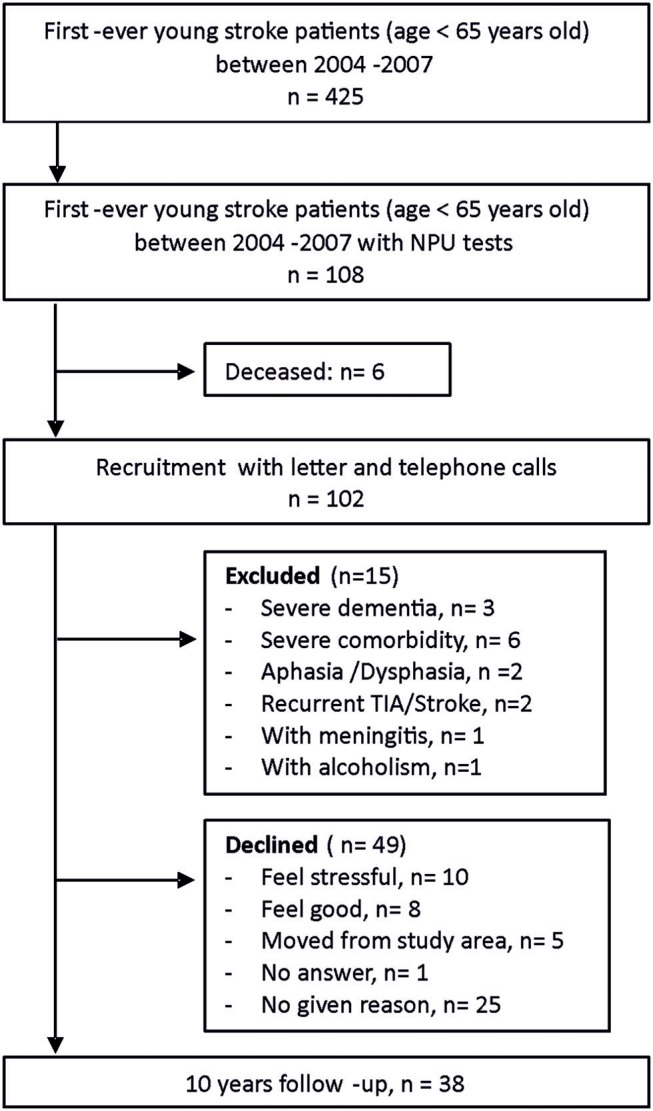
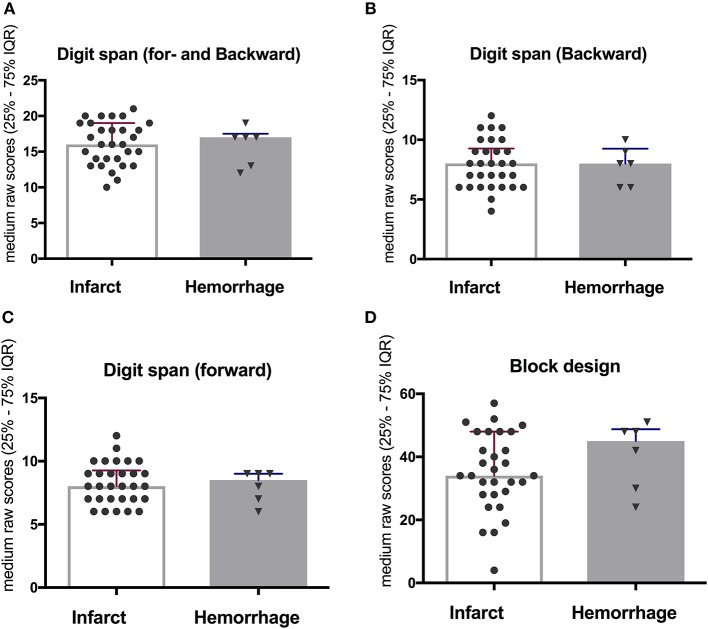
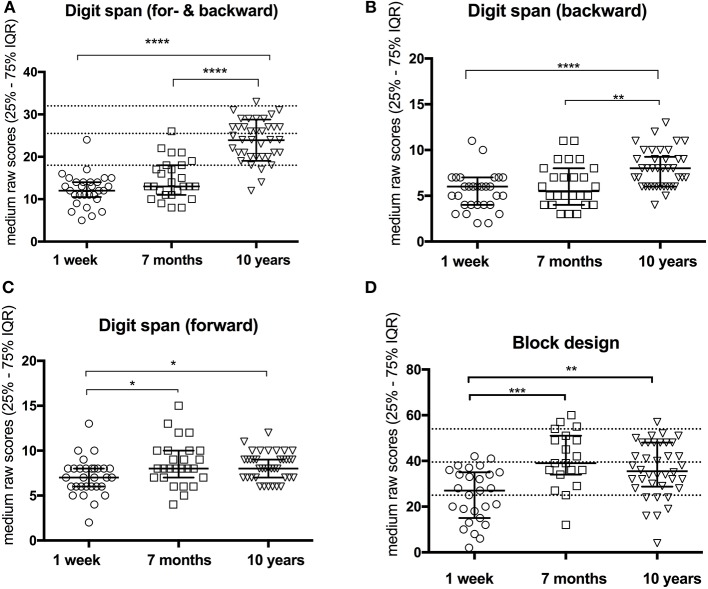
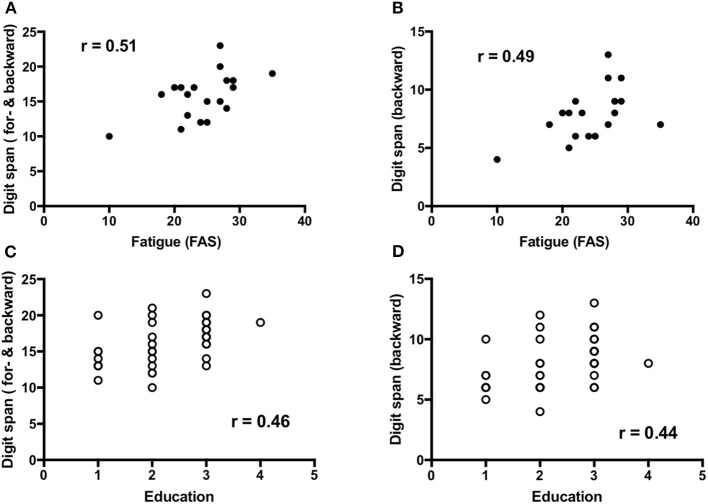
The trajectories of long-term and domain-specific cognitive alterations over a decade after stroke are largely unknown. This study aims to investigate the dynamic alterations of domain-specific cognitive performance among young stroke survivors over 10 years after their first stroke. A prospective cohort study was carried out on 38 young stroke survivors (aged 18-65 at stroke onset) living in the community at 10 years after their first stroke. The cognitive outcomes were assessed repeatedly at 1 week, 7 months, and 10 years after their first stroke on the sub-domains: process speed , visual attention , visuospatial function , executive function (), verbal function , working memory (), immediate memory (), and delayed memory (). Global cognition was evaluated with Mini mental state examination at the two later time-points. We found a delayed significant improvement of working memory with total recovery 10 years after participants' stroke. Visuospatial function recovered already at 7 months and remained stable at 10-year follow-up. Process speed demonstrated a significant decrease at 10 years compared to 7 months after stroke onset, a decrease which could be compensated by enhancements of other cognitive domains. No further deterioration was found in verbal function, immediate-, and delayed memory, and executive function during 10-year follow-up. Global cognition improved by on average two points between 7 months and 10 years. Education level and fatigue showed low to moderate positive correlations with cognitive improvements. The concordance of cognitive improvements between domain-specific and global cognitions strongly suggest that some young stroke survivors do improve their cognitive outcome over a 10-year period following their first stroke. This finding fills a gap of knowledge with respect to the dynamic trajectory of post-stroke cognition, with important implications in clinical practice.
中风后十年长期和特定领域认知改变的轨迹在很大程度上尚不清楚。本研究旨在调查年轻中风幸存者首次中风后10年期间特定领域认知表现的动态变化。对38名首次中风后10年居住在社区的年轻中风幸存者(中风发作时年龄为18 - 65岁)进行了一项前瞻性队列研究。在首次中风后的1周、7个月和10年,对认知结果在以下子领域进行反复评估:处理速度、视觉注意力、视觉空间功能、执行功能、语言功能、工作记忆、即时记忆和延迟记忆。在两个较晚的时间点用简易精神状态检查表评估整体认知。我们发现参与者中风10年后工作记忆有延迟的显著改善且完全恢复。视觉空间功能在7个月时已恢复,并在10年随访中保持稳定。与中风发作后7个月相比,处理速度在10年时显著下降,这种下降可通过其他认知领域的增强得到补偿。在10年随访期间,语言功能、即时和延迟记忆以及执行功能未发现进一步恶化。整体认知在7个月至10年之间平均提高了2分。教育水平和疲劳与认知改善呈低至中度正相关。特定领域认知和整体认知之间认知改善的一致性强烈表明,一些年轻中风幸存者在首次中风后的10年期间确实改善了他们的认知结果。这一发现填补了中风后认知动态轨迹方面的知识空白,对临床实践具有重要意义。