Howard Hughes Medical Institute, Department of Molecular Biology and Genetics, Johns Hopkins University School of Medicine, Baltimore, Maryland 21205.
Howard Hughes Medical Institute, Department of Molecular Biology and Genetics, Johns Hopkins University School of Medicine, Baltimore, Maryland 21205.
J Biol Chem. 2013 Mar 15;288(11):7829-7840. doi: 10.1074/jbc.M112.441030. Epub 2013 Jan 17.
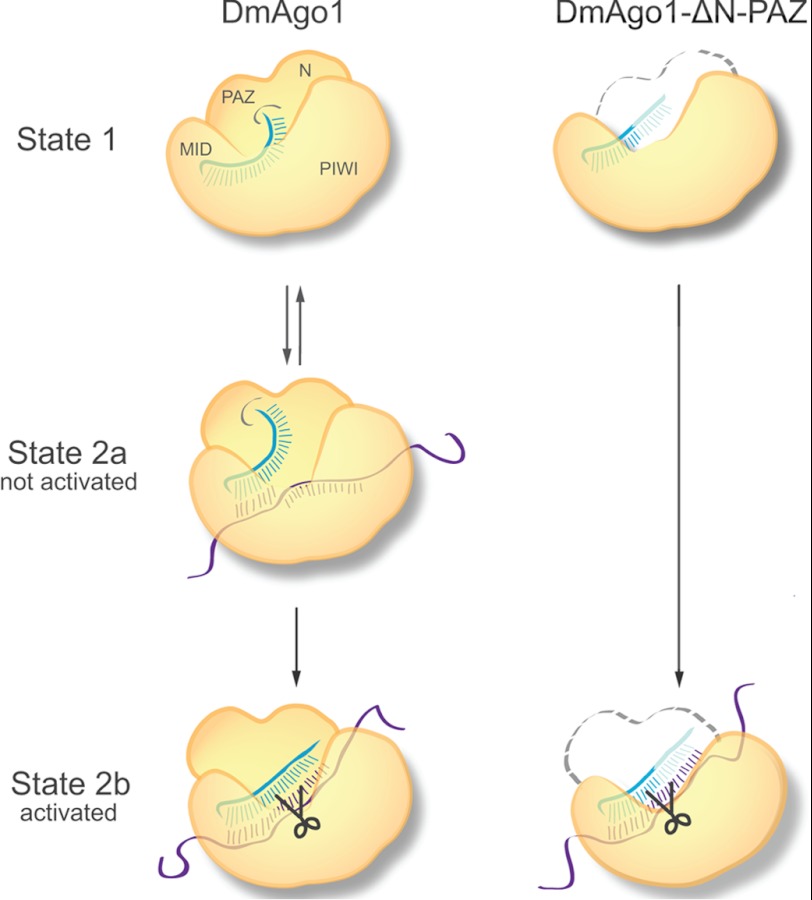
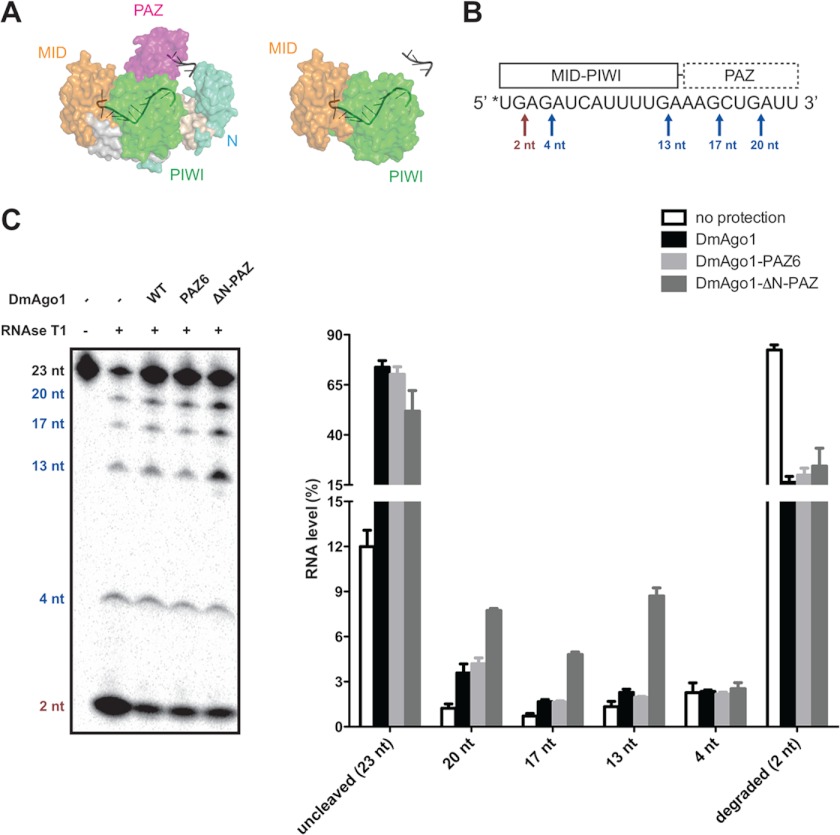
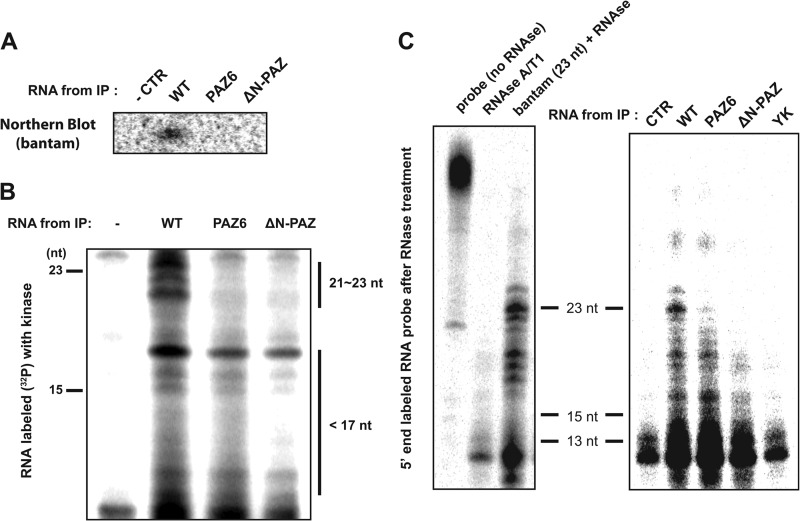
Structural studies indicate that binding of both the guide RNA (siRNA and miRNA) and the target mRNA trigger substantial conformational changes in the Argonaute proteins. Here we explore the role of the N-terminal lobe (and its PAZ domain) in these conformational changes using biochemical and cell culture-based approaches. In vitro, whereas deletion (or mutation) of the N-terminal lobe of DmAgo1 and DmAgo2 had no effect on binding affinity to guide RNAs, we observed a loss of protection of the 3' end of the guide RNA and decreased target RNA binding; consistent with this, in cells, loss of function DmAgo1 PAZ variant proteins (PAZ6 and ΔN-PAZ) still bind RNA, although the RNAs are shorter than normal. We also find that deletion of the N-terminal lobe results in constitutive activation of endogenous PIWI domain-based cleavage activity in vitro, providing insights into how cleavage activity may be regulated in vivo in response to different types of pairing interactions with the target mRNAs.
结构研究表明,向导 RNA(siRNA 和 miRNA)和靶 mRNA 的结合都会引发 Argonaute 蛋白的构象发生显著变化。在这里,我们使用生化和基于细胞培养的方法来探索 N 端结构域(及其 PAZ 结构域)在这些构象变化中的作用。在体外,虽然 DmAgo1 和 DmAgo2 的 N 端结构域缺失(或突变)对向导 RNA 的结合亲和力没有影响,但我们观察到向导 RNA 的 3' 端保护丧失和靶 RNA 结合减少;与之一致的是,在细胞中,功能丧失的 DmAgo1 PAZ 变异蛋白(PAZ6 和 ΔN-PAZ)仍然可以结合 RNA,尽管 RNA 比正常的短。我们还发现,N 端结构域的缺失会导致内源性 PIWI 结构域的切割活性在体外持续激活,这为我们提供了一些见解,即切割活性如何在体内响应与靶 mRNA 的不同类型配对相互作用而受到调节。