Son Ji-Young, Lee Jong-Tae, Anderson G Brooke, Bell Michelle L
School of Forestry and Environmental Studies, Yale University, CT, USA.
Environ Res Lett. 2011 Sep 7;6(3). doi: 10.1088/1748-9326/6/3/034027.
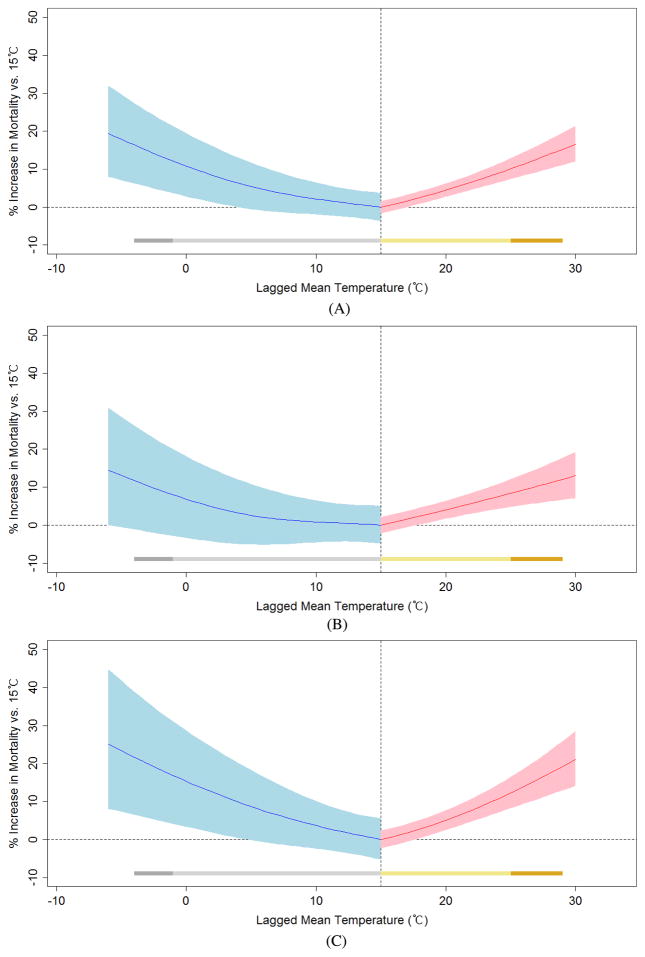
Studies indicate that the mortality effects of temperature may vary by population and region, although little is known about the vulnerability of subgroups to these risks in Korea. This study examined the relationship between temperature and cause-specific mortality for Seoul, Korea, for the period 2000-7, including whether some subgroups are particularly vulnerable with respect to sex, age, education and place of death. The authors applied time-series models allowing nonlinear relationships for heat- and cold-related mortality, and generated exposure-response curves. Both high and low ambient temperatures were associated with increased risk for daily mortality. Mortality risk was 10.2% (95% confidence interval 7.43, 13.0%) higher at the 90th percentile of daily mean temperatures (25 °C) compared to the 50th percentile (15 °C). Mortality risk was 12.2% (3.69, 21.3%) comparing the 10th (-1 °C) and 50th percentiles of temperature. Cardiovascular deaths showed a higher risk to cold, whereas respiratory deaths showed a higher risk to heat effect, although the differences were not statistically significant. Susceptible populations were identified such as females, the elderly, those with no education, and deaths occurring outside of a hospital for heat- and cold-related total mortality. Our findings provide supportive evidence of a temperature-mortality relationship in Korea and indicate that some subpopulations are particularly vulnerable.
研究表明,温度对死亡率的影响可能因人群和地区而异,尽管在韩国对于亚组人群面对这些风险的脆弱性知之甚少。本研究调查了2000年至2007年期间韩国首尔温度与特定病因死亡率之间的关系,包括某些亚组人群在性别、年龄、教育程度和死亡地点方面是否特别脆弱。作者应用了时间序列模型来分析与热相关和与冷相关的死亡率的非线性关系,并生成了暴露-反应曲线。环境温度过高和过低均与每日死亡率风险增加相关。与第50百分位数(15°C)相比,在每日平均温度的第90百分位数(25°C)时,死亡率风险高出10.2%(95%置信区间7.43,13.0%)。比较温度的第10百分位数(-1°C)和第50百分位数时,死亡率风险为12.2%(3.69,21.3%)。心血管疾病死亡对寒冷的风险更高,而呼吸系统疾病死亡对热效应的风险更高,尽管差异无统计学意义。已确定了易感人群,如女性、老年人、未受过教育者,以及因与热和冷相关的总死亡率而在医院外发生的死亡。我们的研究结果为韩国温度与死亡率之间的关系提供了支持性证据,并表明一些亚人群特别脆弱。