Joice Paul, Ross Peter D, Wang Dong, Abel Eric W, White Paul S
Department of Ear, Nose, and Throat, National Health Service Tayside, Ninewells Hospital, Dundee, United Kingdom, and.
Allergy Rhinol (Providence). 2012 Fall;3(2):e61-5. doi: 10.2500/ar.2012.3.0032. Epub 2012 Dec 13.
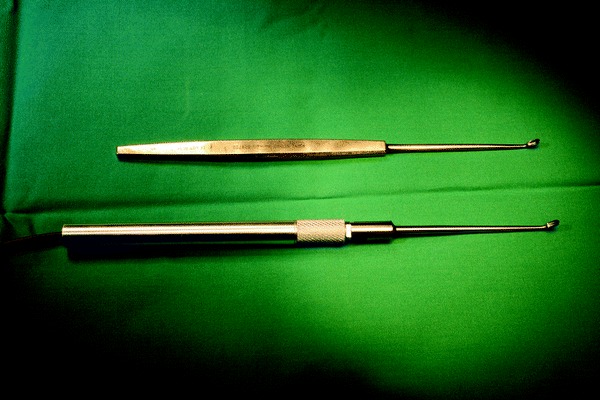
Greater understanding of the surgeon's task and skills are required to improve surgical technique and the effectiveness of training. Currently, neither the objective measurement of osteotomy forces during endoscopic sinus surgery (ESS) nor the validity of the properties of cadaver materials, are well documented. Measurement was performed of peak axial osteotomy force during ESS. A comparison was made of results with previously published cadaver data to validate the force properties of cadaver models. A prospective, consecutive cohort of 25 patients was compared with data from 15 cadaver heads. A modified Storz sinus curette measured osteotomy force from uncinate, bulla ethmoidalis, and ground lamella. Independent variables were osteotomy site, age, gender, indication for surgery, and side. Corresponding cadaver data were analyzed for the independent variables of osteotomy site, side, and gender and then compared with the live patient data. Mean osteotomy force in live patients was 9.6 N (95% CI, 8.9-10.4 N). Mean osteotomy force in the cadaver heads was 6.4 N (95% CI, 5.7-7.0 N). Ethmoid osteotomy of live patients required 3.2 N (95% CI, 2.1-4.3 N) more force than the cadaver heads (p = 0.0001). This relationship was statistically significant at the bulla ethmoidalis (p = 0.002) and the ground lamella (p = 0.0001) but not at the uncinate (p = 0.068). Osteotomy in female live subjects required 1.6 N (95% CI, 0.1-3.1 N) more force than male live subjects (p = 0.03). Cadaver tissue may underestimate the mean osteotomy force required in osteotomy of living ethmoid sinus lamellae by a factor of 1.5 times. Caution may be required in extrapolating force estimates from cadaver tissue to those required in living patients.
为了改进手术技术和提高培训效果,需要对外科医生的任务和技能有更深入的了解。目前,关于鼻内镜鼻窦手术(ESS)中截骨力的客观测量以及尸体材料特性的有效性,都缺乏充分的文献记载。本研究对ESS期间的轴向截骨峰值力进行了测量。将结果与先前发表的尸体数据进行比较,以验证尸体模型的力特性。对25例患者的前瞻性连续队列与15个尸体头部的数据进行了比较。使用改良的史托斯鼻窦刮匙测量来自钩突、筛泡和筛骨基板的截骨力。自变量为截骨部位、年龄、性别、手术指征和手术侧别。对尸体数据的截骨部位、手术侧别和性别的自变量进行分析,然后与活体患者数据进行比较。活体患者的平均截骨力为9.6 N(95%CI,8.9 - 10.4 N)。尸体头部的平均截骨力为6.4 N(95%CI,5.7 - 7.0 N)。活体患者的筛骨截骨所需力比尸体头部多3.2 N(95%CI,2.1 - 4.3 N)(p = 0.0001)。这种关系在筛泡(p = 0.002)和筛骨基板(p = 0.0001)处具有统计学意义,但在钩突处无统计学意义(p = 0.068)。女性活体受试者的截骨所需力比男性活体受试者多1.6 N(95%CI,0.1 - 3.1 N)(p = 0.03)。尸体组织可能会低估活体筛窦基板截骨所需的平均截骨力1.5倍。在将尸体组织的力估计值外推至活体患者所需值时可能需要谨慎。