Varshney Rickul, Frenkiel Saul, Nguyen Lily H P, Young Meredith, Del Maestro Rolando, Zeitouni Anthony, Saad Elias, Funnell W Robert J, Tewfik Marc A
Department of Otolaryngology, Head and Neck Surgery, McGill University, Montreal, Canada.
Royal Victoria Hospital, 687 Ave Des Pins O., Rm E4.41, Montreal, Quebec, H3A 1A1, Canada.
J Otolaryngol Head Neck Surg. 2014 Oct 24;43(1):40. doi: 10.1186/s40463-014-0040-8.
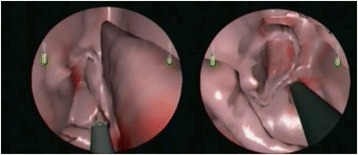
Endoscopic sinus surgery (ESS) is a technically challenging procedure, associated with a significant risk of complications. Virtual reality simulation has demonstrated benefit in many disciplines as an important educational tool for surgical training. Within the field of rhinology, there is a lack of ESS simulators with appropriate validity evidence supporting their integration into residency education. The objectives of this study are to evaluate the acceptability, perceived realism and benefit of the McGill Simulator for Endoscopic Sinus Surgery (MSESS) among medical students, otolaryngology residents and faculty, and to present evidence supporting its ability to differentiate users based on their level of training through the performance metrics.
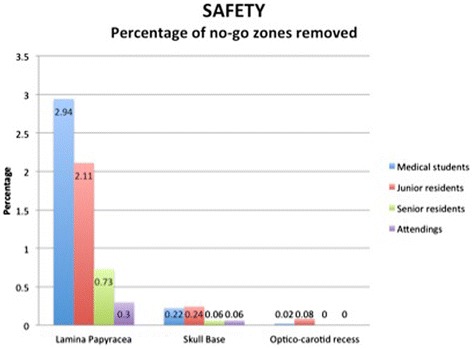
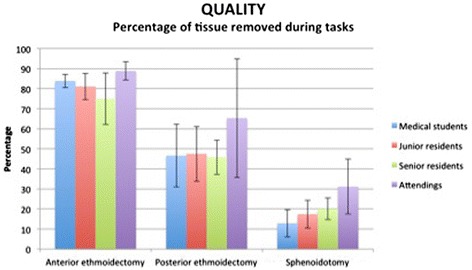
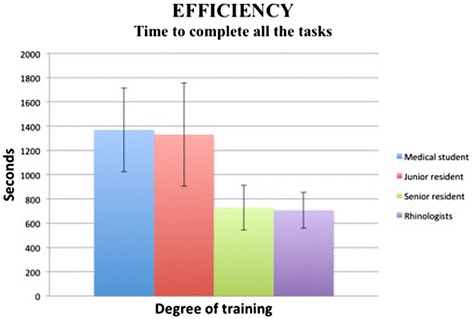
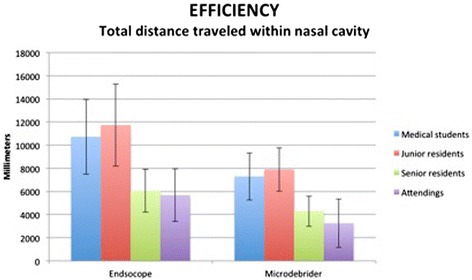
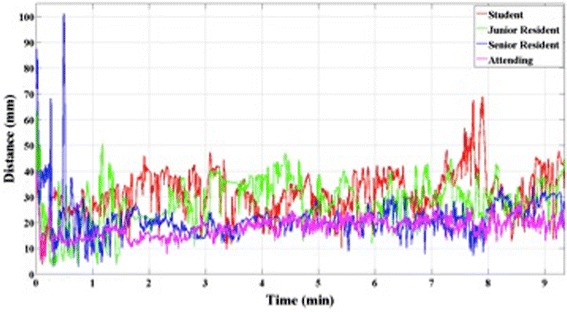
10 medical students, 10 junior residents, 10 senior residents and 3 expert sinus surgeons performed anterior ethmoidectomies, posterior ethmoidectomies and wide sphenoidotomies on the MSESS. Performance metrics related to quality (e.g. percentage of tissue removed), efficiency (e.g. time, path length, bimanual dexterity, etc.) and safety (e.g. contact with no-go zones, maximum applied force, etc.) were calculated. All users completed a post-simulation questionnaire related to realism, usefulness and perceived benefits of training on the MSESS.
The MSESS was found to be realistic and useful for training surgical skills with scores of 7.97 ± 0.29 and 8.57 ± 0.69, respectively on a 10-point rating scale. Most students and residents (29/30) believed that it should be incorporated into their curriculum. There were significant differences between novice surgeons (10 medical students and 10 junior residents) and senior surgeons (10 senior residents and 3 sinus surgeons) in performance metrics related to quality (p < 0.05), efficiency (p < 0.01) and safety (p < 0.05).
The MSESS demonstrated initial evidence supporting its use for residency education. This simulator may be a potential resource to help fill the void in endoscopic sinus surgery training.
鼻内镜鼻窦手术(ESS)是一项技术要求较高的手术,伴有显著的并发症风险。虚拟现实模拟作为手术培训的重要教育工具,已在许多学科中显示出其益处。在鼻科学领域,缺乏具有适当有效性证据支持其纳入住院医师教育的ESS模拟器。本研究的目的是评估麦吉尔鼻窦内镜手术模拟器(MSESS)在医学生、耳鼻喉科住院医师和教员中的可接受性、逼真度和益处,并通过性能指标提供证据支持其根据用户培训水平区分用户的能力。
10名医学生、10名初级住院医师、10名高级住院医师和3名鼻窦外科专家在MSESS上进行了前筛窦切除术、后筛窦切除术和广泛的蝶窦切开术。计算了与质量(如切除组织的百分比)、效率(如时间、路径长度、双手灵活性等)和安全性(如与禁区接触、最大施加力等)相关的性能指标。所有用户完成了一份模拟后问卷,内容涉及MSESS训练的逼真度、有用性和感知益处。
发现MSESS在训练手术技能方面逼真且有用,在10分制评分量表上的得分分别为7.97±0.29和8.57±0.69。大多数学生和住院医师(29/30)认为应将其纳入课程。在与质量(p<0.05)、效率(p<0.01)和安全性(p<0.05)相关的性能指标方面,新手外科医生(10名医学生和10名初级住院医师)和资深外科医生(10名高级住院医师和3名鼻窦外科专家)之间存在显著差异。
MSESS显示出初步证据支持其用于住院医师教育。该模拟器可能是填补鼻内镜鼻窦手术培训空白的潜在资源。