London Centre for Paediatric Endocrinology and Metabolism, Great Ormond Street Hospital for Children NHS Trust, The Institute of Child Health, University College London, London, UK.
Eur J Endocrinol. 2013 Mar 15;168(4):557-64. doi: 10.1530/EJE-12-0673. Print 2013 Apr.
Congenital hyperinsulinism (CHI) is a clinically heterogeneous condition. Mutations in eight genes (ABCC8, KCNJ11, GLUD1, GCK, HADH, SLC16A1, HNF4A and HNF1A) are known to cause CHI.
To characterise the clinical and molecular aspects of a large cohort of patients with CHI.
Three hundred patients were recruited and clinical information was collected before genotyping. ABCC8 and KCNJ11 genes were analysed in all patients. Mutations in GLUD1, HADH, GCK and HNF4A genes were sought in patients with diazoxide-responsive CHI with hyperammonaemia (GLUD1), raised 3-hydroxybutyrylcarnitine and/or consanguinity (HADH), positive family history (GCK) or when CHI was diagnosed within the first week of life (HNF4A).
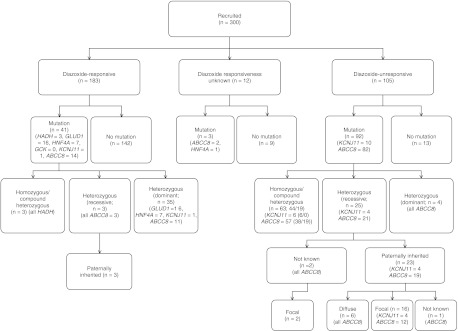
Mutations were identified in 136/300 patients (45.3%). Mutations in ABCC8/KCNJ11 were the commonest genetic cause identified (n=109, 36.3%). Among diazoxide-unresponsive patients (n=105), mutations in ABCC8/KCNJ11 were identified in 92 (87.6%) patients, of whom 63 patients had recessively inherited mutations while four patients had dominantly inherited mutations. A paternal mutation in the ABCC8/KCNJ11 genes was identified in 23 diazoxide-unresponsive patients, of whom six had diffuse disease. Among the diazoxide-responsive patients (n=183), mutations were identified in 41 patients (22.4%). These include mutations in ABCC8/KCNJ11 (n=15), HNF4A (n=7), GLUD1 (n=16) and HADH (n=3).
A genetic diagnosis was made for 45.3% of patients in this large series. Mutations in the ABCC8 gene were the commonest identifiable cause. The vast majority of patients with diazoxide-responsive CHI (77.6%) had no identifiable mutations, suggesting other genetic and/or environmental mechanisms.
先天性高胰岛素血症(CHI)是一种临床表现异质性的疾病。目前已知 8 个基因(ABCC8、KCNJ11、GLUD1、GCK、HADH、SLC16A1、HNF4A 和 HNF1A)的突变可导致 CHI。
对一大群 CHI 患者的临床和分子特征进行描述。
共招募了 300 名患者,并在基因分型前收集了临床信息。对所有患者均分析 ABCC8 和 KCNJ11 基因。在对具有氨血症反应性(GLUD1)、3-羟基丁酸酰基辅酶 A 升高和/或近亲结婚(HADH)、阳性家族史(GCK)或 CHI 于生后第一周内诊断(HNF4A)的患者,寻找 diazoxide 反应性 CHI 中 GLUD1、HADH、GCK 和 HNF4A 基因突变。
在 300 名患者中发现 136 名(45.3%)有突变。ABCC8/KCNJ11 基因突变是最常见的遗传病因(n=109,36.3%)。在 105 名 diazoxide 无反应性患者中,ABCC8/KCNJ11 基因突变在 92 名患者中被鉴定(87.6%),其中 63 名患者有隐性遗传突变,4 名患者有显性遗传突变。在 23 名 diazoxide 无反应性患者中鉴定出 ABCC8/KCNJ11 基因的父系突变,其中 6 名患者有弥漫性疾病。在 183 名 diazoxide 反应性患者中,发现 41 名(22.4%)有突变。这些突变包括 ABCC8/KCNJ11(n=15)、HNF4A(n=7)、GLUD1(n=16)和 HADH(n=3)。
在这个大型系列中,45.3%的患者做出了遗传诊断。ABCC8 基因突变是最常见的可识别病因。绝大多数 diazoxide 反应性 CHI(77.6%)患者无可识别的突变,提示存在其他遗传和/或环境机制。