Yokohira Masanao, Nakano Yuko, Hashimoto Nozomi, Yamakawa Keiko, Ninomiya Fumiko, Kishi Sosuke, Saoo Kousuke, Imaida Katsumi
Onco-Pathology, Department of Pathology and Host-Defense, Kagawa University, Kagawa 761-0793, Japan.
J Toxicol Pathol. 2012 Dec;25(4):257-63. doi: 10.1293/tox.25.257. Epub 2012 Dec 20.
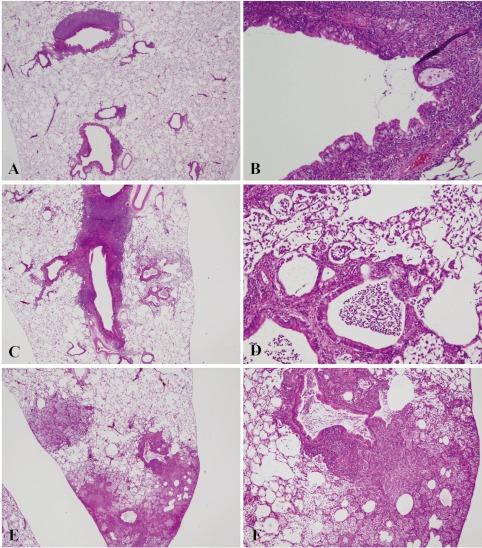
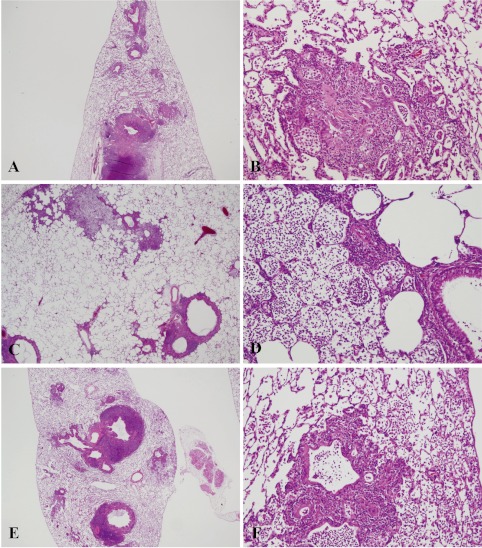
In vivo, nicotine in cigarette smoke induces various effects not only on the respiratory system but also the central and peripheral nerve systems, circulatory organs and digestive organs, and there is a possibility of promotion of lung tumorigenesis. The present experiment was conducted to examine histopathological changes caused by nicotine in the lung with repeated intratracheal instillation (i.t.). Six-week-old male F344 rats were administered nicotine by i.t. at doses of 0.05, 0.1 and 0.2 mg nicotine/rat every 3 weeks beginning at week 4, for up to a total of 9 times and were then sacrificed at week 30. The total number of administrations, total dose of nicotine and effective number of rats were 9 times, 0.45 mg and 5 rats and 4 times, 0.20 mg and 5 rats for the 0.05 mg nicotine/rat group; 3 times, 0.30 mg and 5 rats and 4 times, 0.40 mg and 3 rats for the 0.1 mg group; and 3 times, 0.60 mg and 3 rats for the 0.2 mg group, respectively. As a control group, 5 rats were administered 0.2 ml saline/rat 9 times. Some rats administered 0.1 and 0.2 mg nicotine suffered convulsions just after administration. Histopathologically, though proliferative changes were not observed, neutrophil infiltration, edema and fibrosis in the lung were induced by nicotine. In conclusion, repeated treatment of nicotine promoted neurologic symptoms in the acute phase, and strong inflammation in the lungs in the chronic phase, even at a low dose. Toxicity of nicotine is suggested to depend not on total dose of nicotine in the experiment but rather on repeated injury with consecutive administration.
在体内,香烟烟雾中的尼古丁不仅会对呼吸系统产生各种影响,还会影响中枢和外周神经系统、循环器官以及消化器官,并且有可能促进肺癌的发生。本实验通过反复气管内滴注(i.t.)来研究尼古丁对肺部造成的组织病理学变化。6周龄雄性F344大鼠从第4周开始,每3周接受一次气管内滴注尼古丁,剂量分别为0.05、0.1和0.2mg/只,总共滴注9次,然后在第30周处死。0.05mg/只尼古丁组的给药总次数、尼古丁总剂量和有效大鼠数量分别为9次、0.45mg和5只大鼠,以及4次、0.20mg和5只大鼠;0.1mg组分别为3次、0.30mg和5只大鼠,以及4次、0.40mg和3只大鼠;0.2mg组为3次、0.60mg和3只大鼠。作为对照组,5只大鼠每次接受0.2ml生理盐水,共给药9次。一些接受0.1mg和0.2mg尼古丁的大鼠在给药后立即出现惊厥。组织病理学检查发现,虽然未观察到增殖性变化,但尼古丁可诱导肺部中性粒细胞浸润、水肿和纤维化。总之,即使是低剂量的尼古丁,反复给药也会在急性期引发神经症状,在慢性期导致肺部强烈炎症。实验表明,尼古丁的毒性似乎不取决于尼古丁的总剂量,而是取决于连续给药造成的反复损伤。