Gynecologic Cancer Center, Department of Obstetrics and Gynecology, Cathay General Hospital and Department of Obstetrics and Gynecology, National Taiwan University Hospital, National Taiwan University College of Medicine, Taipei, Taiwan.
J Gynecol Oncol. 2013 Jan;24(1):14-20. doi: 10.3802/jgo.2013.24.1.14. Epub 2013 Jan 8.
To evaluate the clinical outcome and parameters related to coexisting endometrial carcinoma in women with tissue-diagnosed endometrial hyperplasia.
Between January 1991 and December 2009, three hundred and eighty-six patients with the presumptive diagnosis of endometrial hyperplasia were retrieved. Among these, one hundred and twenty-five patients were identified as having coexisting endometrial carcinoma in hysterectomy specimens. The three hundred and eighty-six patients were divided into two groups: the hyperplasia-benign group (261 cases) and the hyperplasia-malignant group (125 cases). Several clinical parameters including age, menopausal status, history of abnormal uterine bleeding, obstetrical history, medical history of diabetes and hypertension, BMI, and preoperative pathologic results were investigated.
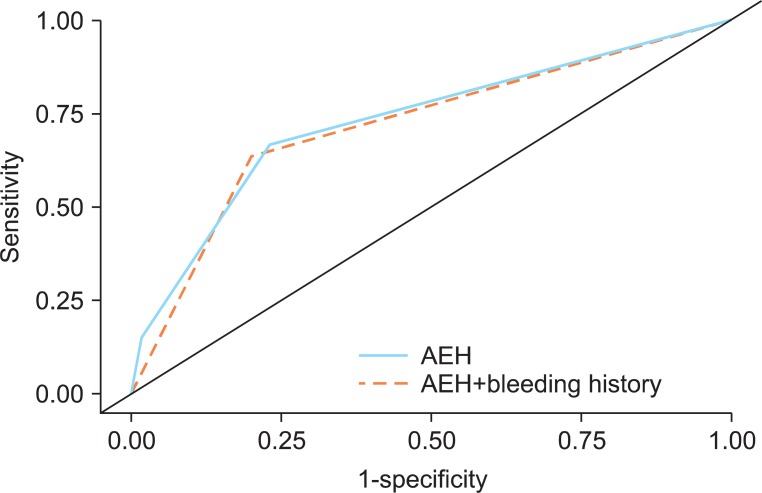
Age ≥53 (odds ratio [OR], 2.40; 95% confidence interval [CI], 1.26 to 4.57), menopausal status (OR, 2.07; 95% CI, 1.14 to 3.76), diabetes history (OR, 7.33; 95% CI, 2.79 to 19.26), abnormal uterine bleeding (OR, 3.99; 95% CI, 1.22 to 13.02), atypical endometrial hyperplasia (OR, 7.38; 95% CI, 4.03 to 13.49), and body mass index ≥27 (OR, 3.24; 95% CI, 1.76 to 5.97) were independent risk factors for prediction of endometrial hyperplasia coexisting with endometrial carcinoma. The diagnostic efficacy of atypical endometrial hyperplasia to predict the endometrial hyperplasia coexisting with endometrial carcinoma was better than or similar to those of other independent factors and combinations of these factors.
Coexisting malignancy should be considered when examining endometrial hyperplasia patients with the related risk factors, especially atypical endometrial hyperplasia.
评估组织学诊断为子宫内膜增生的女性中同时存在子宫内膜癌的临床结局和相关参数。
1991 年 1 月至 2009 年 12 月,共检索到 386 例疑似子宫内膜增生患者。其中,125 例在子宫切除标本中被诊断为同时存在子宫内膜癌。这 386 例患者被分为两组:增生良性组(261 例)和增生恶性组(125 例)。研究了包括年龄、绝经状态、异常子宫出血史、产科史、糖尿病和高血压病史、BMI 和术前病理结果在内的几个临床参数。
年龄≥53 岁(比值比 [OR],2.40;95%置信区间 [CI],1.26 至 4.57)、绝经状态(OR,2.07;95%CI,1.14 至 3.76)、糖尿病史(OR,7.33;95%CI,2.79 至 19.26)、异常子宫出血(OR,3.99;95%CI,1.22 至 13.02)、不典型子宫内膜增生(OR,7.38;95%CI,4.03 至 13.49)和 BMI≥27(OR,3.24;95%CI,1.76 至 5.97)是预测子宫内膜增生同时存在子宫内膜癌的独立危险因素。不典型子宫内膜增生预测子宫内膜增生同时存在子宫内膜癌的诊断效能优于或与其他独立因素及其组合相当。
检查有相关危险因素的子宫内膜增生患者时,应考虑同时存在恶性肿瘤,尤其是不典型子宫内膜增生。