Sansom Institute for Health Research, University of South Australia, Adelaide, Australia.
Int J Equity Health. 2013 Jan 24;12:11. doi: 10.1186/1475-9276-12-11.
Aboriginal and Torres Strait Islander women experience higher rates of obesity, chronic disease, and are less active than non-Indigenous Australian women. Lifestyle programs designed to increase physical activity and encourage healthy eating are needed to ameliorate this disparity. The aim of this study was to identify participants' perceived barriers and enablers to attend group exercise classes as part of a 12-week fitness program.
To understand the factors that influence attendance, a mixed method process evaluation was undertaken in which a quantitative measure of attendance in the group exercise classes was used to identify cases for further qualitative investigation. Aboriginal and/or Torres Strait Islander women aged 18 to 64 years were recruited to a research trial of a fitness program. The 12-week program included two 60-minute group exercise classes per week, and four nutrition education workshops. Semi-structured interviews were conducted at program completion. Participants were stratified by attendance, and interviews from the highest and lowest 25 percentiles analysed. Rigour was strengthened through use of multiple data analysts, member checking and prolonged engagement in the field.
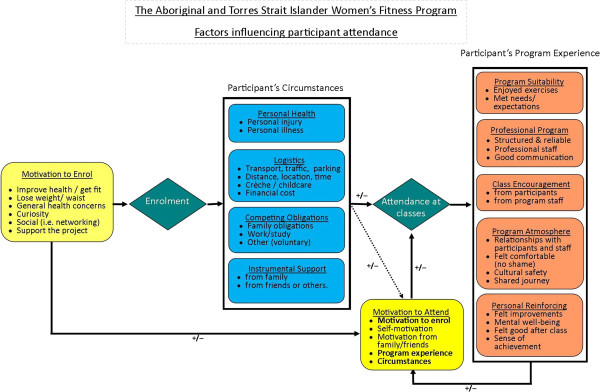
Analyses of the post-program interviews revealed that participants enrolled in the program primarily for the perceived health benefits and all (with one exception) found the program met their needs and expectations. The atmosphere of classes was positive and comfortable and they reported developing good relationships with their fellow participants and program staff. Low attendees described more barriers to attendance, such as illness and competing work and family obligations, and were more likely to report logistical issues, such as inconvenient venue or class times.
Attendance to the 'Aboriginal and Torres Strait Islander Women's Fitness Program' was primarily influenced by the participant's personal health, logistics and competing obligations. Low attendees reported more barriers during the 12-week period and identified fewer enabling factors than high attendees.
Australian New Zealand Clinical Trials Registry ACTRN12610000224022.
与非土著澳大利亚女性相比,原住民和托雷斯海峡岛民女性肥胖率更高、慢性病更多,且活动量较少。需要设计生活方式项目来增加身体活动量并鼓励健康饮食,以改善这一差距。本研究旨在确定参与者参加 12 周健身计划中团体运动课程的感知障碍和促进因素。
为了了解影响出勤率的因素,我们进行了混合方法的过程评估,该评估使用团体运动课程出勤率的定量测量来确定进一步进行定性调查的病例。我们招募了年龄在 18 至 64 岁之间的原住民和/或托雷斯海峡岛民女性参加健身计划的研究试验。为期 12 周的计划包括每周两次 60 分钟的团体运动课和四次营养教育研讨会。在计划完成时进行了半结构化访谈。根据出勤率对参与者进行分层,对最高和最低 25%的参与者进行访谈分析。通过使用多个数据分析员、成员检查和长期参与现场工作来加强严谨性。
对计划后访谈的分析表明,参与者主要是为了感知到的健康益处而参加该计划,所有人(除一人外)都认为该计划满足了他们的需求和期望。课程的氛围积极舒适,他们报告说与其他参与者和计划工作人员建立了良好的关系。出勤率低的参与者描述了更多的出勤障碍,例如疾病和竞争的工作和家庭义务,并且更有可能报告后勤问题,例如不方便的地点或上课时间。
参加“原住民和托雷斯海峡岛民女性健身计划”主要受到参与者个人健康、后勤和竞争义务的影响。出勤率低的参与者在 12 周期间报告了更多的障碍,并且报告的促进因素比高出勤率的参与者少。
澳大利亚和新西兰临床试验注册 ACTRN12610000224022。