Physiotherapy, Faculty of Health, University of Canberra, Bruce, ACT, 2617, Australia.
Health Research Institute, University of Canberra, Bruce, ACT, Australia.
BMC Cardiovasc Disord. 2021 May 1;21(1):222. doi: 10.1186/s12872-021-02016-3.
There is limited evidence of Aboriginal and Torres Strait Islander people attending cardiac rehabilitation (CR) programs despite high levels of heart disease. One key enabler for CR attendance is a culturally safe program. This study evaluates improving access for Aboriginal and Torres Strait Islander women to attend a CR program in a non-Indigenous health service, alongside improving health workforce cultural safety.
An 18-week mixed-methods feasibility study was conducted, with weekly flexible CR sessions delivered by a multidisciplinary team and an Aboriginal and/or Torres Strait Islander Health Worker (AHW) at a university health centre. Aboriginal and Torres Strait Islander women who were at risk of, or had experienced, a cardiac event were recruited. Data was collected from participants at baseline, and at every sixth-session attended, including measures of disease risk, quality-of-life, exercise capacity and anxiety and depression. Cultural awareness training was provided for health professionals before the program commenced. Assessment of health professionals' cultural awareness pre- and post-program was evaluated using a questionnaire (n = 18). Qualitative data from participants (n = 3), the AHW, health professionals (n = 4) and referrers (n = 4) was collected at the end of the program using yarning methodology and analysed thematically using Charmaz's constant comparative approach.
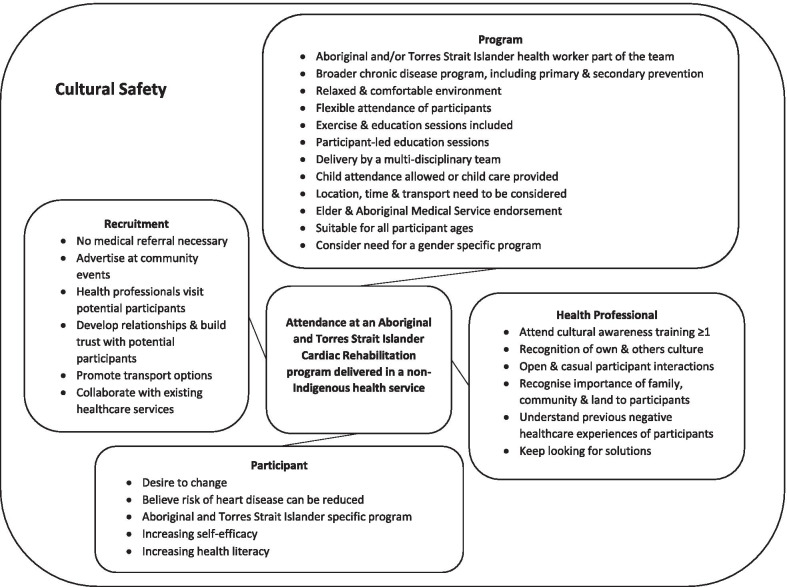
Eight referrals were received for the CR program and four Aboriginal women attended the program, aged from 24 to 68 years. Adherence to the weekly sessions ranged from 65 to 100%. At the program's conclusion, there was a significant change in health professionals' perception of social policies implemented to 'improve' Aboriginal people, and self-reported changes in health professionals' behaviours and skills. Themes were identified for recruitment, participants, health professionals and program delivery, with cultural safety enveloping all areas. Trust was a major theme for recruitment and adherence of participants. The AHW was a key enabler of cultural authenticity, and the flexibility of the program contributed greatly to participant perceptions of cultural safety. Barriers for attendance were not unique to this population.
The flexible CR program in a non-Indigenous service provided a culturally safe environment for Aboriginal women but referrals were low. Importantly, the combination of cultural awareness training and participation in the program delivery improved health professionals' confidence in working with Aboriginal people.
Australian New Zealand Clinical Trials Registry (ANZCTR) 12618000581268, http://www.ANZCTR.org.au/ACTRN12618000581268.aspx , registered 16 April 2018.
尽管心脏病发病率很高,但原住民和托雷斯海峡岛民参加心脏康复 (CR) 计划的证据有限。参加 CR 的一个关键促成因素是文化安全的项目。本研究评估了在非原住民卫生服务机构中为原住民和托雷斯海峡岛民妇女参加 CR 计划提供便利的措施,同时提高卫生工作者的文化安全性。
进行了一项为期 18 周的混合方法可行性研究,每周由多学科团队和一名原住民和/或托雷斯海峡岛民健康工作者 (AHW) 在大学健康中心提供灵活的 CR 课程。招募了有心脏病发作风险或经历过心脏病发作的原住民和托雷斯海峡岛民妇女。在基线和参加每六次课程时收集参与者的数据,包括疾病风险、生活质量、运动能力以及焦虑和抑郁的测量。在项目开始前为卫生专业人员提供了文化意识培训。使用问卷评估健康专业人员在项目前后的文化意识(n=18)。使用讲故事的方法在项目结束时收集参与者(n=3)、AHW(n=4)、卫生专业人员(n=4)和转诊者(n=4)的定性数据,并使用 Charmaz 的恒定性比较方法对其进行主题分析。
收到了 8 份 CR 计划转诊,4 名原住民妇女参加了该计划,年龄在 24 至 68 岁之间。每周课程的出勤率从 65%到 100%不等。在项目结束时,卫生专业人员对实施“改善”原住民的社会政策的看法发生了显著变化,并且自我报告的卫生专业人员行为和技能发生了变化。确定了招募、参与者、卫生专业人员和项目交付的主题,文化安全涵盖了所有领域。信任是招募和参与者坚持的一个主要主题。AHW 是文化真实性的主要推动者,并且该计划的灵活性极大地影响了参与者对文化安全的看法。参加的障碍并非该人群所特有。
非原住民服务中的灵活 CR 计划为原住民妇女提供了一个文化安全的环境,但转诊率较低。重要的是,文化意识培训和参与项目交付的结合提高了卫生专业人员与原住民合作的信心。
澳大利亚和新西兰临床试验注册中心 (ANZCTR) 12618000581268,http://www.ANZCTR.org.au/ACTRN12618000581268.aspx,于 2018 年 4 月 16 日注册。
