Department of Medicine, University of Washington, Seattle, WA, USA.
Sex Transm Infect. 2013 Aug;89(5):409-14. doi: 10.1136/sextrans-2012-050730. Epub 2013 Jan 24.
Teach HIV-negative men who have sex with men (MSM) symptoms of acute HIV infection (AHI) and direct them to nucleic acid amplification testing (NAAT) though Public Health--Seattle & King County (PHSKC).
Cross-sectional surveys, retrospective database analysis and chart review.
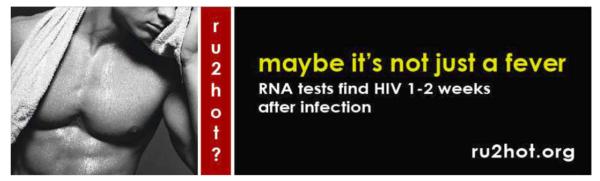
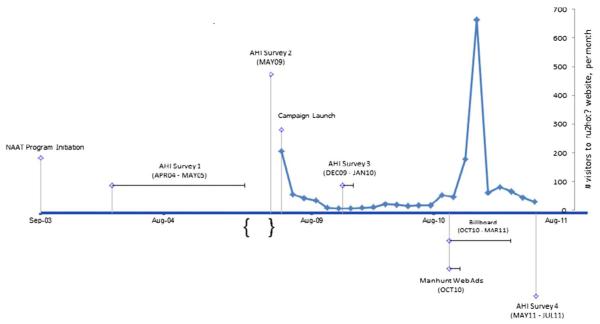
Beginning in June 2009, the ru2hot? campaign described AHI symptoms and NAAT. Two preintervention and two postintervention surveys assessed campaign visibility, symptom knowledge, and healthcare-seeking behaviour. Regression analyses evaluated secular trends in case-finding.
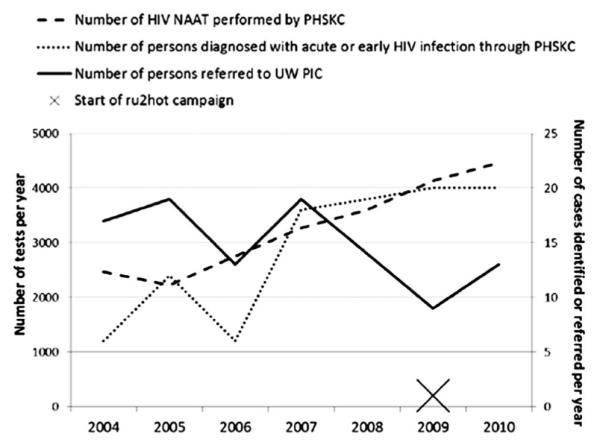
366 MSM completed surveys. In survey 4, 23% of 100 men reported seeing the campaign, and 25% knew 'ru2hot?' referred to AHI. From survey 1 to survey 4, the proportion of subjects who knew ≥2 symptoms or that AHI was a 'flu-like' illness was unchanged (61% vs 57%, p=0.6). However, in survey 4, 13 (72%) of 18 subjects who saw the campaign named fever as a symptom of AHI compared with 19 (35%) of 55 subjects who had not seen the campaign (p=0.005). From 9/2003 to 12/2010, 622 (2.2%) of 27 661 MSM tested HIV-positive, and 111 (18%) were identified by the Public Health--Seattle & King County NAAT programme. In terms of the impact of the campaign on case-finding, diagnosis of EIA-negative/NAAT-positive and OraQuick-negative/EIA-positive cases increased from six in 2004 to 20 in 2010 (p=0.01), but postcampaign numbers were unchanged. 23 (51%) of 45 cases identified before and 8 (44%) of 18 cases identified after the campaign reported symptoms at initial testing (p=0.6).
Although a quarter of MSM surveyed saw the campaign and knowledge of fever (the symptom of emphasis) was high, case-finding was unchanged. Increasing campaign visibility could have had greater impact.
通过西雅图和金县公共卫生局(PHSKC)向感染艾滋病病毒(HIV)阴性的男男性行为者(MSM)传授急性 HIV 感染(AHI)的症状,并引导他们进行核酸扩增检测(NAAT)。
横断面调查、回顾性数据库分析和图表审查。
从 2009 年 6 月开始,ru2hot?运动描述了 AHI 的症状和 NAAT。在干预前和干预后进行了两次调查,以评估运动的可见度、症状知识和寻求医疗保健的行为。回归分析评估了病例发现的季节性趋势。
366 名 MSM 完成了调查。在第 4 次调查中,100 名男性中有 23%的人报告看到了该运动,25%的人知道“ru2hot?”指的是 AHI。从第 1 次调查到第 4 次调查,知道≥2 种症状或 AHI 是“流感样”疾病的参与者比例没有变化(61%对 57%,p=0.6)。然而,在第 4 次调查中,看到该运动的 18 名参与者中有 13 名(72%)将发热列为 AHI 的症状,而没有看到该运动的 55 名参与者中有 19 名(35%)(p=0.005)。从 2003 年 9 月到 2010 年 12 月,27661 名 MSM 中有 622 名(2.2%)HIV 检测呈阳性,其中 111 名(18%)是由西雅图和金县公共卫生局的 NAAT 方案发现的。就运动对病例发现的影响而言,EIA 阴性/NAAT 阳性和 OraQuick 阴性/EIA 阳性病例的诊断从 2004 年的 6 例增加到 2010 年的 20 例(p=0.01),但运动后的病例数没有变化。在初次检测时,有 23 例(51%)在运动前和 8 例(44%)在运动后报告有症状的病例是确诊为 EIA 阴性/NAAT 阳性,而 OraQuick 阴性/EIA 阳性(p=0.6)。
尽管四分之一接受调查的 MSM 看到了该运动,而且对发热(强调的症状)的了解程度很高,但病例发现并没有改变。增加运动的可见度可能会产生更大的影响。