Department of Microbiology and Immunology, Geisel School of Medicine at Dartmouth, Lebanon, NH 03756, USA.
J Immunol. 2013 Mar 1;190(5):2455-63. doi: 10.4049/jimmunol.1201314. Epub 2013 Jan 25.
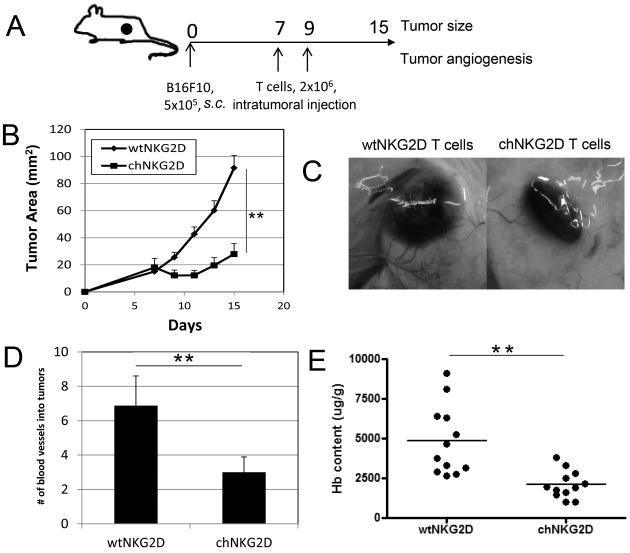
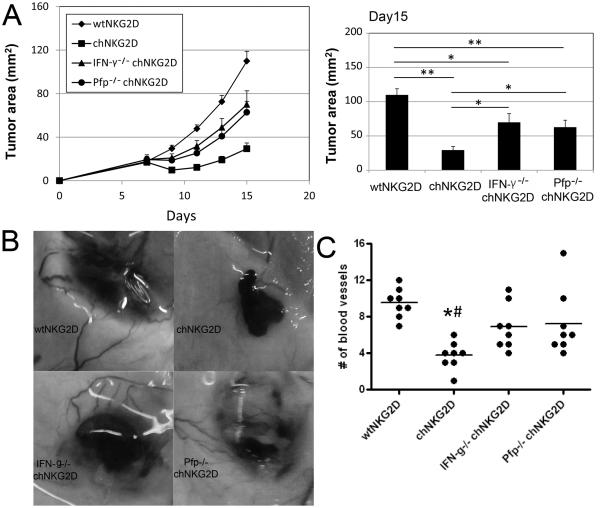
Tumor angiogenesis plays an important role in the development of solid tumors, and targeting the tumor vasculature has emerged as a strategy to prevent growth and progression of solid tumors. In this study, we show that murine tumor vasculature expresses Rae1, a ligand for a stimulatory NK receptor NKG2D. By genetic modification of T cells with an NKG2D-based chimeric Ag receptor, referred to as chNKG2D in which the NKG2D receptor is fused to the signaling domain of CD3ζ-chain, T cells were capable of targeting tumor vasculature leading to reduced tumor angiogenesis and tumor growth. This occurred even in tumors where the tumor cells themselves did not express NKG2D ligands. H5V, an endothelial cell line, expresses Rae1 and was lysed by chNKG2D-bearing T cells in a perforin-dependent manner. In vitro capillary tube formation was inhibited by chNKG2D T cells through IFN-γ and cell-cell contact mechanisms. The in vivo antiangiogenesis effects mediated by chNKG2D-bearing T cells at the tumor site were dependent on IFN-γ and perforin. These results provide a novel mechanism for NKG2D-based targeting of solid tumors.
肿瘤血管生成在实体瘤的发展中起着重要作用,针对肿瘤血管已成为防止实体瘤生长和进展的一种策略。在这项研究中,我们表明,鼠类肿瘤血管表达 Rae1,这是一种刺激 NK 受体 NKG2D 的配体。通过用基于 NKG2D 的嵌合 Ag 受体(称为 chNKG2D,其中 NKG2D 受体与 CD3ζ 链的信号域融合)对 T 细胞进行基因修饰,T 细胞能够靶向肿瘤血管,导致肿瘤血管生成减少和肿瘤生长减少。即使在肿瘤细胞本身不表达 NKG2D 配体的肿瘤中,也会发生这种情况。H5V 是一种内皮细胞系,表达 Rae1,并通过 chNKG2D 携带的 T 细胞以穿孔素依赖的方式被裂解。chNKG2D T 细胞通过 IFN-γ 和细胞-细胞接触机制抑制体外毛细血管形成。在肿瘤部位由 chNKG2D 携带的 T 细胞介导的抗血管生成作用依赖于 IFN-γ 和穿孔素。这些结果为基于 NKG2D 的实体瘤靶向提供了一种新的机制。