Medical Research Council Receptor Biology Research Unit, Division of Medical Biochemistry, Faculty of Health Sciences, University of Cape Town, Cape Town, South Africa.
PLoS One. 2013;8(1):e54532. doi: 10.1371/journal.pone.0054532. Epub 2013 Jan 23.
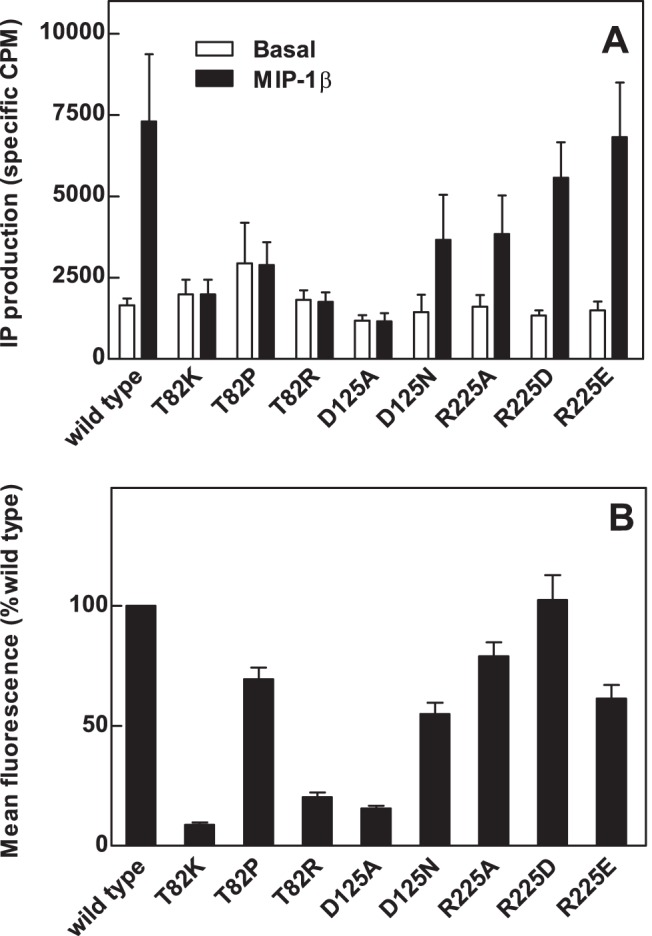
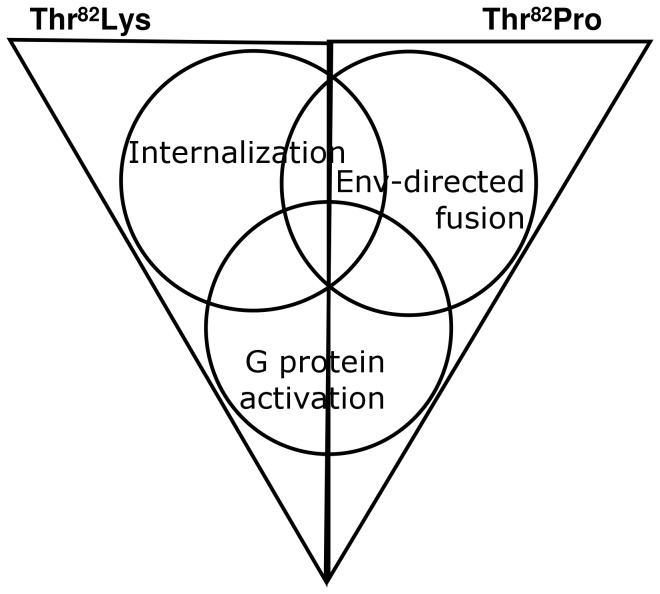
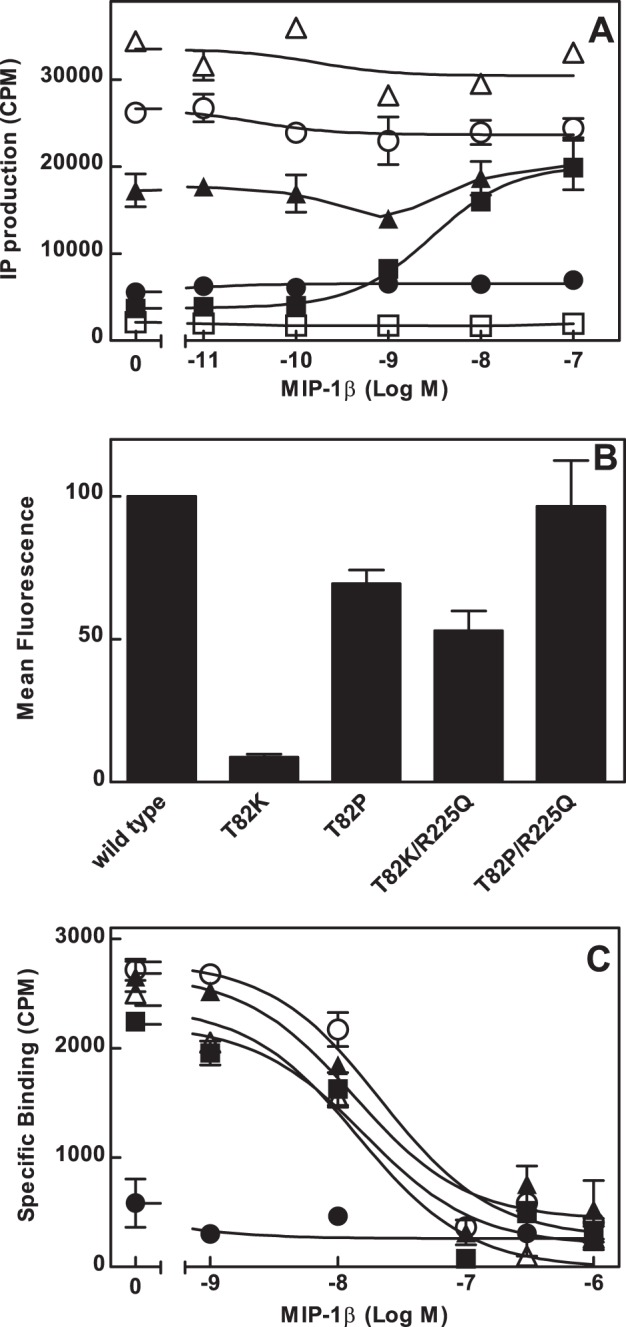
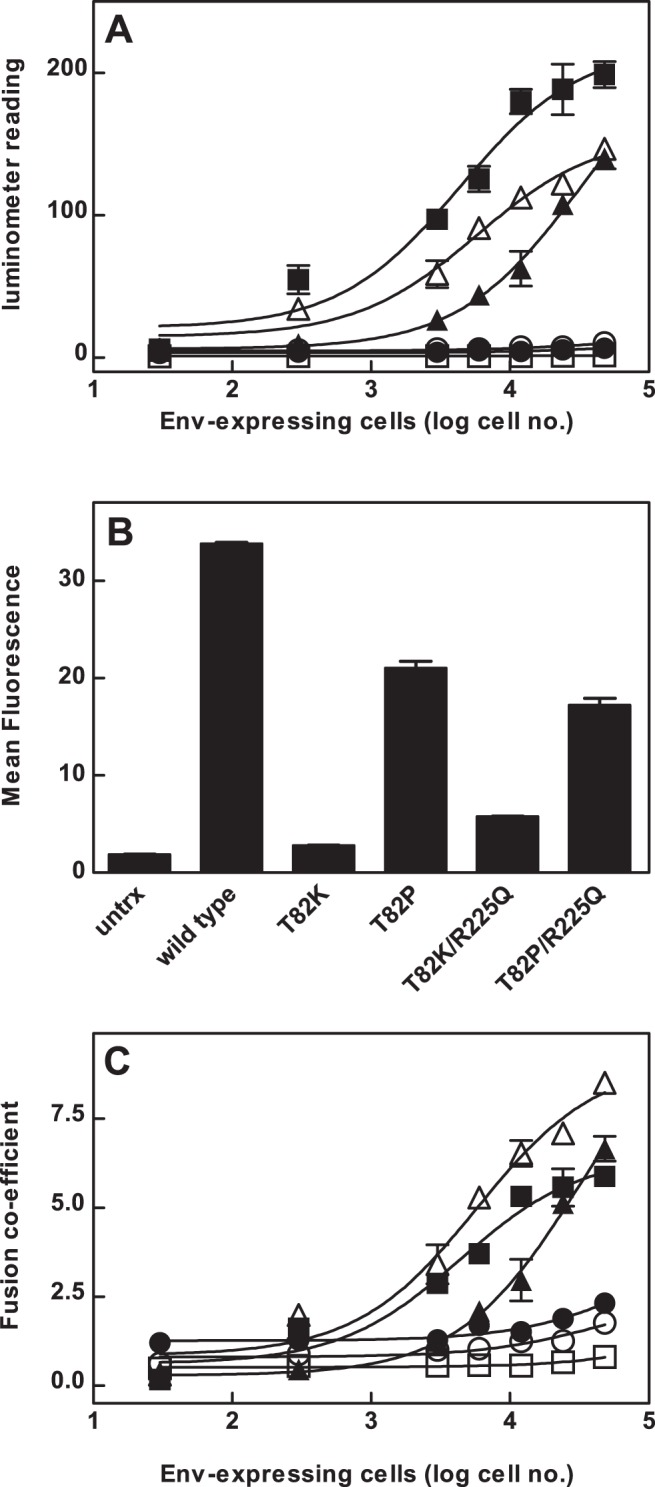
The CCR5 chemokine receptor is a rhodopsin-like G protein-coupled receptor that mediates the effects of pro-inflammatory β-chemokines. CCR5 is also the major co-receptor for entry of human immunodeficiency virus (HIV) into human cells. G protein-coupled receptors exist in ensembles of active and inactive conformations. Active receptor conformations can be stabilized by mutations. Although binding of the HIV envelope protein to CCR5 stimulates cellular signaling, the CCR5 conformation that induces fusion of the viral membrane with cellular membranes is not known. We mutated conserved amino acids to generate constitutively active CCR5 receptors, which are stabilized in active conformations, and tested the ability of constitutively active CCR5 receptors to mediate HIV envelope-directed membrane fusion. Mutation of the Asp³·⁴⁹(¹²⁵) and Arg⁶·³²(²²⁵) residues of CCR5 did not cause constitutive activity, but Lys or Pro substitutions for Thr²·⁵⁶(⁸²), in the TxP motif, caused high basal inositol phosphate signaling. Signaling did not increase in response to MIP-1β, suggesting that the Thr²·⁵⁶(⁸²) mutants were fully stabilized in active conformations. The Thr²·⁵⁶(⁸²)Lys mutation severely decreased cell surface CCR5 expression. Combining the Thr²·⁵⁶(⁸²)Lys mutation with an Arg⁶·³²(²²⁵)Gln mutation partially reversed the decrease in expression. Mutants with Thr²·⁵⁶(⁸²)Lys substitutions were poor mediators of HIV envelope-directed membrane fusion, but mutants with the Thr²·⁶⁵(⁸²)Pro substitution exhibited full co-receptor function. Our results suggest that the Thr²·⁶⁵(⁸²)Lys and Thr²·⁶⁵(⁸²)Pro mutations stabilize distinct constitutively active CCR5 conformations. Lys in position 2.65(82) stabilizes activated receptor conformations that appear to be constitutively internalized and do not induce envelope-dependent membrane fusion, whereas Pro stabilizes activated conformations that are not constitutively internalized and fully mediate envelope-directed membrane fusion.
CCR5 趋化因子受体是一种视紫红质样 G 蛋白偶联受体,介导促炎β趋化因子的作用。CCR5 也是人类免疫缺陷病毒 (HIV) 进入人体细胞的主要共受体。G 蛋白偶联受体存在于活性和非活性构象的集合中。活性受体构象可以通过突变稳定。虽然 HIV 包膜蛋白与 CCR5 的结合刺激细胞信号转导,但诱导病毒膜与细胞膜融合的 CCR5 构象尚不清楚。我们突变了保守的氨基酸,生成了稳定在活性构象中的组成型激活的 CCR5 受体,并测试了组成型激活的 CCR5 受体介导 HIV 包膜指导的膜融合的能力。CCR5 的 Asp³·⁴⁹(¹²⁵)和 Arg⁶·³²(²²⁵)残基的突变不会导致组成型活性,但 Thr²·⁵⁶(⁸²)处的 Lys 或 Pro 取代 TxP 基序中的 Thr²·⁵⁶(⁸²),会导致高基础肌醇磷酸信号。对 MIP-1β 的反应没有增加,表明 Thr²·⁵⁶(⁸²)突变体完全稳定在活性构象中。Thr²·⁵⁶(⁸²)Lys 突变严重降低了细胞表面 CCR5 的表达。将 Thr²·⁵⁶(⁸²)Lys 突变与 Arg⁶·³²(²²⁵)Gln 突变相结合部分逆转了表达的降低。具有 Thr²·⁵⁶(⁸²)Lys 取代的突变体是 HIV 包膜指导的膜融合的不良介体,但具有 Thr²·⁶⁵(⁸²)Pro 取代的突变体表现出完整的共受体功能。我们的结果表明,Thr²·⁶⁵(⁸²)Lys 和 Thr²·⁶⁵(⁸²)Pro 突变稳定了不同的组成型激活的 CCR5 构象。位置 2.65(82)的 Lys 稳定激活的受体构象,这些构象似乎被持续内化,并且不诱导包膜依赖性膜融合,而 Pro 稳定激活的构象,这些构象不被持续内化,并且完全介导包膜指导的膜融合。