Cardiology, Heart Centre and Department of Nursing, Umeå University, Umeå, Sweden.
BMC Cardiovasc Disord. 2013 Jan 29;13:6. doi: 10.1186/1471-2261-13-6.
Reperfusion therapy reduces both morbidity and mortality in myocardial infarction, but the effectiveness depends on how fast the patient receives treatment. Despite the time-dependent effectiveness of reperfusion therapy, many patients with myocardial infarction have delays in seeking medical care. The aim of this study was to describe pre-hospital delay in a first myocardial infarction among men and women with and without diabetes and to describe the association between pre-hospital delay time and diabetes, sex, age, symptoms and size of residential area as a proxy for distance to hospital.
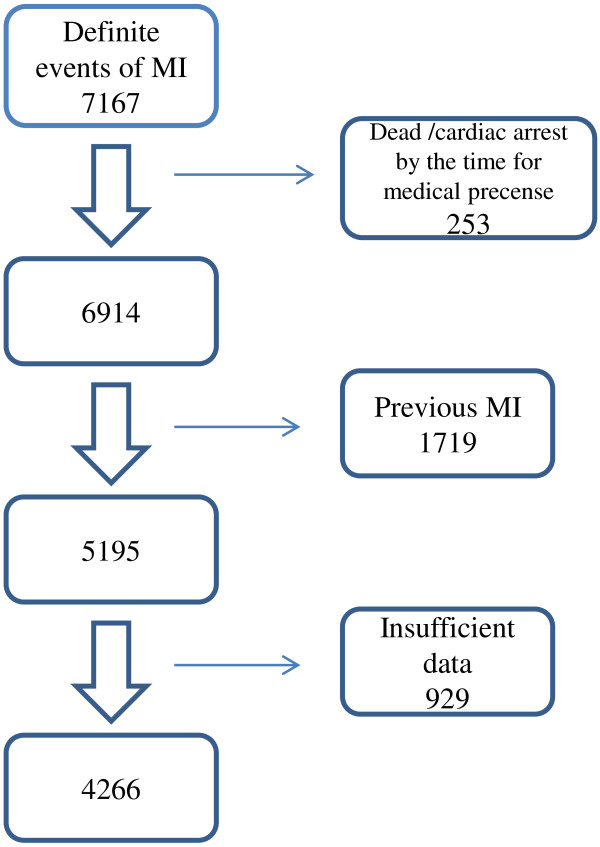
This population based study was based on data from 4266 people aged 25-74 years, with a first myocardial infarction registered in the Northern Sweden MONICA myocardial infarction registry between 2000 and 2008.
The proportion of patients with delay times ≥ 2 h was 64% for patients with diabetes and 58% for patients without diabetes. There was no difference in delay time ≥ 2 h between men and women with diabetes. Diabetes, older age and living in a town or rural areas were factors associated with pre-hospital delay times ≥ 2 h. Atypical symptoms were not a predictor for pre-hospital delay times ≥ 2 h, OR 0.59 (0.47; 0.75).
A higher proportion of patients with diabetes have longer pre-hospital delay in myocardial infarction than patients without diabetes. There are no differences in pre-hospital delay between men and women with diabetes. The largest risk difference for pre-hospital delay ≥ 2 h is between women with and without diabetes. Diabetes, older age and living in a town or rural area are predictors for pre-hospital delay ≥ 2 h.
再灌注治疗可降低心肌梗死的发病率和死亡率,但治疗的及时性是影响疗效的关键。尽管再灌注治疗的效果与时间相关,但仍有许多心肌梗死患者延迟就医。本研究旨在描述有或无糖尿病的首次心肌梗死患者的院前延迟,并描述院前延迟时间与糖尿病、性别、年龄、症状以及居住区域大小(代表与医院的距离)之间的相关性。
本基于人群的研究基于 2000 年至 2008 年间在瑞典北部 MONICA 心肌梗死登记处登记的 4266 名年龄在 25-74 岁之间首次发生心肌梗死的患者的数据。
糖尿病患者中延迟时间≥2 小时的比例为 64%,无糖尿病患者的比例为 58%。糖尿病男性和女性的延迟时间≥2 小时没有差异。糖尿病、年龄较大以及居住在城镇或农村地区是与院前延迟时间≥2 小时相关的因素。不典型症状不是院前延迟时间≥2 小时的预测因素,OR0.59(0.47;0.75)。
糖尿病患者的心肌梗死院前延迟时间较无糖尿病患者更长。糖尿病男性和女性的院前延迟时间没有差异。女性糖尿病患者和无糖尿病患者的院前延迟时间差异最大。糖尿病、年龄较大以及居住在城镇或农村地区是院前延迟时间≥2 小时的预测因素。