Department of Environmental Health Sciences, Johns Hopkins Bloomberg School of Public Health, Baltimore, Maryland, USA.
PLoS One. 2013;8(1):e54733. doi: 10.1371/journal.pone.0054733. Epub 2013 Jan 24.
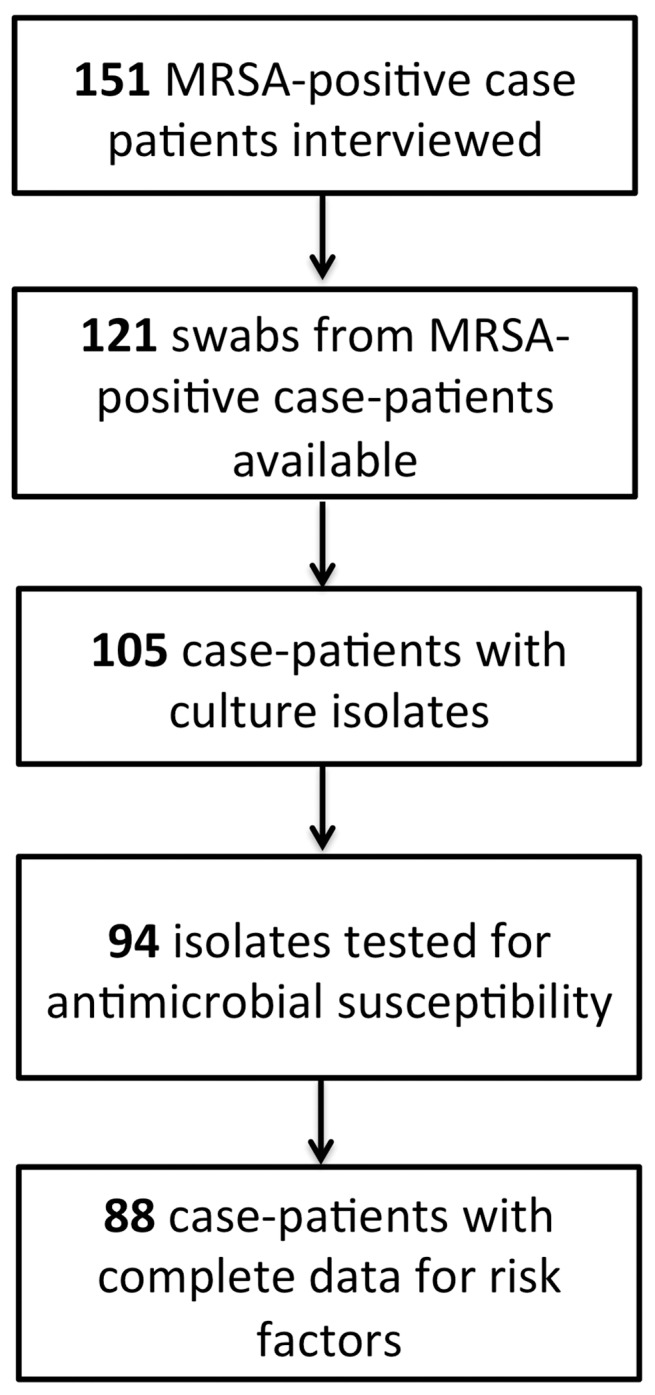
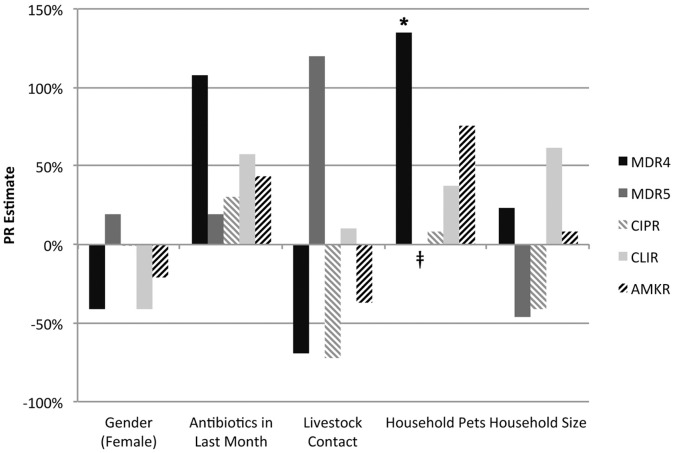
Antimicrobial resistance, particularly in pathogens such as methicillin-resistant Staphylococcus aureus (MRSA), limits treatment options and increases healthcare costs. To understand patient risk factors, including household and animal contact, potentially associated with colonization with multidrug-resistant MRSA isolates, we performed a prospective study of case patients colonized with MRSA on admission to a rural tertiary care hospital. Patients were interviewed and antimicrobial resistance patterns were tested among isolates from admitted patients colonized with MRSA in 2009-10. Prevalence of resistance was compared by case-patient risk factors and length-of-stay outcome among 88 MRSA case patients. Results were compared to NHANES 2003-04. Overall prevalence of multidrug resistance (non-susceptibility to ≥ four antimicrobial classes) in MRSA nasal isolates was high (73%) and was associated with a 1.5-day increase in subsequent length of stay (p = 0.008). History of hospitalization within the past six months, but not antimicrobial use in the same time period, was associated with resistance patterns. Within a subset of working-age case patients without recent history of hospitalization, animal contact was potentially associated with multidrug resistance. History of hospitalization, older age, and small household size were associated with multidrug resistance in NHANES data. In conclusion, recent hospitalization of case patients was predictive of antimicrobial resistance in MRSA isolates, but novel risk factors associated with the household may be emerging in CA-MRSA case patients. Understanding drivers of antimicrobial resistance in MRSA isolates is important to hospital infection control efforts, relevant to patient outcomes and to indicators of the economic burden of antimicrobial resistance.
耐抗生素性,尤其是在像耐甲氧西林金黄色葡萄球菌(MRSA)这样的病原体中,限制了治疗选择并增加了医疗保健成本。为了了解与多药耐药性 MRSA 分离株定植相关的患者风险因素,包括家庭和动物接触,我们对一家农村三级保健医院入院时定植了 MRSA 的病例患者进行了前瞻性研究。对 2009-10 年入院时定植了 MRSA 的患者进行了访谈,并对分离株的抗生素耐药模式进行了测试。对 88 例 MRSA 病例患者的风险因素和住院时间长短的结果进行了比较。结果与 NHANES 2003-04 进行了比较。MRSA 鼻腔分离株的总体多药耐药率(对≥4 种抗菌药物类别的非敏感性)较高(73%),与随后住院时间延长 1.5 天相关(p=0.008)。过去六个月内的住院史,但不是同期的抗生素使用,与耐药模式有关。在没有近期住院史的劳动年龄病例患者亚组中,动物接触可能与多药耐药性有关。住院史、年龄较大和家庭规模较小与 NHANES 数据中的多药耐药性有关。总之,病例患者的近期住院史可预测 MRSA 分离株的抗生素耐药性,但与家庭相关的新的风险因素可能在 CA-MRSA 病例患者中出现。了解 MRSA 分离株中抗生素耐药性的驱动因素对于医院感染控制工作很重要,与患者的结局和抗生素耐药性的经济负担指标相关。