Singh Chandan, Chaudhary Rubina, Gandhi Kavita
School of Energy and Environmental Studies, Devi Ahilya University, Indore, Takshashila Campus, Khandwa Road, Indore, M,P, India.
Iranian J Environ Health Sci Eng. 2013 Jan 22;10(1):13. doi: 10.1186/1735-2746-10-13.
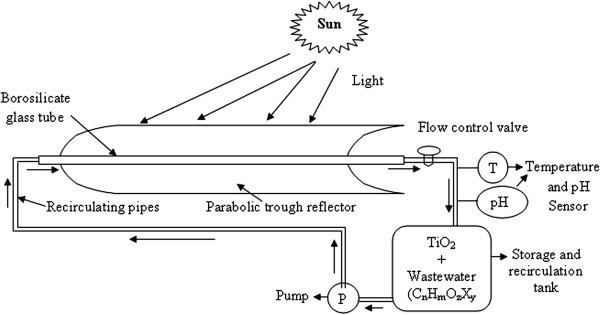
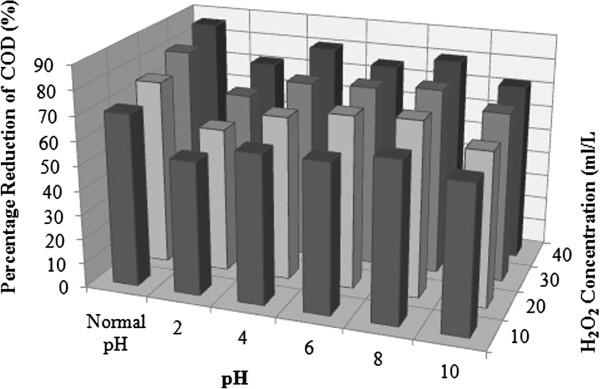
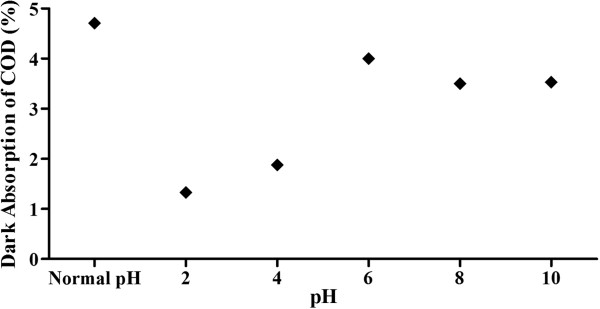
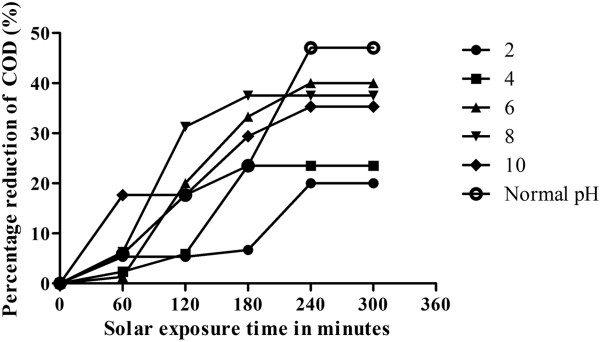
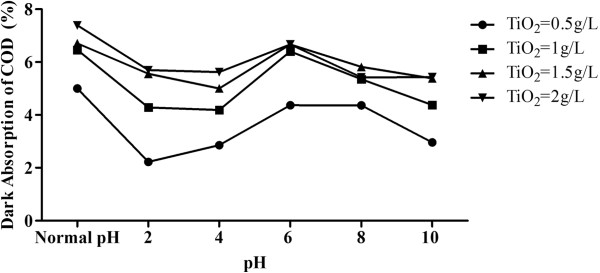
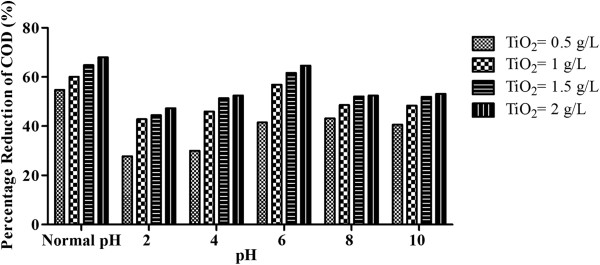
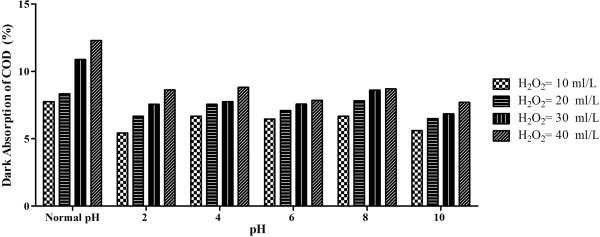
In the present study, solar photocatalytic oxidation has been investigated through laboratory experiments as an alternative to conventional secondary treatment for the organic content reduction of high COD wastewater. Experiments have been performed on synthetic high COD wastewater for solar photocatalytic oxidation using a parabolic trough reactor. Parameters affecting the oxidation of organics have been investigated.The experimental design followed the sequence of dark adsorption studies of organics, followed by photolytic studies (in absence of catalyst) and finally photocatalytic studies in presence and absence of additional oxidant (H2O2). All the experimental studies have been performed at pH values of 2, 4, 6,8,10 and the initial pH value of the wastewater (normal pH). For photocatalytic studies, TiO2 has been used as a photocatalyst. Optimization of catalyst dose, pH and H2O2 concentration has been done. Maximum reduction of organic content was observed at the normal pH value of the wastewater (pH = 6.8). The reaction rate was significantly enhanced in presence of hydrogen peroxide. The optimum pH other than the Normal was in the alkaline range. Acidic pH was not found to be favourable for organic content reduction. pH was found to be a dominant factor affecting reaction rate even in presence of H2O2 as an additional oxidant. Also, the solar detoxification process was effective in treating a waste with a COD level of more than 7500 mg/L, which is a otherwise a difficult waste to treat. It can therefore be used as a treatment step in the high organic wastewater treatment during the primary stage also as it effectively reduces the COD content by 86%.
在本研究中,通过实验室实验对太阳能光催化氧化进行了研究,以作为传统二级处理的替代方法,用于降低高化学需氧量(COD)废水的有机物含量。使用抛物槽式反应器对合成高COD废水进行了太阳能光催化氧化实验。研究了影响有机物氧化的参数。实验设计遵循以下顺序:首先对有机物进行暗吸附研究,然后进行光解研究(无催化剂),最后在有无额外氧化剂(H2O2)的情况下进行光催化研究。所有实验研究均在pH值为2、4、6、8、10以及废水的初始pH值(正常pH)下进行。对于光催化研究,使用TiO2作为光催化剂。对催化剂用量、pH值和H2O2浓度进行了优化。在废水的正常pH值(pH = 6.8)下观察到有机物含量的最大降低。在过氧化氢存在下,反应速率显著提高。除正常pH值外,最佳pH值在碱性范围内。发现酸性pH值不利于有机物含量的降低。即使在有H2O2作为额外氧化剂的情况下,pH值仍是影响反应速率的主要因素。此外,太阳能解毒工艺对于处理COD水平超过7500 mg/L的废水有效,否则该废水难以处理。因此,它也可在初级阶段用作高有机废水处理的一个处理步骤,因为它能有效降低86%的COD含量。