Department of Medicine, Emory University, Atlanta Veterans Affairs Medical Center, Decatur, Georgia, USA.
Pulm Circ. 2012 Oct;2(4):483-91. doi: 10.4103/2045-8932.105037.
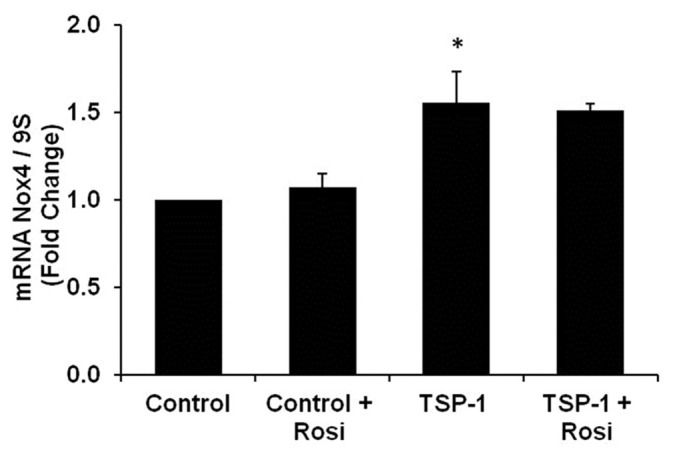
Transforming growth factor-β1 (TGF- β1) and thrombospondin-1 (TSP-1) are hypoxia-responsive mitogens that promote vascular smooth muscle cell (SMC) proliferation, a critical event in the pathogenesis of pulmonary hypertension (PH). We previously demonstrated that hypoxia-induced human pulmonary artery smooth muscle (HPASMC) cell proliferation and expression of the NADPH oxidase subunit, Nox4, were attenuated by the peroxisome proliferator-activated receptor γ (PPARγ) agonist, rosiglitazone. The current study examines the hypothesis that rosiglitazone regulates Nox4 expression and HPASMC proliferation by attenuating TSP-1 signaling. Selected HPASMC were exposed to normoxic or hypoxic (1% O(2)) environments or TSP-1 (0-1 μg/ ml) for 72 hours ± administration of rosiglitazone (10 μM). Cellular proliferation, Nox4, TSP-1, and TGF-β1 expression and reactive oxygen species generation were measured. Mice exposed to hypoxia (10% O(2)) for three weeks were treated with rosiglitazone (10 mg/kg/day) for the final 10 days, and lung TSP-1 expression was examined. Hypoxia increased TSP-1 and TGF-β1 expression and HPASMC proliferation, and neutralizing antibodies to TSP-1 or TGF-β1 attenuated proliferation. Rosiglitazone attenuated hypoxia-induced HPASMC proliferation and increases in mouse lung and HPASMC TSP-1 expression, but failed to reduce increases in TGF-β1 expression or Nox4 expression and activity caused by direct TSP-1 stimulation. Transfecting HPASMC with siRNA to Nox4 attenuated hypoxia- or TSP-1-stimulated HPASMC proliferation. These findings provide novel evidence that TSP-1-mediated Nox4 expression plays a critical role in hypoxia-induced HPASMC proliferation. PPARγ activation with exogenous ligands attenuates TSP-1 expression to reduce Nox4 expression. These results clarify mechanisms of hypoxia-induced SMC proliferation and suggest additional pathways by which PPARγ agonists may regulate critical steps in the pathobiology of PH.
转化生长因子-β1(TGF-β1)和血小板反应蛋白-1(TSP-1)是低氧反应性有丝分裂原,可促进血管平滑肌细胞(SMC)增殖,这是肺动脉高压(PH)发病机制中的关键事件。我们之前的研究表明,低氧诱导的人肺动脉平滑肌(HPASM)细胞增殖和 NADPH 氧化酶亚基 Nox4 的表达,可被过氧化物酶体增殖物激活受体γ(PPARγ)激动剂罗格列酮减弱。本研究检验了以下假设,即罗格列酮通过减弱 TSP-1 信号转导来调节 Nox4 表达和 HPASMC 增殖。选择 HPASMC 暴露于常氧或低氧(1% O2)环境或 TSP-1(0-1 μg/ml)72 小时,同时给予罗格列酮(10 μM)。测量细胞增殖、Nox4、TSP-1 和 TGF-β1 的表达和活性氧的生成。将暴露于低氧(10% O2)3 周的小鼠用罗格列酮(10 mg/kg/天)治疗 10 天,然后检查肺 TSP-1 的表达。低氧增加了 TSP-1 和 TGF-β1 的表达和 HPASMC 的增殖,中和 TSP-1 或 TGF-β1 的抗体可减弱增殖。罗格列酮减弱了低氧诱导的 HPASMC 增殖和增加小鼠肺和 HPASMC 的 TSP-1 表达,但未能减少直接由 TSP-1 刺激引起的 TGF-β1 表达或 Nox4 表达和活性的增加。用 Nox4 的 siRNA 转染 HPASMC 可减弱低氧或 TSP-1 刺激的 HPASMC 增殖。这些发现提供了新的证据,表明 TSP-1 介导的 Nox4 表达在低氧诱导的 HPASMC 增殖中起着关键作用。外源性配体激活 PPARγ 减弱 TSP-1 表达以减少 Nox4 表达。这些结果阐明了低氧诱导的 SMC 增殖的机制,并提示了 PPARγ 激动剂可能调节 PH 病理生物学中关键步骤的其他途径。