National Laboratory of Biomacromolecules, Institute of Biophysics, Chinese Academy of Sciences, Datun Road 15, Beijing 100101, China.
BMC Biol. 2013 Feb 1;11:12. doi: 10.1186/1741-7007-11-12.
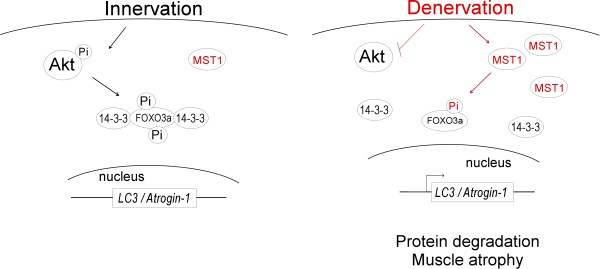
Skeletal muscle undergoes rapid atrophy upon denervation and the underlying mechanisms are complicated. FOXO3a has been implicated as a major mediator of muscle atrophy, but how its subcellular location and activity is controlled during the pathogenesis of muscle atrophy remains largely unknown. MST1 (Mammalian Sterile 20-like kinase 1) is identified as a central component of the Hippo signaling pathway. MST1 has been shown to mediate phosphorylation of FOXO3a at Ser207. Whether this MST1-FOXO signaling cascade exerts any functional consequence on cellular homeostasis remains to be investigated.
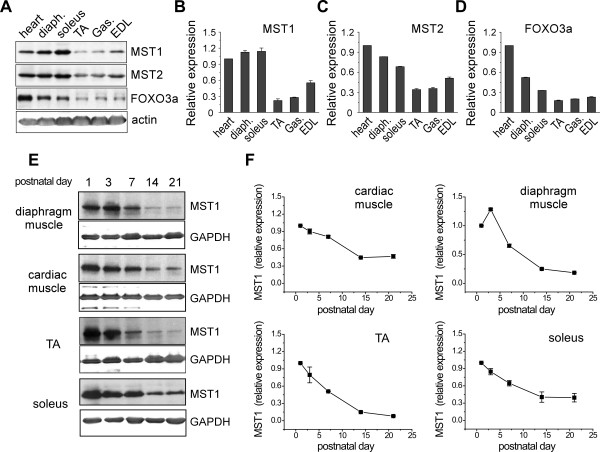
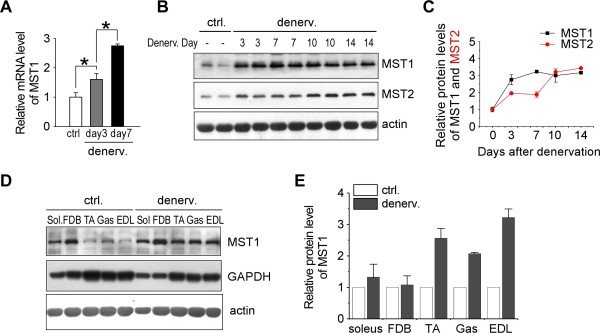
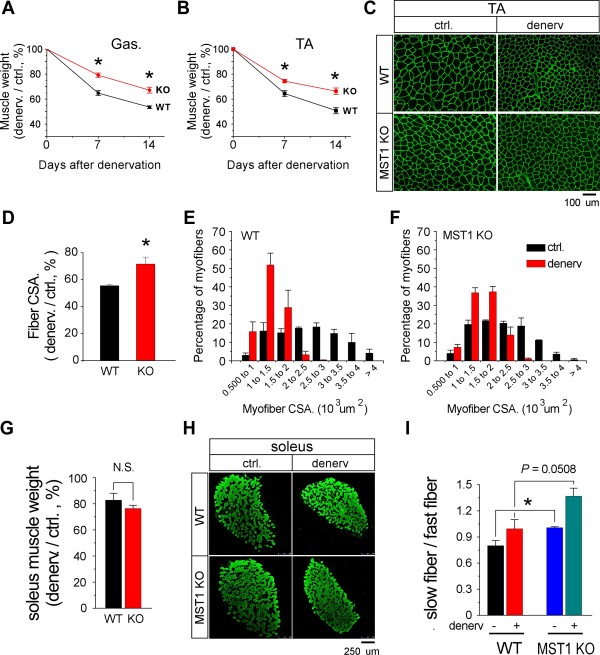
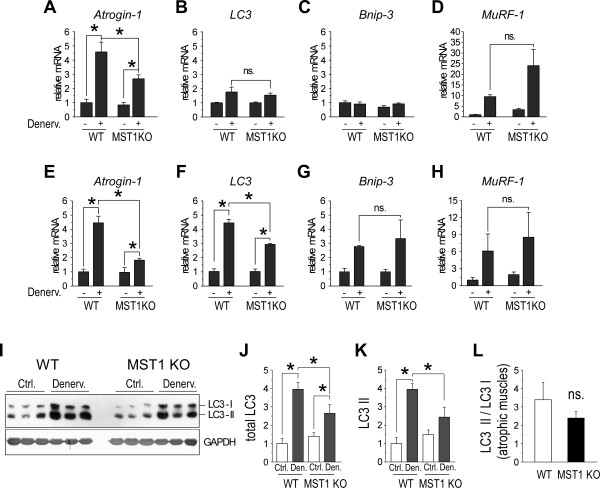
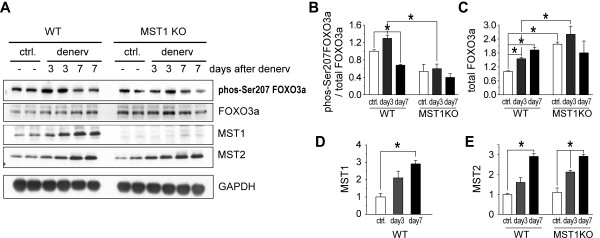
We identified that MST1 kinase was expressed widely in skeletal muscles and was dramatically up-regulated in fast- but not slow-dominant skeletal muscles immediately following denervation. The results of our histological and biochemical studies demonstrated that deletion of MST1 significantly attenuated denervation-induced skeletal muscle wasting and decreased expression of Atrogin-1 and LC3 genes in fast-dominant skeletal muscles from three- to five-month-old adult mice. Further studies indicated that MST1, but not MST2, remarkably increased FOXO3a phosphorylation level at Ser207 and promoted its nuclear translocation in atrophic fast-dominant muscles.
We have established that MST1 kinase plays an important role in regulating denervation-induced skeletal muscle atrophy. During the early stage of muscle atrophy, the up-regulated MST1 kinase promoted progression of neurogenic atrophy in fast-dominant skeletal muscles through activation of FOXO3a transcription factors.
失神经支配后骨骼肌会迅速萎缩,其潜在机制较为复杂。FOXO3a 已被认为是肌肉萎缩的主要介导因子,但在肌肉萎缩的发病机制中,其亚细胞位置和活性如何受到调控仍知之甚少。MST1(哺乳动物不育 20 样激酶 1)被鉴定为 Hippo 信号通路的核心组成部分。已有研究表明,MST1 介导 FOXO3a 在 Ser207 上的磷酸化。该 MST1-FOXO 信号级联是否对细胞稳态产生任何功能影响仍有待研究。
我们发现 MST1 激酶在骨骼肌中广泛表达,在失神经支配后即刻快速但非缓慢优势骨骼肌中表达显著上调。我们的组织学和生化研究结果表明,MST1 缺失可显著减轻失神经诱导的骨骼肌萎缩,并降低 3-5 月龄成年小鼠快速优势骨骼肌中 Atrogin-1 和 LC3 基因的表达。进一步的研究表明,MST1(而非 MST2)可显著增加 Atrogin-1 快速优势萎缩肌肉中 FOXO3a 在 Ser207 上的磷酸化水平,并促进其核转位。
我们已经证实 MST1 激酶在调节失神经诱导的骨骼肌萎缩中发挥重要作用。在肌肉萎缩的早期阶段,上调的 MST1 激酶通过激活 FOXO3a 转录因子促进快速优势骨骼肌中的神经源性萎缩进展。