Department of Internal Medicine, University of Texas Medical Branch, Galveston, TX 77555, USA.
BMC Health Serv Res. 2013 Feb 1;13:39. doi: 10.1186/1472-6963-13-39.
The electronic medical record (EMR) is one of the most promising components of health information technology. However, the overall impact of EMR adoption on outcomes at US hospitals remains unknown. This study examined the relationship between basic EMR adoption and 30-day rehospitalization, 30-day mortality, inpatient mortality and length of stay.
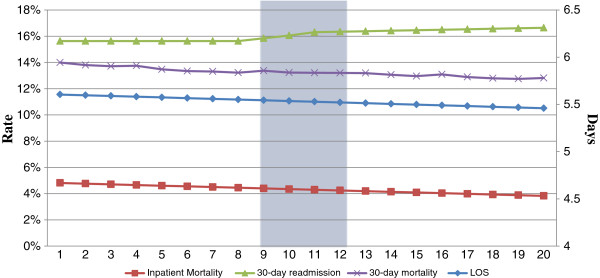
Our overall approach was to compare outcomes for the two years before and two years after the year of EMR adoption, at 708 acute-care hospitals in the US from 2000 to 2007. We looked at the effect of EMR on outcomes using two methods. First, we compared the outcomes by quarter for the period before and after EMR adoption among hospitals that adopted EMR. Second, we compared hospitals that adopted EMR to those that did not, before and after EMR adoption, using a generalized linear model.
Hospitals adopting EMR experienced 0.11 (95% CI: -0.218 to -0.002) days' shorter length of stay and 0.182 percent lower 30-day mortality, but a 0.19 (95% CI: 0.0006 to 0.0033) percent increase in 30-day rehospitalization in the two years after EMR adoption. The association of EMR adoption with outcomes also varied by type of admission (medical vs. surgical).
Previous studies using observational data from large samples of hospitals have produced conflicting results. However, using different methods, we found a small but statistically significant association of EMR adoption with outcomes of hospitalization.
电子病历(EMR)是医疗信息技术最有前途的组成部分之一。然而,EMR 采用对美国医院结果的总体影响尚不清楚。本研究考察了基本 EMR 采用与 30 天再入院率、30 天死亡率、住院死亡率和住院时间之间的关系。
我们的总体方法是比较 2000 年至 2007 年美国 708 家急症护理医院 EMR 采用前后两年的结果。我们使用两种方法研究 EMR 对结果的影响。首先,我们比较了 EMR 采用前后各季度的结果。其次,我们在 EMR 采用前后,使用广义线性模型比较了采用 EMR 的医院和未采用 EMR 的医院的结果。
采用 EMR 的医院住院时间缩短 0.11 天(95%CI:-0.218 至-0.002),30 天死亡率降低 0.182%,但 30 天再入院率增加 0.19%(95%CI:0.0006 至 0.0033)。EMR 采用与结果的关联也因入院类型(内科与外科)而异。
先前使用大量医院观察数据的研究得出了相互矛盾的结果。然而,使用不同的方法,我们发现 EMR 采用与住院结果之间存在微小但具有统计学意义的关联。