
Rad9、Rad17、TopBP1 和 claspin 在热诱导 ATR 激酶激活和耐热性中发挥重要作用。
Rad9, Rad17, TopBP1 and claspin play essential roles in heat-induced activation of ATR kinase and heat tolerance.
机构信息
Department of Molecular Oncology, Graduate School of Medical Sciences, Kyushu University, Fukuoka, Japan.
出版信息
PLoS One. 2013;8(2):e55361. doi: 10.1371/journal.pone.0055361. Epub 2013 Feb 1.
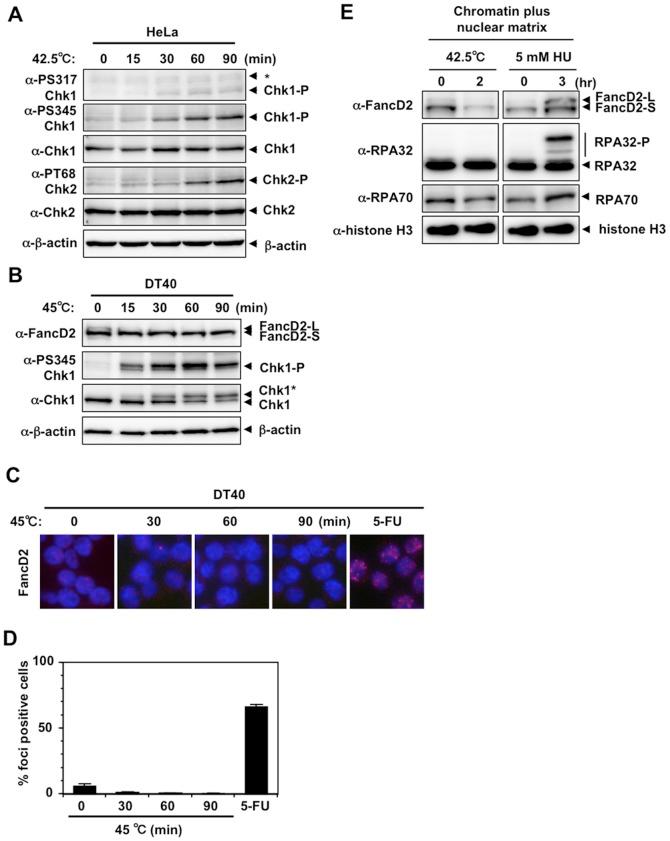
Hyperthermia is widely used to treat patients with cancer, especially in combination with other treatments such as radiation therapy. Heat treatment per se activates DNA damage responses mediated by the ATR-Chk1 and ATM-Chk2 pathways but it is not fully understood how these DNA damage responses are activated and affect heat tolerance. By performing a genetic analysis of human HeLa cells and chicken B lymphoma DT40 cells, we found that heat-induced Chk1 Ser345 phosphorylation by ATR was largely dependent on Rad9, Rad17, TopBP1 and Claspin. Activation of the ATR-Chk1 pathway by heat, however, was not associated with FancD2 monoubiquitination or RPA32 phosphorylation, which are known as downstream events of ATR kinase activation when replication forks are stalled. Downregulation of ATR, Rad9, Rad17, TopBP1 or Claspin drastically reduced clonogenic cell viability upon hyperthermia, while gene knockout or inhibition of ATM kinase reduced clonogenic viability only modestly. Suppression of the ATR-Chk1 pathway activation enhanced heat-induced phosphorylation of Chk2 Thr68 and simultaneous inhibition of ATR and ATM kinases rendered severe heat cytotoxicity. These data indicate that essential factors for activation of the ATR-Chk1 pathway at stalled replication forks are also required for heat-induced activation of ATR kinase, which predominantly contributes to heat tolerance in a non-overlapping manner with ATM kinase.
热疗被广泛用于治疗癌症患者,尤其是与放射治疗等其他治疗方法联合使用。热疗本身可激活 ATR-Chk1 和 ATM-Chk2 通路介导的 DNA 损伤反应,但尚不完全清楚这些 DNA 损伤反应是如何被激活并影响耐热性的。通过对人 HeLa 细胞和鸡 B 淋巴瘤 DT40 细胞进行遗传分析,我们发现 ATR 诱导的 Chk1 Ser345 磷酸化在很大程度上依赖于 Rad9、Rad17、TopBP1 和 Claspin。然而,热诱导的 ATR-Chk1 通路的激活与 FancD2 单泛素化或 RPA32 磷酸化无关,当复制叉停滞时,ATR 激酶的激活被认为是这些下游事件。ATR、Rad9、Rad17、TopBP1 或 Claspin 的下调大大降低了高热时集落形成细胞的存活率,而 ATM 激酶的基因敲除或抑制仅适度降低了集落形成细胞的存活率。抑制 ATR-Chk1 通路的激活增强了热诱导的 Chk2 Thr68 磷酸化,同时抑制 ATR 和 ATM 激酶导致严重的热细胞毒性。这些数据表明,在停滞的复制叉处激活 ATR-Chk1 通路的必需因素也需要激活 ATR 激酶,ATR 激酶主要以与 ATM 激酶不重叠的方式对耐热性做出贡献。



 Zotero 插件