Laboratory Animal Management Center, Cancer Research Institute, School of Basic Medical Sciences, Southern Medical University, Guangzhou, 510515, China.
Department of Pharmacy, Nanfang Hospital, Southern Medical University, Guangzhou, 510515, China.
J Exp Clin Cancer Res. 2024 Feb 29;43(1):62. doi: 10.1186/s13046-024-02983-3.
In recent years, the development of adjunctive therapeutic hyperthermia for cancer therapy has received considerable attention. However, the mechanisms underlying hyperthermia resistance are still poorly understood. In this study, we investigated the roles of cold‑inducible RNA binding protein (Cirbp) in regulating hyperthermia resistance and underlying mechanisms in nasopharyngeal carcinoma (NPC).
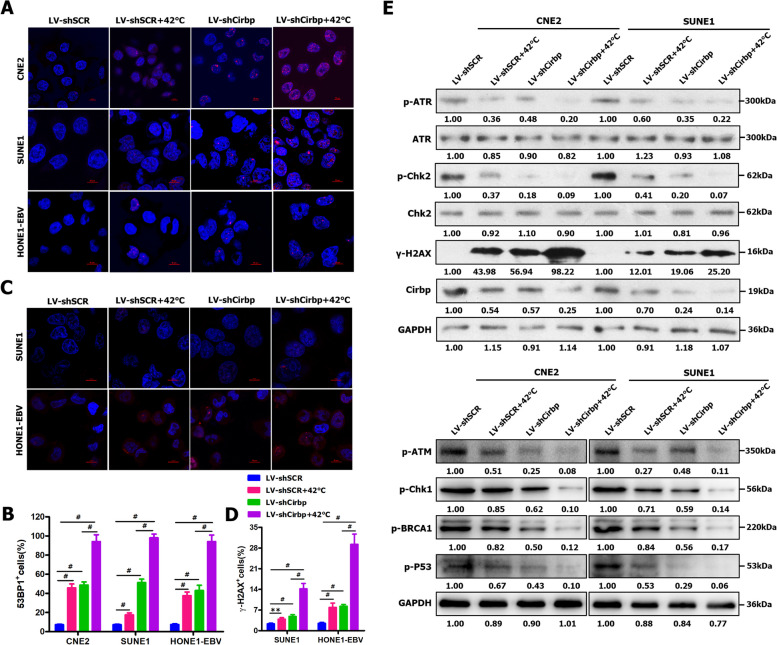
CCK-8 assay, colony formation assay, tumor sphere formation assay, qRT-PCR, Western blot were employed to examine the effects of hyperthermia (HT), HT + oridonin(Ori) or HT + radiotherapy (RT) on the proliferation and stemness of NPC cells. RNA sequencing was applied to gain differentially expressed genes upon hyperthermia. Gain-of-function and loss-of-function experiments were used to evaluate the effects of RNAi-mediated Cirbp silencing or Cirbp overexpression on the sensitivity or resistance of NPC cells and cancer stem-like cells to hyperthermia by CCK-8 assay, colony formation assay, tumorsphere formation assay and apoptosis assay, and in subcutaneous xenograft animal model. miRNA transient transfection and luciferase reporter assay were used to demonstrate that Cirbp is a direct target of miR-377-3p. The phosphorylation levels of key members in ATM-Chk2 and ATR-Chk1 pathways were detected by Western blot.
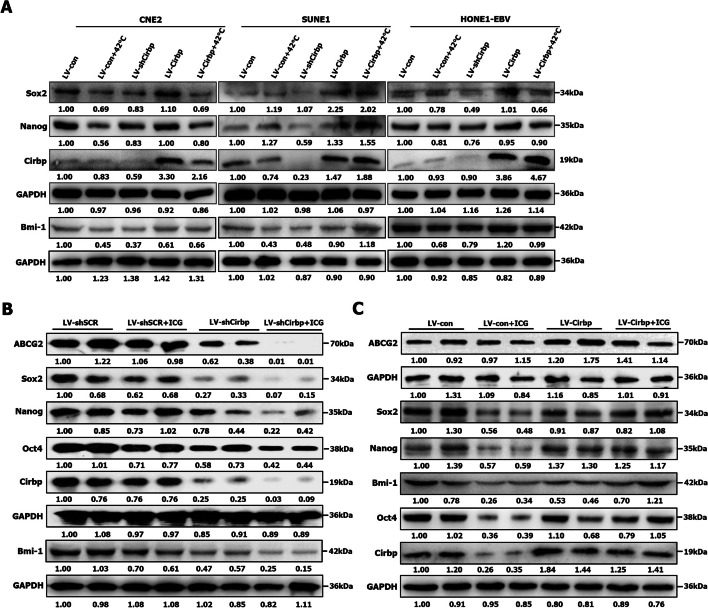
Our results firstly revealed that hyperthermia significantly attenuated the stemness of NPC cells, while combination treatment of hyperthermia and oridonin dramatically increased the killing effect on NPC cells and cancer stem cell (CSC)‑like population. Moreover, hyperthermia substantially improved the sensitivity of radiation‑resistant NPC cells and CSC‑like cells to radiotherapy. Hyperthermia noticeably suppressed Cirbp expression in NPC cells and xenograft tumor tissues. Furthermore, Cirbp inhibition remarkably boosted anti‑tumor‑killing activity of hyperthermia against NPC cells and CSC‑like cells, whereas ectopic expression of Cirbp compromised tumor‑killing effect of hyperthermia on these cells, indicating that Cirbp overexpression induces hyperthermia resistance. ThermomiR-377-3p improved the sensitivity of NPC cells and CSC‑like cells to hyperthermia in vitro by directly suppressing Cirbp expression. More importantly, our results displayed the significantly boosted sensitization of tumor xenografts to hyperthermia by Cirbp silencing in vivo, but ectopic expression of Cirbp almost completely counteracted hyperthermia-mediated tumor cell-killing effect against tumor xenografts in vivo. Mechanistically, Cirbp silencing-induced inhibition of DNA damage repair by inactivating ATM-Chk2 and ATR-Chk1 pathways, decrease in stemness and increase in cell death contributed to hyperthermic sensitization; conversely, Cirbp overexpression-induced promotion of DNA damage repair, increase in stemness and decrease in cell apoptosis contributed to hyperthermia resistance.
Taken together, these findings reveal a previously unrecognized role for Cirbp in positively regulating hyperthermia resistance and suggest that thermomiR-377-3p and its target gene Cirbp represent promising targets for therapeutic hyperthermia.
近年来,癌症治疗辅助治疗性热疗的发展受到了广泛关注。然而,热疗抵抗的机制仍知之甚少。在这项研究中,我们研究了冷诱导 RNA 结合蛋白 (Cirbp) 在调节鼻咽癌 (NPC) 中的热疗抵抗及其潜在机制中的作用。
采用 CCK-8 检测、集落形成检测、肿瘤球形成检测、qRT-PCR、Western blot 检测探讨热疗 (HT)、HT+冬凌草甲素 (Ori) 或 HT+放疗 (RT) 对 NPC 细胞增殖和干性的影响。RNA 测序用于获得热疗后差异表达的基因。采用 RNAi 介导的 Cirbp 沉默或 Cirbp 过表达的功能获得和功能丧失实验,通过 CCK-8 检测、集落形成检测、肿瘤球形成检测和凋亡检测,以及皮下异种移植动物模型,评估 Cirbp 沉默或过表达对 NPC 细胞和癌干细胞样细胞对热疗的敏感性或耐药性的影响。瞬时转染 miRNA 和荧光素酶报告基因检测表明 Cirbp 是 miR-377-3p 的直接靶标。Western blot 检测 ATM-Chk2 和 ATR-Chk1 通路关键成员的磷酸化水平。
我们的研究结果首次表明,热疗显著减弱了 NPC 细胞的干性,而热疗联合冬凌草甲素处理则显著增强了对 NPC 细胞和癌干细胞样细胞的杀伤作用。此外,热疗明显提高了放疗耐药 NPC 细胞和癌干细胞样细胞对放疗的敏感性。热疗明显抑制 NPC 细胞和异种移植肿瘤组织中的 Cirbp 表达。此外,Cirbp 抑制显著增强了热疗对 NPC 细胞和癌干细胞样细胞的抗肿瘤杀伤活性,而过表达 Cirbp 则削弱了热疗对这些细胞的杀伤作用,表明 Cirbp 过表达诱导了热疗耐药性。Thermomir-377-3p 通过直接抑制 Cirbp 表达,提高了 NPC 细胞和癌干细胞样细胞对热疗的敏感性。更重要的是,我们的结果显示,体内 Cirbp 沉默显著增强了肿瘤异种移植对热疗的敏感性,而过表达 Cirbp 则几乎完全抵消了热疗对肿瘤异种移植细胞的杀伤作用。机制上,Cirbp 沉默通过使 ATM-Chk2 和 ATR-Chk1 通路失活,抑制 DNA 损伤修复、降低干性和增加细胞死亡,从而促进热疗增敏;相反,Cirbp 过表达通过促进 DNA 损伤修复、增加干性和减少细胞凋亡,促进热疗耐药。
综上所述,这些发现揭示了 Cirbp 在正向调节热疗抵抗中的先前未知作用,并表明 thermomiR-377-3p 和其靶基因 Cirbp 可能是治疗性热疗的有前途的靶点。