Department of Molecular and Clinical Medicine, Clinical Physiology, Sahlgrenska University Hospital, Sahlgrenska Academy at the University of Gothenburg, Gothenburg, 413 45, Sweden.
EJNMMI Res. 2013 Feb 6;3(1):9. doi: 10.1186/2191-219X-3-9.
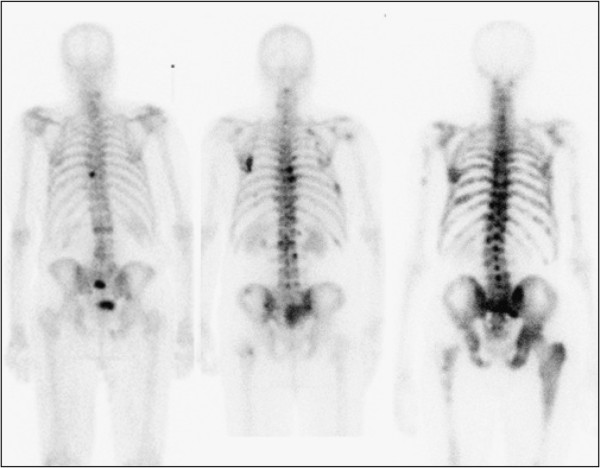
The objective of this study was to explore the prognostic value of the Bone Scan Index (BSI) obtained at the time of diagnosis in a group of high-risk prostate cancer patients receiving primary hormonal therapy.
This was a retrospective study based on 130 consecutive prostate cancer patients at high risk, based on clinical stage (T2c/T3/T4), Gleason score (8 to 10) and prostate-specific antigen (PSA) (> 20 ng/mL), who had undergone whole-body bone scans < 3 months after diagnosis and who received primary hormonal therapy. BSI was calculated using an automated method. Cox proportional-hazards regression models were used to investigate the association between clinical stage, Gleason score, PSA, BSI and survival. Discrimination between prognostic models was assessed using the concordance index (C-index).
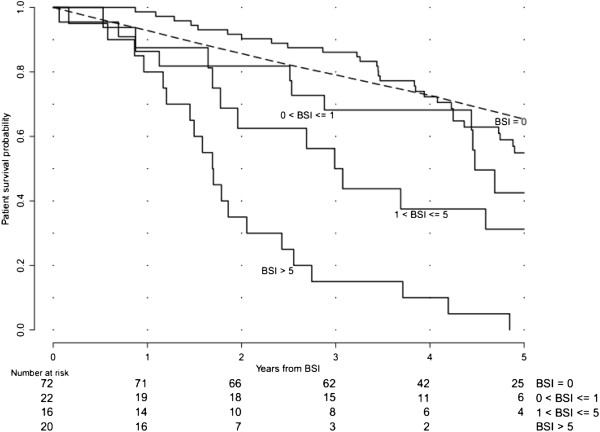
In a multivariate analysis, Gleason score (p = 0.01) and BSI (p < 0.001) were associated with survival, but clinical stage (p = 0.29) and PSA (p = 0.57) were not prognostic. The C-index increased from 0.66 to 0.71 when adding BSI to a model including clinical stage, Gleason score and PSA. The 5-year probability of survival was 55% for patients without metastases, 42% for patients with BSI < 1, 31% for patients with BSI = 1 to 5, and 0% for patients with BSI > 5.
BSI can be used as a complement to PSA to risk-stratify high-risk prostate cancer patients at the time of diagnosis. This imaging biomarker, reflecting the extent of metastatic disease, can be of value both in clinical trials and in patient management when deciding on treatment.
本研究旨在探讨在接受初始激素治疗的一组高危前列腺癌患者中,在诊断时获得的骨扫描指数(BSI)的预后价值。
这是一项回顾性研究,基于 130 例连续的高危前列腺癌患者,根据临床分期(T2c/T3/T4)、Gleason 评分(8 至 10 分)和前列腺特异性抗原(PSA)(>20ng/ml)进行分组,这些患者在诊断后 3 个月内进行了全身骨扫描,且接受了初始激素治疗。BSI 使用自动方法进行计算。Cox 比例风险回归模型用于研究临床分期、Gleason 评分、PSA、BSI 与生存之间的关系。使用一致性指数(C-index)评估预后模型的区分度。
在多变量分析中,Gleason 评分(p=0.01)和 BSI(p<0.001)与生存相关,但临床分期(p=0.29)和 PSA(p=0.57)与生存无关。当将 BSI 添加到包含临床分期、Gleason 评分和 PSA 的模型中时,C-index 从 0.66 增加到 0.71。无转移患者的 5 年生存率为 55%,BSI<1 的患者为 42%,BSI=1 至 5 的患者为 31%,BSI>5 的患者为 0%。
BSI 可作为 PSA 的补充,用于在诊断时对高危前列腺癌患者进行风险分层。这种反映转移疾病程度的影像学生物标志物,在临床试验和决定治疗时的患者管理中都具有价值。