Department of Bacteriology, University of Wisconsin-Madison, Madison, Wisconsin, USA.
mBio. 2013 Feb 5;4(1):e00033-13. doi: 10.1128/mBio.00033-13.
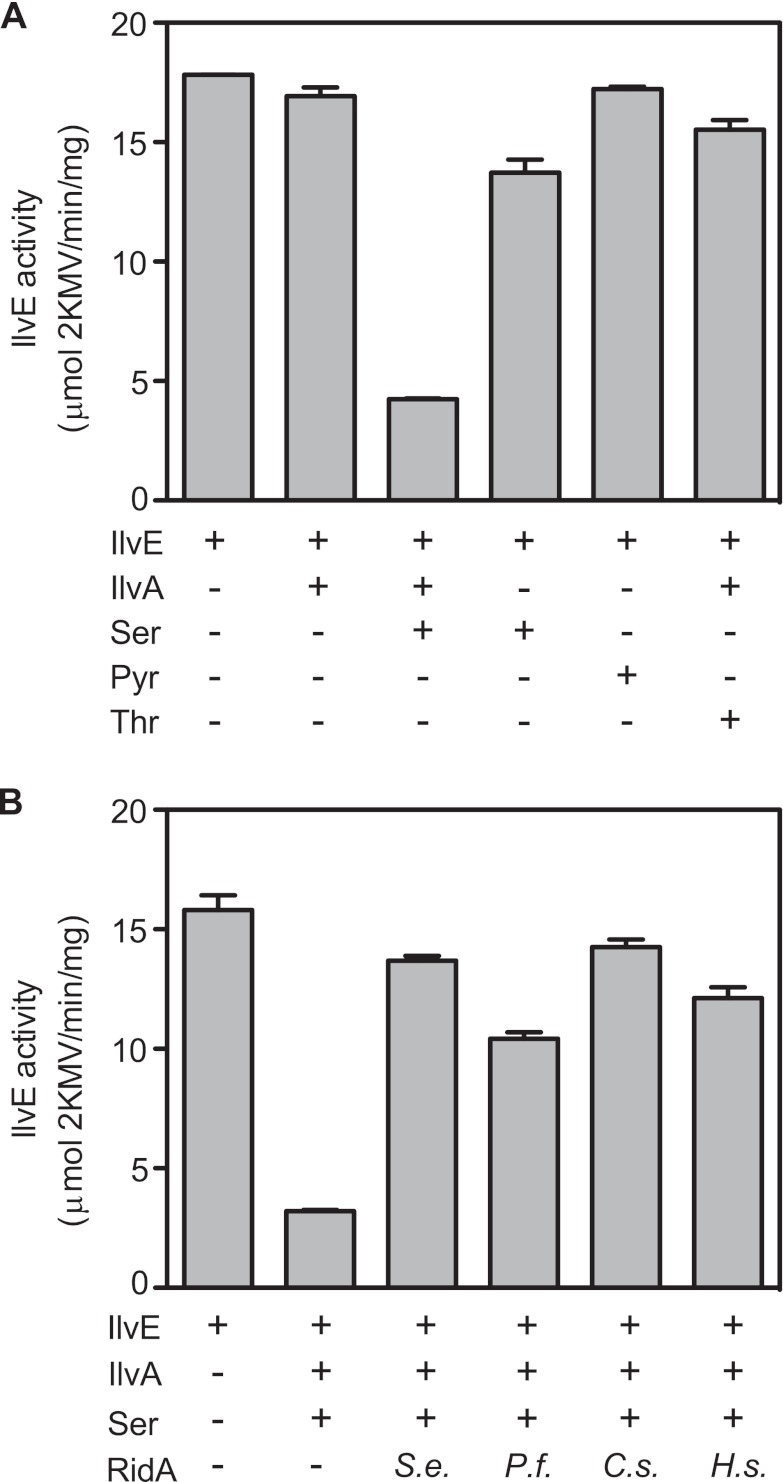
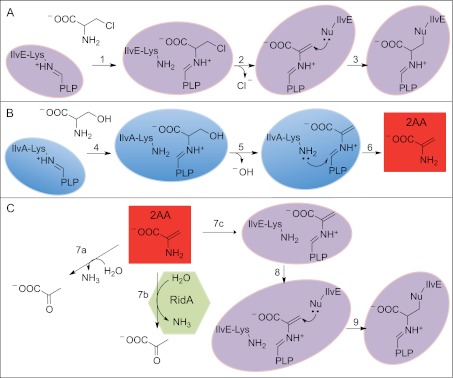
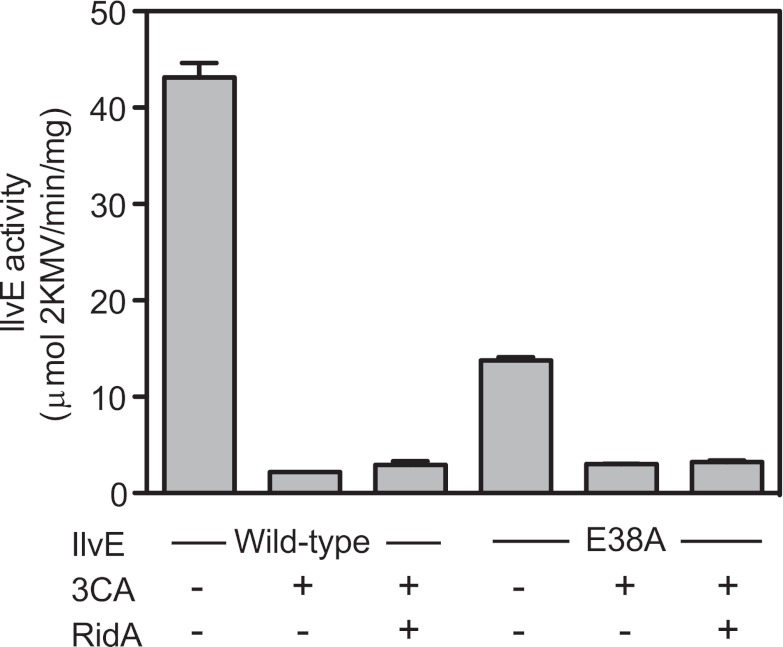
Pyridoxal 5'-phosphate (PLP) is a coenzyme synthesized by all forms of life. Relevant to the work reported here is the mechanism of the PLP-dependent threonine/serine dehydratases, which generate reactive enamine/imine intermediates that are converted to keto acids by members of the RidA family of enzymes. The RidA protein of Salmonella enterica serovar Typhimurium LT2 is the founding member of this broadly conserved family of proteins (formerly known as YjgF/YER057c/UK114). RidA proteins were recently shown to be enamine deaminases. Here we demonstrate the damaging potential of enamines in the absence of RidA proteins. Notably, S. enterica strains lacking RidA have decreased activity of the PLP-dependent transaminase B enzyme IlvE, an enzyme involved in branched-chain amino acid biosynthesis. We reconstituted the threonine/serine dehydratase (IlvA)-dependent inhibition of IlvE in vitro, show that the in vitro system reflects the mechanism of RidA function in vivo, and show that IlvE inhibition is prevented by RidA proteins from all domains of life. We conclude that 2-aminoacrylate (2AA) inhibition represents a new type of metabolic damage, and this finding provides an important physiological context for the role of the ubiquitous RidA family of enamine deaminases in preventing damage by 2AA. IMPORTANCE External stresses that disrupt metabolic components can perturb cellular functions and affect growth. A similar consequence is expected if endogenously generated metabolites are reactive and persist in the cellular environment. Here we show that the metabolic intermediate 2-aminoacrylate (2AA) causes significant cellular damage if allowed to accumulate aberrantly. Furthermore, we show that the widely conserved protein RidA prevents this accumulation by facilitating conversion of 2AA to a stable metabolite. This work demonstrates that the reactive metabolite 2AA, previously considered innocuous in the cell due to a short half-life in aqueous solution, can survive in the cellular environment long enough to cause damage. This work provides insights into the roles and persistence of reactive metabolites in vivo and shows that the RidA family of proteins is able to prevent damage caused by a reactive intermediate that is created as a consequence of PLP-dependent chemistry.
吡哆醛 5'-磷酸(PLP)是所有生命形式合成的辅酶。与这里报道的工作相关的是 PLP 依赖性苏氨酸/丝氨酸脱水酶的机制,该酶生成反应性烯胺/亚胺中间体,这些中间体被 RidA 家族的酶转化为酮酸。鼠伤寒沙门氏菌血清型 LT2 的 RidA 蛋白是这个广泛保守的蛋白质家族(以前称为 YjgF/YER057c/UK114)的创始成员。RidA 蛋白最近被证明是烯胺脱氨酶。在这里,我们证明了在没有 RidA 蛋白的情况下烯胺的破坏性潜力。值得注意的是,缺乏 RidA 的鼠伤寒沙门氏菌菌株的 PLP 依赖性转氨酶 B 酶 IlvE 的活性降低,该酶参与支链氨基酸生物合成。我们在体外重新构建了苏氨酸/丝氨酸脱水酶(IlvA)依赖性 IlvE 抑制,表明体外系统反映了 RidA 功能在体内的机制,并表明 RidA 蛋白可防止来自所有生命领域的 IlvE 抑制。我们得出结论,2-氨基丙烯酸(2AA)抑制代表了一种新的代谢损伤类型,这一发现为普遍存在的 RidA 烯胺脱氨酶家族在防止 2AA 引起的损伤方面的作用提供了重要的生理背景。重要性破坏代谢成分的外部压力会扰乱细胞功能并影响生长。如果内源性产生的代谢物是反应性的并且在细胞环境中持续存在,则预期会产生类似的后果。在这里,我们表明,如果允许代谢中间产物 2-氨基丙烯酸(2AA)异常积累,它会导致显着的细胞损伤。此外,我们表明,广泛保守的蛋白质 RidA 通过促进 2AA 转化为稳定的代谢物来防止这种积累。这项工作表明,以前由于在水溶液中的半衰期短而被认为在细胞中无害的反应性代谢物 2AA 可以在细胞环境中存活足够长的时间以造成损伤。这项工作提供了对体内反应性代谢物的作用和持久性的见解,并表明 RidA 蛋白家族能够防止由 PLP 依赖性化学产生的反应性中间产物引起的损伤。