1. The Jane and Jerry Weintraub Center for Reconstructive Biotechnology, and Division of Oral Biology and Medicine, UCLA School of Dentistry, University of California, Los Angeles, CA 90095;
J Cancer. 2013;4(1):12-24. doi: 10.7150/jca.5519. Epub 2012 Dec 1.
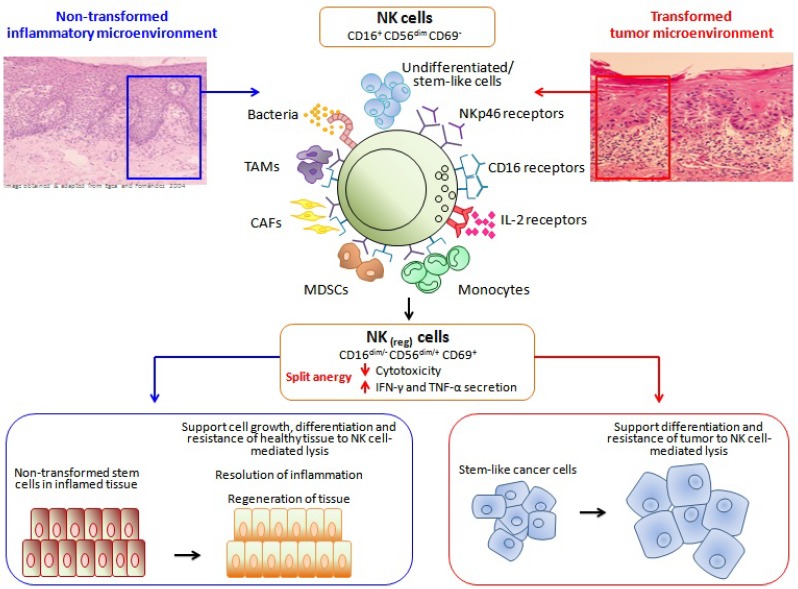
Accumulated evidence from our laboratory indicates that conditioned or anergized NK cells have the ability to induce resistance of healthy stem cells and transformed cancer stem cells through both secreted factors and direct cell-cell contact by inducing differentiation. Cytotoxic function of NK cells is suppressed in the tumor microenvironment by a number of distinct effectors and their secreted factors. Furthermore, decreased peripheral blood NK cell function has been documented in many cancer patients. We have previously shown that NK cells mediate significant cytotoxicity against primary oral squamous carcinoma stem cells (OSCSCs) as compared to their more differentiated oral squamous carcinoma cells (OSCCs). In addition, human embryonic stem cells (hESCs), human mesenchymal stem cells (hMSCs), human dental pulp stem cells (hDPSCs) and induced human pluripotent stem cells (hiPSCs) were all significantly more susceptible to NK cell mediated cytotoxicity than their differentiated counterparts or parental cells from which they were derived. We have also reported that inhibition of differentiation or reversion of cells to a less-differentiated phenotype by blocking NFκB or gene deletion of COX2 significantly augmented NK cell function. Furthermore, the induction of resistance of the stem cells to NK cell mediated cytotoxicity and their subsequent differentiation is amplified when either the stem cells or the NK cells were cultured in the presence of monocytes. Therefore, we propose that the two stages of NK cell maturation namely CD16+CD56dimCD69- NK cells are important for the lysis of stem cells or poorly differentiated cells whereas the CD16dim/-CD56dim/+CD69+NK cells are important for differentiation and eventual regeneration of the tissues and the resolution of inflammation, thus functionally serving as regulatory NK cells (NK(reg)). CD16 receptor on the NK cells were found to be the receptor with significant potential to induce NK cell anergy, however, our recent data indicated that NKp46 but not NKp30 or NKp44 were also able to induce significant anergy in NK cells, although the levels were less when compared to CD16 receptor triggering. The concept of split anergy in NK cells and generation of NK(reg) and its contribution to cell differentiation, tissue repair and regeneration and in tumor resistance will be discussed in this review.
我们实验室的积累证据表明,经过条件或失能处理的 NK 细胞通过分泌因子和直接细胞-细胞接触诱导分化,具有诱导健康干细胞和转化的癌症干细胞产生抗性的能力。NK 细胞的细胞毒性功能在肿瘤微环境中受到许多不同效应物及其分泌因子的抑制。此外,许多癌症患者的外周血 NK 细胞功能下降已得到证实。我们之前已经表明,与更分化的口腔鳞状细胞癌细胞 (OSCCs) 相比,NK 细胞对原发性口腔鳞状癌细胞干细胞 (OSCSCs) 具有显著的细胞毒性作用。此外,人类胚胎干细胞 (hESCs)、人类间充质干细胞 (hMSCs)、人类牙髓干细胞 (hDPSCs) 和诱导多能干细胞 (hiPSCs) 都比其分化的对应物或从中衍生而来的亲本细胞更容易受到 NK 细胞介导的细胞毒性作用。我们还报告说,通过阻断 NFκB 或 COX2 的基因缺失来抑制分化或使细胞逆转为分化程度较低的表型,可显著增强 NK 细胞的功能。此外,当干细胞或 NK 细胞在单核细胞存在的情况下培养时,干细胞对 NK 细胞介导的细胞毒性的抗性及其随后的分化会被放大。因此,我们提出 NK 细胞成熟的两个阶段,即 CD16+CD56dimCD69-NK 细胞,对于裂解干细胞或分化不良的细胞很重要,而 CD16dim/-CD56dim/+CD69+NK 细胞对于组织的分化和最终再生以及炎症的消退很重要,因此在功能上充当调节性 NK 细胞 (NK(reg))。NK 细胞上的 CD16 受体被发现是具有诱导 NK 细胞失能的显著潜力的受体,然而,我们最近的数据表明,NKp46 而不是 NKp30 或 NKp44 也能够在 NK 细胞中诱导显著的失能,尽管与 CD16 受体触发相比,水平较低。本文将讨论 NK 细胞的分裂失能概念以及 NK(reg)的产生及其对细胞分化、组织修复和再生以及肿瘤抵抗的贡献。